


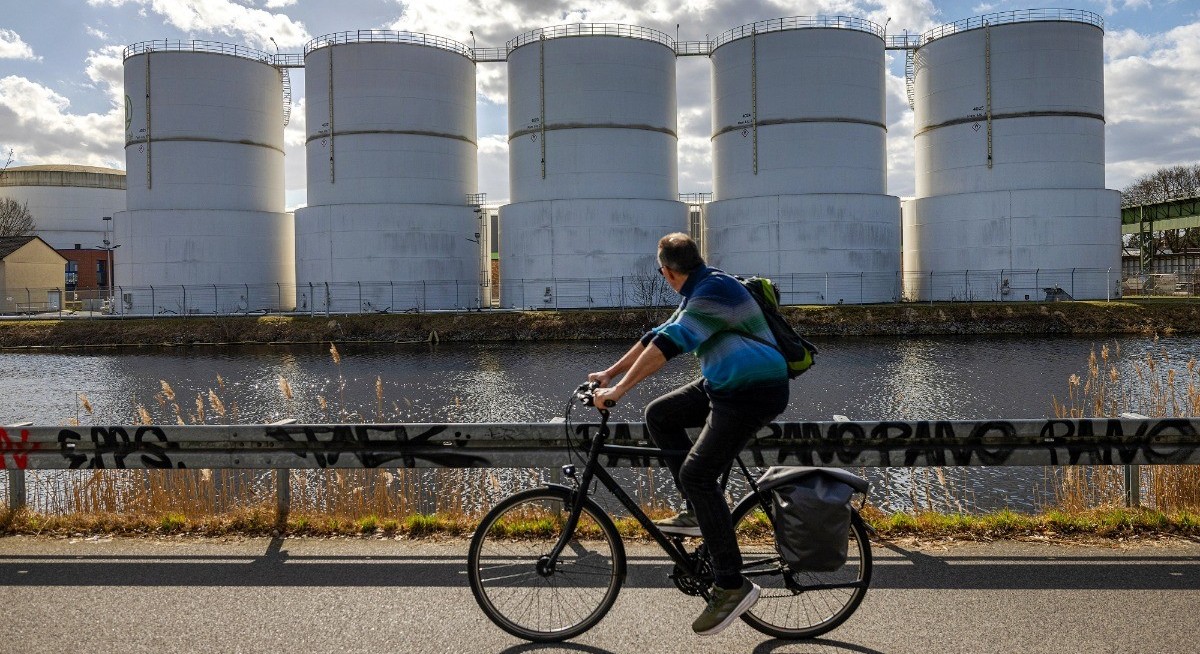


(March 27): The economic toll of the Iran war is hitting home in Europe, where more muted growth and faster inflation risk deepening industrial, fiscal and political pressures across the region.
Donald Trump’s military campaign, whose conclusion remains as unclear as when the first attacks were launched a month ago, is prompting countries to slash their expectations for output while bracing for an energy-driven upswing in prices.
The upshot for a continent that was just finally shaking off the effects of the conflict in Ukraine appears to be a partial return to the policy settings used to vanquish that crisis as households are offered aid and central banks pivot towards interest-rate hikes.
For companies, while the fallout is already straining resource-hungry sectors — including German chemical makers — there’s a growing danger it will spread more broadly as personal incomes are eroded.
All that will be on the minds of European Union finance ministers convening on Friday. They’ll be briefed by International Energy Agency chief Fatih Birol in a hastily arranged video call to assess the war’s impact and how to better coordinate relief.

See also: Investing in brilliant, good, bad and ugly times
“It’s very clearly the energy-intensive sectors that are hurt first and foremost,” said Christian Keller, Barclays’s head of economics research. “But the longer it lasts, it will go into every sector, every input price.”
As oil and gas markets push higher and sentiment indicators plunge, Germany and Italy are among countries weighing cuts to their official growth projections, following a more sombre outlook last week from the European Central Bank.
The current shock “is probably beyond what we can imagine at the moment,” Christine Lagarde said in an Economist podcast released on Thursday. This “leads to a sort of a delayed assessment of how serious this current crisis is.”
See also: Trump threatens escalation with sides at odds on peace talks
The German chemical industry — hit hard by the last spike in energy costs in 2022 — has warned of output cuts with the Strait of Hormuz still effectively shut.

Production at the country’s biggest ammonia plant, SKW Piesteritz GmbH, has been scaled back to the technical minimum of 85%, while Evonik Industries, a maker of specialty chemicals, is still surveying the damage it may face.
“It’s still too early to quantify the exact consequences,” chief executive officer Christian Kullmann said. But “Evonik won’t be able to escape the indirect consequences of the hostilities.”
Container shipper Hapag-Lloyd AG is facing additional weekly costs of US$40 million-US$50 million for things like fuel, insurance and storage. The company is trying to recover some through “contingency and emergency charges,” CEO Rolf Habben Jansen said.
Such costs are threatening to cascade through the supply chain, making life more expensive for everyone. Consumers are well aware: The share of households expecting faster price growth over the next year has risen “very strongly,” France’s statistics office said.
Next Plc, the British fashion company, warned it could raise prices between 1.5% and 2% if the war exceeds three months. Sweden’s Hennes & Mauritz AB said a drawn-out conflict could trigger a spillover from energy that risks curbing consumption.
To stay ahead of Singapore and the region’s corporate and economic trends, click here for Latest Section
The reversal of fortunes in a region that had until recently been looking forward to an economic revival and benign inflation following last year’s trade turmoil could be consequential.
For the euro zone, one question is whether the conflict acts as a spur or an impediment to reforms enabling the bloc to go it alone in a world of crumbling US support and fiercer Chinese competition. Funding economic-support measures is also an issue for many countries, however, with only Germany having meaningful fiscal space.
“Fiscal policy remains the main lever for shielding voters from inflation. While economic research favours targeted support to limit incentives for higher energy use, untargeted transfers to wider segments of the population might still be politically appealing for incumbents. However, not all European governments have the fiscal space to pursue such an option,” says Bloomberg Economics.
The UK, meanwhile, must tap already strained finances to ease cost-of-living struggles that are fuelling populists at both ends of the spectrum. Like the ECB, traders reckon the Bank of England (BOE) will have to raise borrowing costs.
“The government will have to tread ever so carefully in what it does to extend the net this time round,” Andy Haldane, British Chambers of Commerce president and former BOE policymaker, told Bloomberg Television.
“The room for manoeuvre is very slight, the UK’s very plainly in the sights of markets from a public debt perspective,” he said. “The scope for misstep here speaks to a degree of caution and prudence in how that net is extended much as the political pressures will mount. Now is not the time for bravery.”
A flavour of just how bold Group of Seven policymakers will be is likely to come on Monday as energy and finance ministers speak virtually. French finance chief Roland Lescure summed up the scale of the challenge posed by the war.
“We’re at the intersection of economic issues, energy issues, inflation, central banks,” he said on Thursday.
Uploaded by Evelyn Chan




