


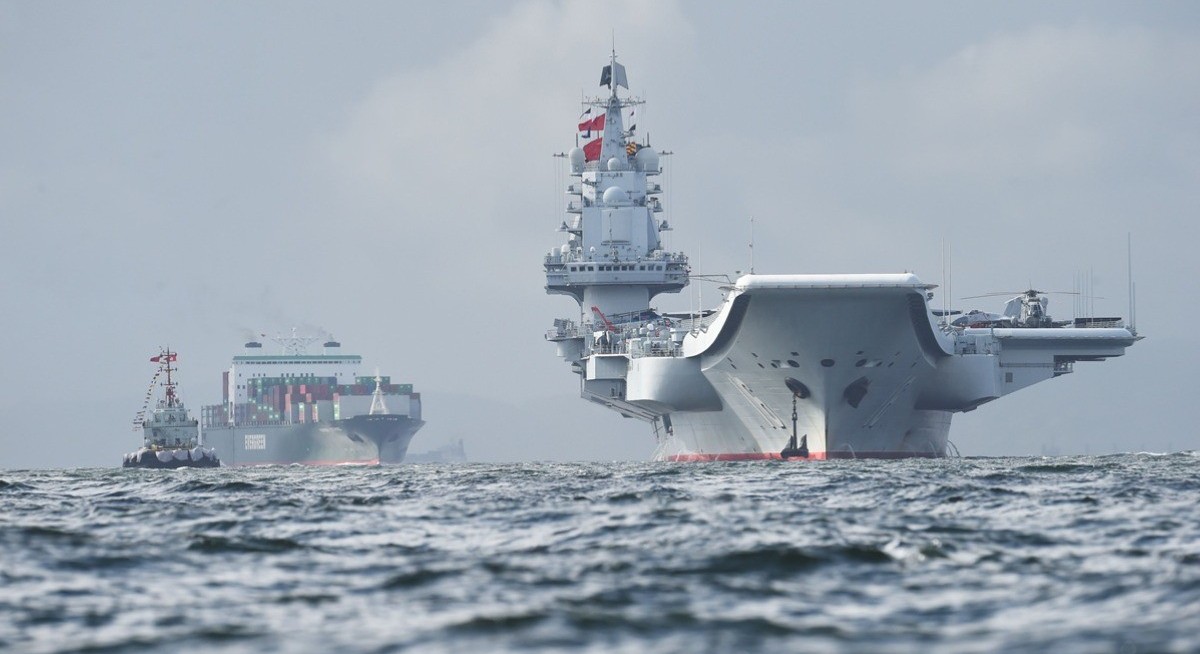


“It is a stern warning against ‘Taiwan independence’ separatist forces, and it is a legitimate and necessary action to safeguard China’s sovereignty and national unity,” Senior Colonel Shi Yi said.
The People’s Liberation Army (PLA) said in a separate statement that from 8am to 6pm Tuesday, it would hold live-fire exercises in five blocks around Taiwan, saying “any irrelevant vessel or aircraft is advised not to enter” the area. China’s maritime authorities listed an extra two large zones where the military would “organise live ammunition shooting”. Some of the blocks are in or near the Taiwan Strait, one of the world’s busiest shipping routes.
The Defense Ministry in Taipei criticised China for “irrational provocative actions,” adding that it deployed forces to conduct “combat-readiness drills”. Taiwan’s aviation authority said marking out areas for live-fire drills severely undermines flight safety, and that it was reviewing alternative plane routes.
Investors in Taiwan tend to shrug off such military activity. The benchmark Taiex gauge rose 0.9% to 28,810, extending a record high on strong investor demand for the advances tech products like chips that are Taiwanese companies’ specialty. Defence shares on both sides of the strait rose.
See also: Russia and Ukraine envoys set for new US-led talks in Geneva
The drills underscore how sensitive the Taiwan question is to Beijing. It has reacted angrily to the US earlier this month approving a package of arms sales to Taiwan worth up to US$11 billion ($14.13 billion), saying it raised the chances of a clash between the superpowers. On Friday, China unveiled largely symbolic sanctions against 20 US defence companies and 10 executives.
These are the first major PLA drills off Taiwan since April, when it held two days of exercises to test blockade capabilities. Those manoeuvres also involved mock strikes on simulated targets including ports and energy facilities.
The manoeuvres come just two months into the one-year truce that China and the US reached in their trade dispute. Dylan Loh, associate professor of Nanyang Technological University, said the exercises were unlikely to disrupt the agreement and the PLA would probably refrain from any move that could spark a response from the US.
See also: Trump privately weighed quitting trade pact he signed with Canada, Mexico — Bloomberg
“I think they will want to hit the Goldilocks zone of inflicting pain and demonstrating resolve but not being seen as disproportionate such that it may piss off the US,” he said.
“A missile flying over the island would certainly fall under the escalation that could invite tit for tat,” said Loh. In 2022, China sent missiles directly over the main island of Taiwan, in response to then-House speaker Nancy Pelosi visiting Taipei.
William Yang, senior analyst for North East Asia at the International Crisis Group, said that the areas the Chinese military marked for the exercises were bigger than in the past, “suggesting that China is trying to demonstrate progress in its military’s capabilities to impose control over larger areas around Taiwan in a potential invasion.”
He added that the PLA was signalling “the clear intent to enhance its troops’ anti-access and area-denial capabilities, which sends a direct signal to the US and its allies, especially Japan about Beijing’s determination to block external interference in future contingency over Taiwan.”
Beijing and Tokyo have been at odds since early November, when Japanese Prime Minister Sanae Takaichi effectively said her nation’s military could theoretically be deployed if China were to attack Taiwan.
Underscoring how Taiwan is a key red line for China, it also reacted fiercely to those remarks, including by placing limits on Chinese tourists travelling to Japan and public criticism of Takaichi.
The latest armed forces manoeuvres illustrate how the PLA has developed the ability since 2022 to deploy assets rapidly, said Jaime Ocon, a research fellow at Taiwan Security Monitor, a research initiative at George Mason University.
To stay ahead of Singapore and the region’s corporate and economic trends, click here for Latest Section
“China is getting very, very good at conducting snap exercises to the point where one could happen very quickly, without too many people having eyes and being able to predict what’s going to happen,”he said.
“The sheer ability to gather a large amount of ships, a large amount of aircraft quickly, not just because of proximity, but because of capability, I think that’s very dangerous for Taiwan.”
‘Egregious in nature’
An expert with China’s Academy of Military Sciences said in a video on social media that the PLA was holding the drills now because “collusion between the US and Taiwan has become frequent and egregious in nature.”
Fu Zhengnan pointed to the size of the latest arms package and what he said was a shift from defensive to offensive weaponry.
Fu was likely referring to the High Mobility Artillery Rocket System, or HIMARS. Those weapons, which Ukraine has used effectively in its fight against Russia, can strike well into China’s southeastern coast. Taiwan first got them last year and started testing them in May 2025.
Beijing has stepped up military intimidation of the democracy of 23 million people since Taiwanese President Lai Ching-te took office in May 2024. China views Taiwan as a breakaway province that must be brought under its control, by force if necessary — a stance Taipei steadfastly rejects.
The US is Taiwan’s main military backer and is required by its law to supply the democracy with the weapons to defend itself.
In an interview that aired on Sunday and touched on the US$11 billion arms package, Lai said Taiwan must “keep raising the difficulty” for any attack by China.
“When we ask our service members to stand on the front lines to defend the country, we must ensure they are provided with weapons in sufficient quantity and of high quality,” he told Sanlih E-Television.
Uploaded by Liza Shireen Koshy




