


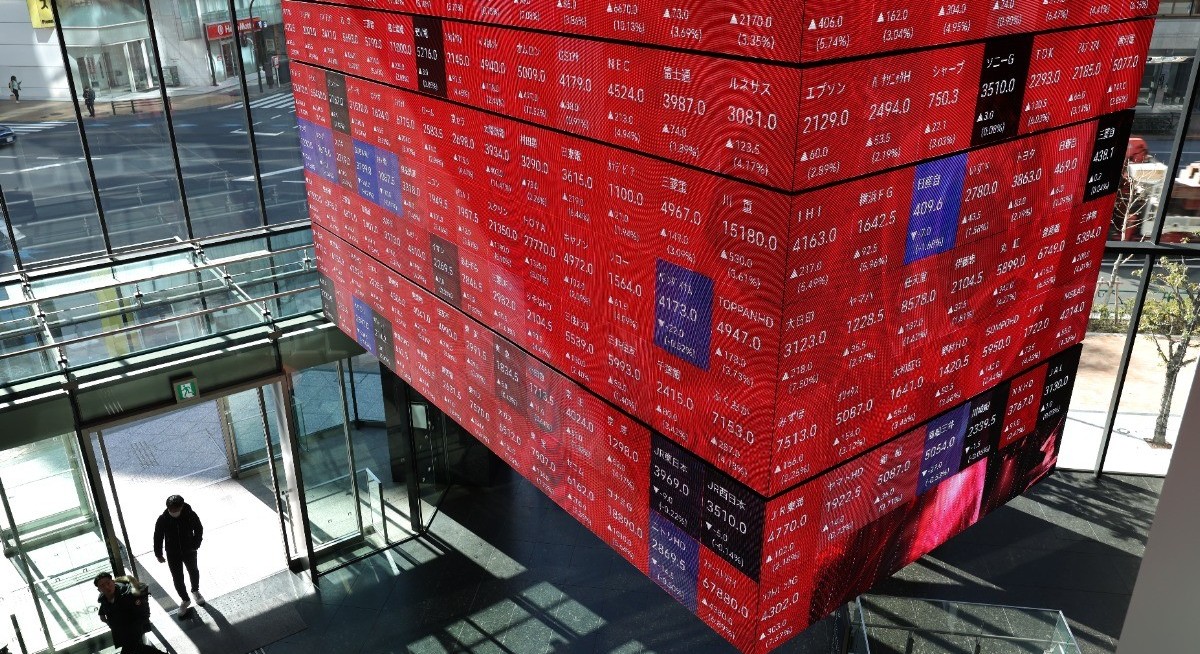


After lagging behind US equities in the immediate aftermath of the Iran war, Asia has staged a strong rebound. The MSCI Asia Pacific Index has surged 14% this month, outpacing the S&P 500’s 9.9% gain. The resilience of Asia’s tech hubs suggests the AI-capex cycle is increasingly decoupled from the broader business cycle, with investors attracted to sectors offering clear earnings visibility.
“Asia’s outperformance versus the US is becoming a more credible story,” said Charu Chanana, chief investment strategist at Saxo Markets. “While there is no durable macro conviction, money still needs somewhere credible to go. Right now, that is AI, and Asia remains the backbone of that trade.”

Confidence in Asia’s outperformance is reinforced by a widening gulf in growth projections. Analysts expect earnings per share for South Korea’s Kospi and Taiwan’s Taiex to surge 212% and 58% respectively over the next 12 months — dwarfing the 24% growth forecast for the S&P 500, according to data compiled by Bloomberg.
See also: Tech founder’s downfall in Indonesia shows rising business risks
Yet, even with Asian equities’ breakout, the region remains a value play — trading at just 14 times forward earnings compared to the 21 times multiple commanded by US equities.
The strength of earnings growth has pushed valuations for Korea “down more substantially on a PE/growth ratio basis than in the US,” according to Vis Nayar, chief investment officer at Eastspring Investments. “If estimates for Korean earnings prove right, it is now so cheap on this basis that it is ‘off the chart.’”

See also: Citi analyst blasted by Indonesia says fiscal risks have peaked
Meanwhile, foreign inflows into Asian emerging-market equities excluding China have totalled about US$11 billion in April, putting the region on track for its largest monthly intake in more than two years.
Recent earnings have reinforced the narrative. Chipmakers SK Hynix Inc, Taiwan Semiconductor Manufacturing Co and Samsung Electronics Co all posted strong earnings thanks to solid AI demand. China’s latest DeepSeek model also further drove optimism in its technology breakthroughs.
BNP Paribas expects tech strength through the rest of 2026, with Northeast Asian equity markets in favour until a slowdown in momentum becomes more apparent in earnings forecasts.
Still, risks remain. MSCI’s Asia benchmark has yet to fully recover losses since the Iran conflict, even as the S&P 500 has pushed to fresh records. Investors are also wary of the region’s reliance on hyperscalers, leaving the rally sensitive to earnings from US tech heavyweights including Alphabet Inc, Amazon.com Inc, Meta Platforms Inc and Microsoft Corp.

So far, there are few signs of retrenchment. Major cloud companies have continued to signal sustained investment in servers, data centres and AI compute. That helps explain why investors are increasingly willing to look through near-term risks.
“North Asia appears better positioned,” said George Efstathopoulos, a portfolio manager at Fidelity International. “US growth is still holding up, but capital is being redirected, less towards buybacks and more into investment, much of which feeds into Asian supply chains, such as names in China mid-caps and Korea memory chips.”
To stay ahead of Singapore and the region’s corporate and economic trends, click here for Latest Section
The weaker dollar adds another tailwind for Asian stocks. Ronald Temple, Lazard’s chief market strategist, expects non-US equities to gain if the conflict nears an end, as pre-war trends like dollar weakness may return, lifting them over US peers. Invesco echoed a similar sentiment.
In the medium term, “Asia should still outperform the US given the exposure to the next stage of technology development around physical AI,” said Julia Wang, chief investment officer for North Asia at Nomura International Wealth Management, pointing to a period of three months or longer.
Uploaded by Evelyn Chan




