


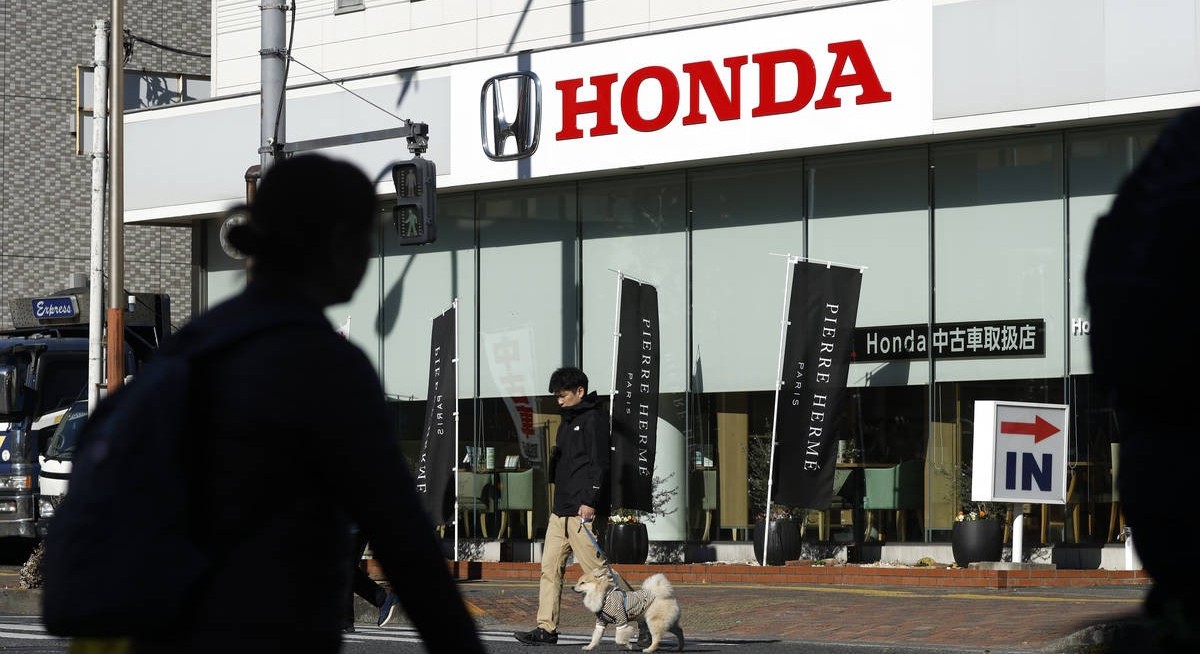


(March 16): Honda Motor Co invested too much and too late into a short-lived electric vehicle (EV) boom, and now finds itself saddled with an ageing line-up and questions about its future as an automaker.
The Japanese company stunned investors by dropping a JPY2.5 trillion (US$15.7 billion or $20.1 billion) impairment charge bomb last week stemming largely from its ill-timed bet on EVs — some scrapped just months before debuting. That is likely a precursor to reporting its first annual loss on record.
But Honda’s problems aren’t limited to its failed bid to catch up with all-electric market leaders BYD Co and Tesla Inc.
Long known for spunky and innovative vehicles, Honda has had trouble in recent years living up to that reputation. Nowhere is that more the case than in the US, by far its largest revenue generator. Sales in the US grew a sub-average 0.5% last year and Honda’s once-promising China business also has stalled in recent years.
The result has been four consecutive quarters of losses from its auto operations, the longest slump since the Fukushima earthquake and tsunami 15 years ago. The saving grace for Honda has been its other business lines, such as motorcycles, that remain highly profitable.

See also: China EV maker Voyah drops 13% in HK debut without fresh funds
Weak results from its core automobile business predates any ongoing issues with EVs, according to Bloomberg Intelligence senior auto analyst Tatsuo Yoshida. “The reason the company recorded such a large overall loss this time is that the EV losses were simply too large to be offset.”
Honda was the first carmaker to sell a hybrid gas-electric vehicle in the US, beating Toyota Motor Corp’s Prius to market by seven months with its Insight model. But currently it offers just four hybrid models, compared with Toyota’s 29 hybrids. And despite a goal of doubling hybrid sales by the end of the decade, Honda said earlier this year that it’s cutting back on production of hybrids in the US.
Toyota has moved quickly to add hybrid options to most of its line-up, and even gone hybrid-only with several key models such as the Camry sedan, Sienna minivan and Sequoia full-size sport utility vehicle (SUV). Hybrid versions of its RAV4 and other vehicles are among its best-sellers.
See also: BYD stakes growth on batteries, charging with China sales slowing
Meanwhile, Ford Motor Co pioneered a hot new segment with its compact hybrid Maverick truck, and plans to offer that option on nearly every model. Hybrids currently make up about one-third of Ford’s F-150 full-size truck sales.
Honda doesn’t offer a hybrid option on its truck, minivan or larger SUVs. It reintroduced its Prelude sports coupe as a hybrid-only model late last year, but demand has been underwhelming. It sold just 299 last month.
The company had much riding on the success of its latest software-defined vehicles: Two new 0 series EV models and the all-electric Acura RSX set to debut in the US next year. But all three were scrapped in the strategic about-face.
“Given that the Honda 0 Series was positioned as a core model in Honda’s SDV strategy, the decision was unexpected,” Masahiro Akita, an analyst at Bernstein with a 'market perform' rating on the stock, wrote in a March 12 research note.
Break with tradition
Chief executive officer Toshihiro Mibe broke with Honda’s long history as an internal combustion engine whiz — in cars, motorcycles, boats, lawn movers and generators — in an effort to reinvent the company as an electric motor powerhouse by 2040. His vision of initially achieving 40% EV sales by 2030 — later revised down to 20% — is now in tatters.
Mibe held out hope for EVs long after most of Honda’s peers had shifted gears.
To stay ahead of Singapore and the region’s corporate and economic trends, click here for Latest Section
General Motors Co was one of the first established automakers to commit to an all-electric future back in 2021, but was also one of the first to tap the breaks when demand slowed.
During an aborted partnership with GM, Honda had an early indication of lukewarm demand for EVs in the US. It launched the Prologue EV in 2024, a model built in a GM factory using that Detroit-based automaker’s battery technology.
Sales of that car last month came to 1,067, down 64% from a year ago — due largely to the loss of US federal subsidies in September.
But as recently as earlier this year, Honda doubled down on its commitment to electric batteries by buying out partner LG Energy Solution Ltd’s stake in a new US$4.4 billion ($5.6 billion) plant in Ohio. That came even as Ford and Stellantis NV, which makes the Jeep and Ram brands, were pulling out of similar ventures.
While Honda’s EV capitulation came late, it had already begun to rethink its approach to the car business.
In a sign of that broader reset, Honda quietly announced in February it would reverse an organisational change made six years ago under Mibe’s predecessor, Takahiro Hachigo, that separated vehicle development from advanced R&D. This restructuring move puts vehicle development back under the control of its R&D unit, a tacit admission Honda has lost focus on delivering innovative cars and trucks.
“Through this change, Honda R&D will be further advanced as an R&D organisation capable of continuing to create compelling products, through which Honda will further increase its competitiveness,” it said.
Chasing sales targets
The slow decline of Honda’s car operations can be traced back more than a decade to a time when management was fixated more on volume and variety than product quality or capital efficiency.
In 2012, then-CEO Takanobu Ito set an audacious goal of doubling annual sales to six million vehicles within five years. To do that, it built factories in China, Indonesia and Thailand, and accelerated production development to meet the target, which in turn placed pressure on its engineers and led to a series of recalls and botched vehicle launches.
While Hachigo, who succeeded Ito as the CEO, shifted the focus away from chasing sales targets, Honda never recovered its mojo even as rivals such as Hyundai Motor Co. and BYD began taking away market share. The Tokyo-based company’s global sales volume peaked in 2019 at 5.32 million vehicles; it expects to sell 3.3 million in the fiscal year ending this month, down from last year’s 3.7 million.
That has left Honda in a weaker position to absorb other blows, ranging from US President Donald Trump’s tariffs on cars imported into the US to a glut of vehicles and price deflation in China. Bernstein notes Honda’s Chinese sales have declined for 24 consecutive months.
Mibe told reporters that Honda will make other changes as part of its EV reset. The board will detail plans of that broader overhaul in a revised business plan expected to debut around the same time it announces full-year financial results in May.
Uploaded by Tham Yek Lee




