


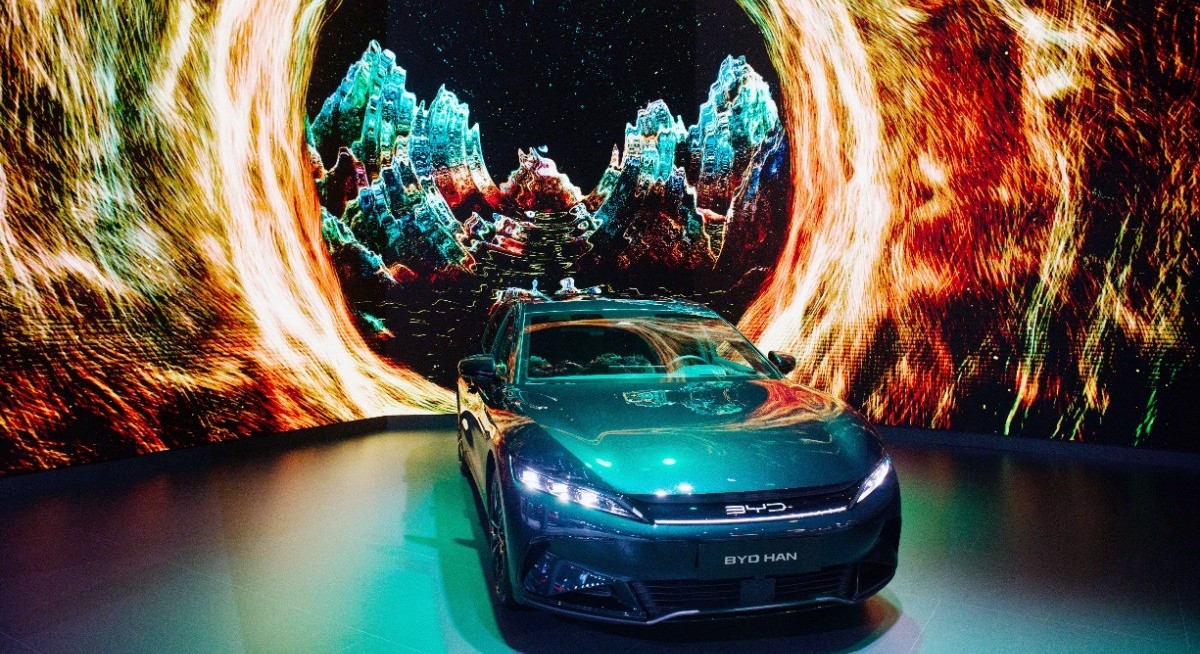


(March 6): China’s BYD Co unveiled more powerful batteries and faster charging capabilities, along with refreshed and new models, as the world’s largest electric-car maker seeks to reverse a deepening sales slump in its home market.
Among a suite of tech upgrades, BYD launched its latest generation of so-called “blade batteries” and ultra-fast flash charging architecture in Shenzhen on Thursday. The technology is capable of refilling the newest batteries from 10% to 70% in five minutes, and close to fully charged in nine minutes.
Even in extreme cold, recharging only slows down marginally, the company added.
“Replacing fuel-powered cars with new energy vehicles is a mission-critical answer to national energy security,” said Wang Chuanfu, the company’s chairman, at the event, citing recent conflicts in Iran and the impact on oil industry. “No one knows batteries better than BYD,” Wang said.
BYD is betting more pragmatically on offering solutions to driving range concerns, rather than flashy smart driving features. Long criticised for lagging behind software-centric rivals like Huawei Technologies Co and Xiaomi Corp, BYD’s “God’s Eye” assistance system unveiled last year only got tepid market reactions.

See also: Huawei and SP Mobility launch ultra-fast EV charging that can bypass grid limits
Sales plunged 36% in January-February from a year earlier, ceding the company’s China sales crown to Geely Automobile Holdings Ltd. The shares are down around 40% from its peak in May 2025.
While BYD’s export sales remain strong, its struggles are symptomatic of volatile global EV demand that has prompted US and European automakers walk back their electric strategies. At home, it has been hit by the end of government incentives such as EV purchase tax exemptions and less generous trade-in subsidies, as well as a cooling domestic economy among a sluggish property market.
At Thursday’s event, BYD also rolled out a series of models equipped across its product lineup with its latest technologies. These included the mass market Dynasty and Ocean series to luxury Yangwang, such as the larger Datang sport utility vehicle that can drive up to 950km (590 miles) on a single charge.
See also: BYD’s US$60 bil wipeout points to deeper turmoil for Chinese electric cars
The new battery cells will be first installed into ten models, Wang said. To further boost sales, the company pledged to offer one year of complimentary flash-charging services. It’s also set to build 20,000 flash charging stations, including 2,000 highway stations, by the end of the year. BYD is also weighing to deploy the facilities overseas. Meanwhile, the company redesigned the charging piles with less weight, it added.
Global push
While the upgrades are aimed at bolstering BYD’s domestic performance, they are also expected to boost international expansion, where lacking charging infrastructure remains one of the biggest impediments for drivers to switch to an EV. Overseas sales jumped to 106,000 vehicles last month, and the company is aiming to sell 1.3 million cars abroad in 2026.
To be sure, much of the fanfare surrounding Thursday’s event could be more of a marketing victory than a step-change in EV technology. Some of the related technologies have previously been teased in various forms but haven’t been commercialised across its lineup.
For example, the first generation of BYD’s ultra-fast charging, which launched in the first half of 2025 and dubbed “megawatt-flash charging,” was only made available on two models, the Han L and Tang L. The cars only sold around 33,000 units last year, less than 1% of BYD’s total deliveries.
Moreover, the actual roll-out of the ultra fast charging-capable charging stations or piles was still limited, and real-world conditions may not perform the same as the optimum conditions used during testing.
Uploaded by Felyx Teoh




