


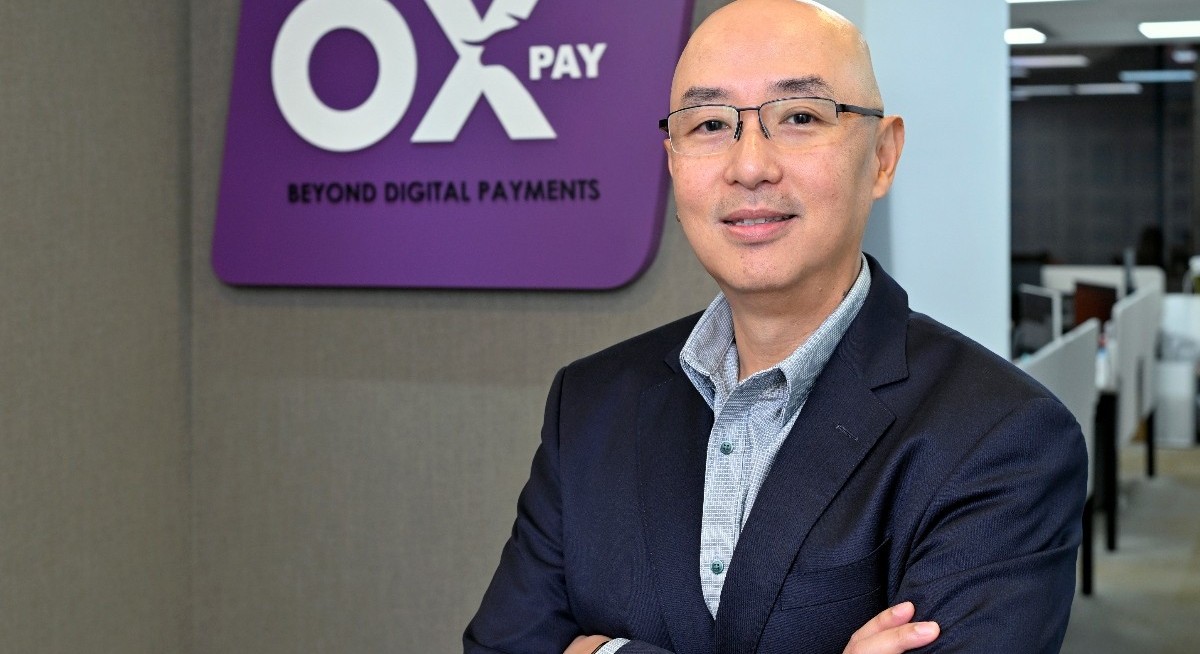


OxPay, previously known as MC Payment, became a listed entity following the reverse takeover of video content analysis firm Artivision Technologies in February 2021. After a boardroom tussle, control eventually settled with non-independent chairman Ching Chiat Kwong, who holds a 27.4% stake, and his son Shawn Ching, who also sits on the board as a non-independent chairman.
The Chings can provide the capital, but they were looking for someone to lead the company. “Shawn, in particular, is very passionate about the company, and he told me about the difficulties that he faces. Prior to the meeting, I did some research, and frankly speaking, OxPay has all the right ingredients for success,” says Chin in an interview with The Edge Singapore.
As Chin describes it, OxPay wholly owns subsidiaries in Malaysia, Thailand and Indonesia. Each is a sizeable market in its own right, with close economic ties across the region. Crucially, the subsidiaries have secured the required licences to operate in their respective countries, giving OxPay a solid foundation to build on.
In Singapore, as a major payment institution, OxPay holds multiple Monetary Authority of Singapore (MAS) licences. “However, the payment space, especially in Singapore, is a very competitive market. It gets even tougher when there are a lot of new entrants, and therefore the landscape is highly competitive,” says Chin.
See also: Indonesia’s Danantara wealth fund sees senior management shakeup
“Before my stint with AXS, I was in a few other start-ups as well. So I took on the role as OxPay’s CEO, and at my current age, I see this as an opportunity to be an entrepreneur for the last time. Having accumulated experience and knowledge in the payment space, which is something very close to my heart and passionate about, I hope that I can help OxPay navigate these difficulties,” says Chin, who was 52 when he took on this role.
Revamp and improve
With the board’s support, Chin has devised a plan to reduce the company’s reliance on merchant payment services as its primary growth driver. Instead, OxPay will aim to expand across multiple markets and industry segments. “The most competitive market is Singapore. You have numerous competitors eyeing such a small pie in Singapore. It is slightly less competitive in both Malaysia and Thailand due to the sheer market size. So those are the challenges for OxPay, and we have to look away from just maintaining one revenue,” he adds.
See also: Relocation specialist Chasen rides chip growth; eyes more solar panel projects
In the latest 9MFY2025 results, OxPay’s revenue was up 21% y-o-y to $3.4 million. The higher revenue was contributed by the digital commerce enabling solutions (DCES) segment for Malaysia, partially offset by the decrease in revenue from the merchant payment services business segment for Singapore.
Even with the higher revenue, OxPay chalked up a slightly wider loss of $2.1 million for 9MFY2025, from $1.96 million in 9MFY2024, mainly due to lower gross profit margin and existing overhead costs such as administrative expenses. Even so, OxPay’s share price has jumped more than 66% in the past 12 months to trade at 5 cents as of Jan 7, valuing the company at $15.6 million.
Despite the gains in the share price, Chin knows his job is only just beginning, but he remains upbeat. “We have a good payment platform, and we just need to strengthen a few key areas such as compliance, product capability and offerings. For a business to expand, regulatory compliance is non-negotiable and is the key to it.”
Beyond rewriting some policies, Chin is embedding stronger controls and processes into the workflow. He says OxPay has succeeded in fostering a highly compliant culture. “It all starts with the people. You can have the best processes in place, but if the people are not following them and do not take them seriously, it will fail,” he adds.
To improve efficiency, Chin is digitalising operational processes and workflows to reduce manual intervention and shift everything onto a single platform that can be rolled out across the markets where OxPay operates with minimal fuss. “We are building a lot of resilience into our payment capabilities, and therefore I am glad to say that we have built in quite a number of key resiliencies to the foundation of our business across the last several months,” Chin adds.
To drive the topline, OxPay is expanding its suite of products and allowing merchants to be onboarded more easily. “From the cost perspective, all these improvement works are part of our strategic investment to scale the business. When I came in, this is something that we communicated to our board that these are the fundamental things that we should do, and they agree.”
Chin aims to attract more sign-ups, but the bigger goal is to build and strengthen the company’s foundation to support future growth. OxPay plans to market itself more actively and boost awareness and adoption across different market segments.
To stay ahead of Singapore and the region’s corporate and economic trends, click here for Latest Section
OxPay had always relied on the business-to-business (B2B) segment to drive its revenue. However, Chin knows this is not sustainable, and therefore he wants to venture into the business-to-consumer (B2C) segment, where the e-commerce market alone is in the trillions globally. Domestically, the B2C space represents a market opportunity that exceeds $100 billion per annum.
Chin also plans to leverage his extensive experience to build a platform focused on bill payment activities. He says: “We know how to penetrate this market and will offer it as a new revenue driver for OxPay. Today, we are insulated from the consumers and therefore, by creating a B2C platform, consumers can interact directly with us and allow us to grow our user base.”
“In the future, we can also bring in financial services and insurance to our users as well. These will generate new revenue eventually for OxPay, and this is when the ecosystem will be healthy. But first, we have to take the first step of building, acquire the customers and give them the services they want,” he adds.
Capitalising on the JS-SEZ, entering Bhutan
Given OxPay’s presence across both sides of the Causeway, with hundreds of thousands of people crossing the border daily, Chin calls his aim to capture more cross-border payment processing opportunities a “no-brainer”, particularly with the establishment of the Johor-Singapore Special Economic Zone (JS-SEZ). “In fact, this will be one of our priorities to kickstart in the first quarter of 2026,” he says.
OxPay also has its eyes on emerging markets. On Nov 27, 2025, OxPay announced that it had received in-principle approval to provide money services in Bhutan’s Gelephu Mindfulness City (GMC). OxPay intends to capitalise on the growing global adoption of crypto-related payments and GMC’s supportive regulatory framework for digital asset financial services.
“Bhutan is emerging as a leading crypto-friendly jurisdiction in Asia. They are supported by a progressive regulatory framework and make it very business-friendly to expand into Bhutan and use the country as a launch pad. Bhutan, for a start, is an interesting space, but our larger goal is South Asia,” says Chin.
South Asia, he adds, leads the world in crypto payment adoption, generating around US$500 million ($643 million) in transaction volume in 2025 alone and continuing to grow. Beyond volume, the region’s high adoption rate and its two billion-strong population make it a space everyone is competing for.
“Having received the in-principle approval is one thing, now it’s really about executing it, bringing our know-how to run this new venture. Earlier on, we said that we are fixing our fundamentals, because only when the fundamentals are fixed, then your business can have the ability to scale up,” says Chin.
For now, he will not commit to a specific investment amount. He plans to adopt an asset-light structure, so the required investment is expected to be modest. For Bhutan, OxPay will stick to merchant payment services that allow cards, e-wallets and crypto payments, as well as business remittance on the back of crypto payments.
Why these two lines of business in Bhutan? Chin says that Bhutan’s reliance on tourism means cards and e-wallets are widely used for payments, while the younger generation is increasingly embracing crypto.
Meanwhile, about 80% of Bhutan’s imports come from India, and businesses pay upstream suppliers via SWIFT, a method that takes longer to process and is costly in terms of fees.
“Ultimately, I think the volume of the transaction will shift because it is proving to be a more efficient payment method. So we are trying to get a foothold in this new economy for our licensed entity,” says Chin.
Volunteer withdrawal of the MAS licence
On Dec 18, OxPay also announced plans to give up its e-money and account issuance services in Singapore as part of its major payment institution (MPI) licence, as the company has not been using these two licences.
Even if there are no activities conducted, companies holding these licences are still obliged to file monthly reports. “If you do not have any activity beyond six months when the licence was first filed, the company will be subjected to fines,” says Chin, adding that the application has been approved by the MAS.
Chin believes that from the regulator’s perspective, it is making the right move as it will deter any company from applying for all the relevant licences and yet conducting no activity and trying to sell the company together with all the licences at the end of the day.
“We respect the regulatory requirement. And if we do find a need for those licences again, we can reapply for it,” adds Chin. The variation of its MPI Licence is not expected to have a material impact on OxPay’s earnings per share or net tangible assets per share for FY2025.
In the meantime, Chin will focus on strengthening the company’s fundamentals and profitability, including increasing total processing volume through expansion into the B2C segment. “In 2026, our priority is to strengthen the collaboration between our subsidiaries and unlock the company’s value. By leveraging each other’s strengths, we can bring value to our merchants and customers.”




