


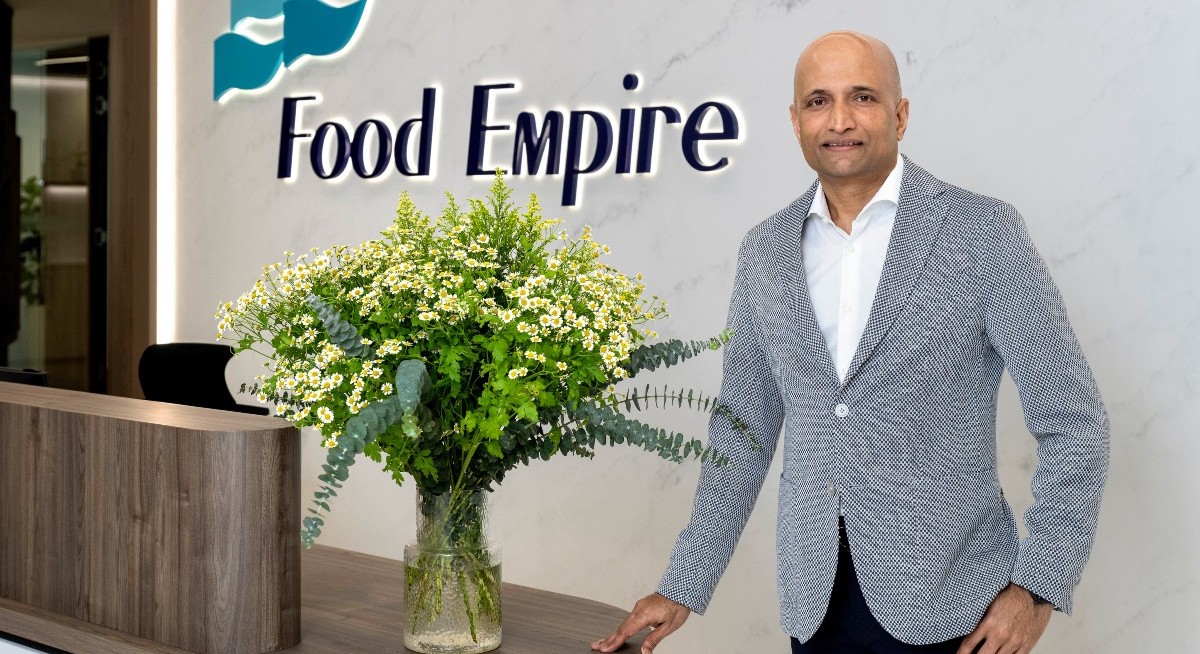


Nair’s working life spans mainly three time zones. He spends about a month in Europe. Another month is spent in Asia, where Singapore, the company’s headquarters, becomes his base. Then there’s Dubai, which sits in between, both geographically and logistically.
Dubai was discovered as a sweet spot during Covid-19 when lockdown restrictions in Singapore were severe. “I didn’t want to come here and be cut off with no connections.” Nair ended up staying outside Singapore throughout the pandemic and used Dubai, which required only a negative test rather than a two-week quarantine, as his operational hub.
“Food Empire’s operations are not typical of a company. Our business is spread out,” he explains. “If I come into any country which locks me down, and if I need to really go there, what do I do?”
The answer, it turned out, was Dubai, which kept connections open. The location proved useful once again when the Russia-Ukraine war began in February 2022. Singapore Airlines used to fly direct to Moscow from Changi Airport. Nair had to find other routes after that. “Life has become difficult for me, for everybody who travels to the city.”
See also: Hong Lai Huat maintains property focus despite marble mining bonanza in Cambodia
“Moscow has become completely disconnected from Europe, basically because of the sanctions,” he says. “But it’s connected by Dubai, so I got lucky. Dubai became my base because of Covid-19. For me, Dubai is easier because I’m just seven hours from Singapore, via India and Vietnam.”
Due to the lack of connectivity, this route has become a new norm for Nair.
With this new set of travel plans, Nair now tries to spend two, three, or four weeks in Asia at a time. Before the conflict, Nair could easily travel to Singapore, settle what needed to be done, and move on to his next location. Now, he has to see how best to optimise his time when he’s in a particular location or region.
See also: BofA names Dominic Tan Southeast Asia investment banking head
Covid-19 also changed how Nair holds some of his meetings. “A lot of that stuff, such as conference calls, you can do it remotely. Wherever I am, we do online meetings.” Given the nature of its business, Food Empire has local management teams across its various markets. Major businesses have an executive board as well as department heads. “Whenever they need my guidance or anything, we will connect wherever I am.”
All this fuss with travelling, arranging meetings, ensuring connectivity, and so on, is for a good reason. As group CEO of Food Empire, Nair leads a company that is present in over 60 countries, supported by 10 manufacturing facilities and 23 offices globally.
In Asia, the company operates facilities in Vietnam, Malaysia and India. Vietnam is the largest, with a team of over 2,000. Malaysia, which is primarily focused on manufacturing, has 400 to 600 employees. Its factories also service smaller markets such as the Middle East and Africa. India, Food Empire’s coffee hub, where all its coffee is manufactured, has around 600 employees.
A well-oiled machine
Food Empire’s spread has been tested repeatedly through pandemics, wars and sanctions. Yet so far, the business has held on nicely, even though Nair is kept on his toes constantly. “The world has become very difficult with local conflicts now,” Nair muses. “Russia has its continuing conflict with Ukraine. There’s no end to it. Now, it’s the Middle East, although we don’t have a substantial business right now.”
What the company needs to mitigate, however, are the cost pressures caused by rising oil prices, which will have repercussions for packaging materials, which are petroleum by-products. A consolation, if it can be considered one, is that the entire industry is uniformly hit, not just Food Empire. “If your shipments are going out of the Middle East, freight costs will go up.”
Since the war started, Nair has already seen a 20% increase in packaging material costs, which is “not much” and will not significantly affect margins. “These are very small things compared to what Food Empire has seen”, says Nair. Indeed, the company has been forced to weather tougher episodes. When fighting between Russia and Ukraine broke out, the currencies of Russia, Ukraine and Kazakhstan devalued by between 200% and 300%.
To stay ahead of Singapore and the region’s corporate and economic trends, click here for Latest Section
And of course, the pandemic. “Covid was a very big learning [experience]. It was a complete lockdown and disaster. We faced all kinds of issues during the pandemic in terms of logistics, because we are moving a lot of the ingredients from farm-growing countries,” he explains. “Coffee doesn’t grow in Europe; it has to come from either Latin America, Asia or Africa.”
Shipping during the pandemic was an issue as well, given that the company’s major markets, Russia, Kazakhstan and Uzbekistan, are landlocked. “We had significant challenges, but our teams are very experienced in all these markets, so they knew how to navigate them.” When things could be shipped, it cost a lot more, recalls Nair. For one, moving a 40-foot container from Asia to any European port before Covid-19 would have cost about US$2,000 ($2,570). During the pandemic, this shot up to US$8,000, he says.
For now, Nair is less concerned about the Middle East crisis, which has led to a blockade of the Strait of Hormuz. “We’ll solve it, but I’m a very optimistic person,” he says. “The problems are there, but they’ll solve them. I don’t lose my sleep over the blockade.” He adds that since the Middle East accounts for a small share of Food Empire’s income, the company won’t be materially affected.
What has kept Food Empire surviving and even grown stronger is a combination of experienced management and brand strength.
Between FY2021 and FY2025, Food Empire posted record revenue in each year and ended FY2025 with a new record in earnings.
In FY2022, just after the Russia-Ukraine conflict, Food Empire generated revenue of US$148.4 million from Russia, an increase of 29.1% y-o-y, described as “high levels of growth” driven by strong consumer demand, despite margin pressures from foreign exchange and economic volatility.

Food Empire's classic black tea brand, Accam. Photo: Albert Chua/The Edge Singapore
According to Nair, the sanctions did not affect the business. “There can never be sanctions on food products or medicines, because these are necessities. So any company dealing with necessities, essentials like food and beverages or medicines, can never be sanctioned by any government,” he stresses.
In the last few years, Food Empire’s business in Russia has continued to grow. In FY2025, revenue from Russia grew by another 34.8% y-o-y to US$191 million, driven by higher sales volumes, price gains, improved in-store execution, broader representation of the product range, and a 10% appreciation of the Russian ruble against the US dollar, the company’s reporting currency. The ruble’s appreciation may have played a part, but, to Nair, the bigger driver was the brand’s ability to pass price increases on to consumers at a time when the industry had to raise prices.
Further improvements have been recorded most recently. In its 1QFY2026 business update, Food Empire achieved another 16.9% y-o-y growth in revenue to US$159.7 million.
With this steady growth record, investors have shown their appreciation by moving the share price needle. Year to date, Food Empire’s share price has gained 18.63% to close at $2.42 on June 24, extending a growth of 172% from June 2021 to December 2025. At this level, the company, which crossed the $1 billion market cap milestone last June, is now worth about $1.6 billion.
To Nair, Food Empire’s success reflects the resilience of its business model and the strength of its brands. The pandemic or war has not caused a direct effect on consumption. With each new challenge, the management team got more astute. “Each of these crises, I would say, has worked in favour of Food Empire,” he says.
Coming back to the ongoing war in Russia and Ukraine, Food Empire now runs a so-called “sanctions committee” to ensure that it stays on the right side of the US-led international community. For now, indirect effects stemming from the sanctions include finding alternative ways to send samples from Singapore to Moscow as leading delivery firms such as FedEx, DHL and UPS no longer operate in the Russian capital. This means the company has to reroute deliveries through Vietnam or Kazakhstan and rely on local courier companies, stretching the delivery time to 10 to 14 days from four days previously — something Nair has to “get used to” and plan for.
Even so, Nair looks forward to the day when the conflict ends and sanctions are lifted, as it will, of course, make life “much easier”.
Meanwhile, a key reason Food Empire can continue to cope with these challenges and grow its financials is the strength of its brands, says Nair.
The $100 mil brand
Due to the traditional makeup of Singapore’s economy, many listed companies focus on efficiency and capability as suppliers to large companies, rather than on branding. For a consumer-facing company like Food Empire, the heavy emphasis on brand building is a necessity. Brand Finance estimates the company’s brand is worth US$101 million.
According to Nair, Food Empire’s chairman, Tan Wang Cheow, drawing on his own background running trading businesses, appreciates the power of building effective proprietary brands. “Show me who else built a brand of $100 million in the last few years? Very few.”
The intangible power of a strong brand means Food Empire has a certain degree of price inelasticity relative to the market and can pass on some of the higher costs to consumers rather than being forced to compete on price alone. Having said that, Nair is quick to stress that Food Empire would only raise its prices if the company has “no other solutions”.
Since 2023, the company has faced rising coffee prices, no thanks to changing weather patterns. 2024, in particular, was bad for all kinds of agricultural products, such as coffee and cocoa. “I can see that this is not the same world as it was 10 years ago. Every place has changed, including Singapore. I’ve lived in Singapore since 1993, so it’s not the same. The climate patterns, the weather, everything has changed here,” he says.
According to Nair, over his 30 years in Moscow, he has not seen the city reach 15°C in March, which he called “too warm”. Yet the city returned to sub-zero temperatures in early April. “It’s all haywire,” says Nair, who is betting that a strong brand can help Food Empire better cope with these fluctuations in costs, including those outside of the company’s control.
When asked whether Food Empire would consider moving upstream by establishing its own plantation, Nair says it’s not being considered for now. “These plans are just at the back end of our brand. Unless I need a brand story to have a plantation, I wouldn’t.”
“In the last 10 years, which company would’ve built a brand from scratch? Food Empire. We’re different. And it is only now that most people are looking at us. We stand out as we’re differently run from a general company,” he says.
Product R&D
Besides its strong emphasis on brand building, the company is not afraid to make big, bold moves into markets long dominated by established incumbents. Imagine selling instant coffee in Vietnam, where the habit of drinking local drip coffee is ingrained and renowned.
As Nair recalls, Vietnam, which is one of Food Empire’s fastest-growing markets today, nearly didn’t happen. Food Empire first entered this market around 2010 and the first couple of years were a struggle. “I was almost on the verge of closing it down because we were not getting the product right,” he shares. “By 2013, we were not able to break in. We tried many, many products and they were not catching.”

Nauryz, an established tea brand Food Empire acquired from Kazakhstan. Photo: Albert Chua/The Edge Singapore
It was the company’s final attempt, in which it identified a gap — marketing iced coffee with a blend — after a failed product launch by one of the big players, which finally caught on. The product became so popular that one of the store owners told Food Empire that if the coffee couldn’t sell, she would buy it and drink it herself, recalls Nair. “You have to get the gap. And the gap was this, and it usually comes through hits and trials. There’s no guarantee.”
Going into a new market requires goals and discipline. “What we do is, we go in, we try to find this gap for two, three years. I wouldn’t go more than three years, because it’s burning cash,” he says. “During the three years, you would be burning cash because you have a team on the ground and you have trials, trying to find that unique product.”
While the company typically gives a new market three years to succeed, it stuck with Myanmar for five years. “We had hopes that we got the product right and we would break, but we quit because we understood that a lot of factors were working against us,” he says, listing reasons ranging from the devalued currency to the political system. It also took the company longer in Myanmar due to the market’s restrictions. A Singapore company couldn’t go in straightaway and start experimenting; you need a joint venture partner, among other things, says Nair.
“We tried,” he adds, of Myanmar. “We didn’t see ourselves making money; we didn’t see a future, and then we quit. We closed down. It’s a very difficult moment for us, because we spent five years of our lives.” Having said that, when asked whether Food Empire will consider returning, Nair says he is “always open” and that this applies to most markets.
Empire takes flight
Beyond geographies, Food Empire has taken its services, quite literally, on flights. In July 2025, the company signed an agreement with Santan Food Services to develop and launch a range of ready-to-drink beverages. The collaboration will begin with the launch of a Vietnamese iced coffee product for sale on AirAsia flights.
Food Empire was connected to the airline through its investor, Ikhlas Capital, run by figures such as former CIMB CEO Nazir Razak. “It’s more of a marketing thing,” says Nair, adding that the collaboration is unlikely to contribute meaningfully to its top and bottom lines.
The collaboration makes sense because AirAsia connects people in most parts of Southeast Asia. “From our perspective, it’s a good thing if those passengers fly and they come in contact with a product which has Food Empire’s brand. It’s more of a first contact.”
Rewarding shareholders
The brand-building and geographic expansion of the past decade have clearly paid off for Food Empire. Beyond record top and bottom lines, Food Empire had, for the first time, declared an interim dividend during the 1HFY2025, bringing the year’s total dividend to 12 cents per share.
Food Empire is rewarding shareholders in another way. On May 13, it announced a one-for-five bonus issue to mark its 25th anniversary. Food Empire last issued bonus shares in June 2008. The company explains that having more shares will enhance liquidity and “institutional relevance”. As Food Empire’s market cap has grown, it has been included in recent years in a growing list of market indexes, including the MSCI SMID Cap Index, FTSE ST All-Share Consumer Staples Index, and iEdge Singapore Next 50 Index. Food Empire notes that some institutional investors, whose style is to build portfolios mirroring the weightings of the stocks that make up these indexes, require a certain level of liquidity before they can do so.
Meanwhile, the decision to dual-list in Hong Kong — announced in October 2023 — is “on hold” because valuations there did not meet the company’s expectations.
Plans in the making
Looking ahead, the team has its work cut out. In the pipeline are two capacity expansion projects, a spray-dried soluble coffee manufacturing facility in South India and a new freeze-dried soluble coffee manufacturing facility in Vietnam, to be completed by 2027 and 2028, respectively.
There have been occasional market murmurs that Food Empire is open to talking to potential buyers. In a February report, Chee Zheng Feng and Andy Sim of DBS Group Research went as far as to name a potential buyer. “Tata Consumer jump out as the best fit, given operational synergies with the existing coffee business, rich valuation to support equity raise to fund earnings-accretive acquisition and India and Russia’s neutral and pragmatic stance towards each other,” according to the analysts.
Unsurprisingly, Nair declines to comment on this. Regardless of whether that pans out, Nair is open to acquiring other businesses, although he is not “hard-pressed” to do so. “Every geography in which Food Empire works is growing. So we’re not compelled to look into new geographies,” he says.
When opportunities do come, the company looks for strong brands and a clear product line, says Nair. The purchase of Nauryz, a tea brand in Kazakhstan, is the template. It is an existing brand with scale and it is in a market the company already understands. What the company won’t touch is anything unprofitable, he says.
On new geographies, the threshold is population scale. Food Empire will only consider entering geographies with a population of at least 25 million to make brand building worthwhile. Despite being the company’s listing venue, Singapore doesn’t make the cut. “The city-state is too small for us,” Nair says.
In the next five years, Nair hopes to see Food Empire remain on the same track. “Now we are pleased that at least the investment community understands [us] a little bit. [It’s] still a very little bit,” he says. “They don’t understand the power of brands; they don’t understand the brands which we have. They don’t understand how resilient the model is. I think they have understood [a little], but they don’t understand in depth because our markets are spread out. We understand that, but the financials are proving it,” he adds.




