


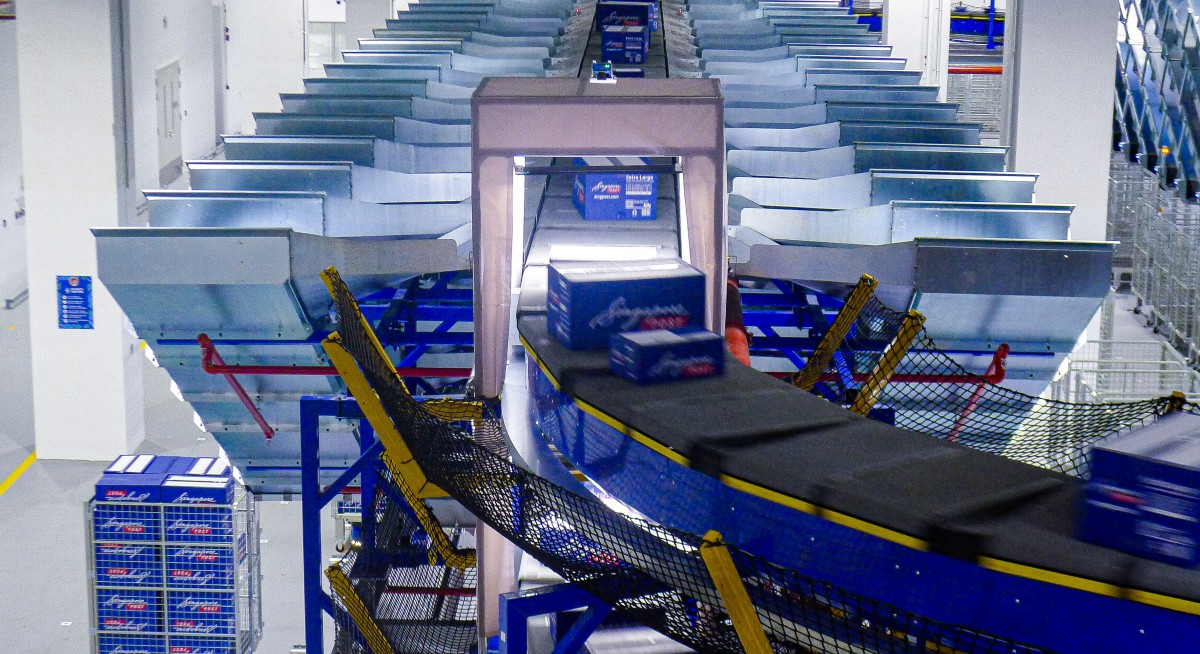


This will help overcome the inefficiencies of manually sorting differently-sized parcels at two separate facilities, says Goh Chee Hiong, vice-president of operations at SingPost. Previously, letters and smaller parcels were sorted at the SingPost Centre at Paya Lebar, while large parcels were sorted at Tampines.
“With the last mile, we run the largest postal and logistics team (in Singapore), across 1.9 million posters every day,” says Goh, noting that SingPost will be better equipped for seasonal spikes such as the Black Friday or 11.11 online sales.
The consolidation of all the parcel-sorting capabilities will free up around 80,000 sq ft of space at Paya Lebar, which is where SingPost maintains its corporate headquarters, and also where it leases out office and retail space.
SingPost CEO Mark Chong says the company will have a combined total of one million sq ft of warehousing space to be deployed, so SingPost “will focus also on bringing in warehousing customers” across its properties.
A spokesperson also confirmed that architects have been hired to plot out a possible redevelopment of SingPost Centre once airspace restrictions are removed with the planned relocation of Paya Lebar Air Base.
The emphasis on e-commerce logistics by SingPost is for a good reason. With a structural decline in the previous core business of delivering domestic mail, coupled with a middling-at-best report card of overseas ventures, SingPost has had a difficult 10 years. In 2016, S&P Global Ratings had an “A” rating for the company’s debt.
Over the years, the ratings agency has downgraded the rating to BBB–/Stable. Its share price, above $2 more than a decade ago, has since trended down to close at 33 cents on June 9. Recently, however, sentiment is turning positive.
See also: Yoma’s comeback
On May 15, S&P said SingPost is likely to have more predictable and stable revenue over the next 12 to 18 months. This follows the company’s focus on reviving its core business and decision to retain SingPost Centre, which, under the previous management, was shortlisted as an asset to be divested, deemed to be valued at more than $1 billion by some analysts.
“Steady cash generation from the property business will help mitigate operating losses in the postal business. We project that a large chunk of earnings for SingPost over the next one to two years will come from rental earnings. This follows the company’s move to drop an earlier plan to divest SingPost Centre, its flagship property asset,” S&P says.
S&P observes that SingPost Centre has generated steady earnings over the past three years, supported by an occupancy rate of consistently close to 100%. SingPost also aims to strengthen its postal businesses by improving operating efficiency and reducing costs, S&P adds. Automation from the new sorting facility appears to be a key initiative towards cost reduction.
Chong says the centralised and automated hub at Tampines is “a major operational milestone in the execution of our strategy”, as the “improved operating model” serves to reduce cost-toserve by more than 10% and is a way to “stabilise our ship”. He adds that “2030 and beyond” is an estimated goal to completely move all operations to the hub, including letter-sorting machinery, which SingPost says it will have to test before making the move.
Unsurprisingly, the company, facing manpower issues like many other businesses, is focusing on technology. S&P estimates the company will spend about $40 million in the current FY2027 ending March 2027 on automation and technology. “I believe in 100% automation; automation is the final way,” says Goh.
Goh envisions that Tampines will be a “lights-off facility” that is able to run 24/7 with minimal human supervision, with 150 personnel for command centre operations and 50–60 technicians for upkeep as the minimum number necessary to man such an automated facility. This is a reduction from the some 300 workers in this sector that SingPost employs currently — out of a total of around 1,600 full-time staff — although Goh adds that they intend to redeploy staff during the rescale for automation, and that “Singaporeans [will be] prioritised”.
In the meantime, SingPost is focused on its core logistics business. It plans to further leverage its expansive last-mile delivery network by implementing a neighbourhood framework through SingPost@MyBlock.
To stay ahead of Singapore and the region’s corporate and economic trends, click here for Latest Section
SingPost@MyBlock is SingPost’s initiative to allow HDB residents to conveniently send letters and parcels through letterboxes installed at the foot of their blocks. Following a successful trial launched last October by Deputy Prime Minister Gan Kim Yong, SingPost will proceed to roll this out to all HDB estates in three phases by September. SingPost says that items dropped off before 10am will be delivered by the next working day.
This is part of the company’s efforts to do away with the currently underutilised street posting boxes, increasing the previous 786 touchpoints to over 30,000 through the new HDB letterbox nests.
SingPost notes there will be no change for private housing, so non-HDB residents will still continue to rely on street posting boxes. These new projects are in line with SingPost’s earlier-announced bid to “strengthen core fundamentals, build scalable capabilities, and capture new growth opportunities”.
Going forward, Chong, who took on his role less than a year ago, says he would like to see market, service, and customer-base expansion. This first area of market expansion is already underway, with SingPost’s recent international partnership with European e-commerce and parcel delivery company Asendia.
“We will branch beyond doing postal and parcels to do sensitive high-trust logistics, such as serving domestic B2B markets. We want to get into sectors such as healthcare and other government sectors, and we will build up our cross-border partnerships to grow international bodies,” says Chong.
In terms of expanding service, other than its warehousing endeavours, SingPost is hoping to service customers “beyond the existing e-commerce platforms”, adds Chong, listing “retail customers, enterprise customers, as well as government”.




