


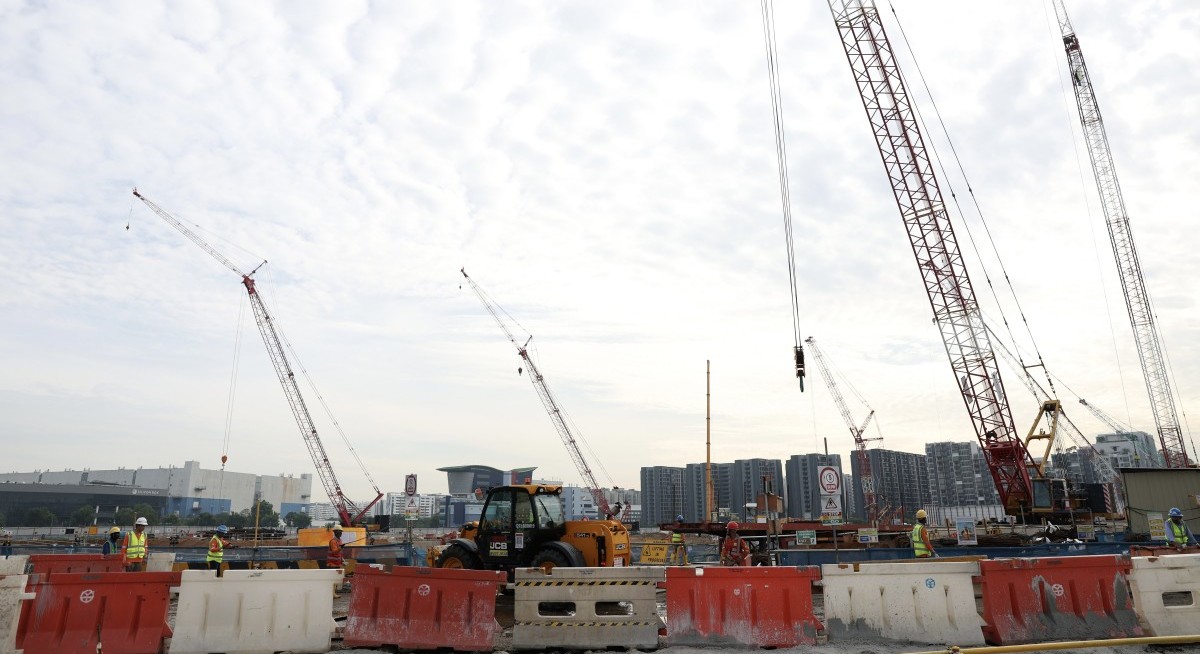


Those spikes have prompted the government to act. On April 7, National Development Minister Chee Hong Tat announced that the government will provide support to construction firms working on critical public-sector projects. Specifically, the government will help bear 50% of the cost increases due to higher diesel and bitumen costs. According to Chee, this includes firms involved in earthworks, piling, roadworks and reclamation for public-sector projects.
According to estimates from the Building and Construction Authority, total construction demand for Singapore in 2026 will range between $47 billion and $53 billion. This is in line with the roughly $50.5 billion in construction contracts that were awarded in 2025. Natalie Ong, an analyst at CGS International Securities Singapore (CGSI), estimates that roughly 60% of the construction demand forecast for 2026 will come from the public sector.
“For the built environment sector, the cost increases in diesel and bitumen have a significant impact on some of the contractors. It will be difficult for these firms to fully absorb the cost increases over a sustained period,” says Chee in a Facebook post.
“The impact from the war is affecting all countries. But similar to how we dealt with [the] Covid-19 pandemic, the key is how we respond to it — that will determine how the world views Singapore after the crisis, whether global investors have higher or lower confidence in Singapore after watching us in action, and whether we as a society become more cohesive or less united.”
Shekhar Jaiswal, head of equity research at RHB Singapore, sees the government’s 50% cost-sharing scheme as a “temporary cushion” given that the scheme is “quite specific” addressing only four types of works and only for three months.
“While we expect it to ease immediate cash-flow pressures and reduce the risk of stoppages, it does not address other cost pressures across the industry, such as electricity for batching plants, premixed concrete production, crane operation or freight surcharges,” he says.
Representatives for listed construction companies Koh Brothers Group, Ley Choon Group and Pan-United Corporation either declined or did not provide comment when asked by The Edge Singapore about the impact of rising fuel prices on their businesses.
See also: Singapore’s built environment must build a collaboration advantage
In response to questions posed by a shareholder to OKP Holdings on the Singapore Exchange’s website on April 22 ahead of its AGM, the company addressed the impact of changing raw material costs. In FY2024 and FY2025, construction materials accounted for 15.8% and 12.1% of total cost of sales respectively. “We are not heavily exposed to volatility in raw material prices. As a result, we have not seen any significant compression in our margins from changes in raw material prices. We will continue to monitor the situation closely and manage procurement efficiently, but overall the impact remains limited, barring any significant deterioration in the global or local economic environment,” says OKP.
Not as bad as Covid-19
Analysts that The Edge Singapore spoke to say that while the oil shock will not be as disruptive as the Covid-19 pandemic, higher diesel and bitumen prices will result in tighter margins for construction firms.
“We do not expect the impact of higher oil costs to be worse than the impact of Covid-19,” says CGSI’s Ong. “Covid-19’s impact on the sector was profound due to construction delays (work stoppages, time and cost incurred to comply with new regulations), leading to project cost escalations and margin pressure.”
Yik Ban Chong, an analyst at Phillip Securities Research, shares a similar view. Chong believes that any potential disruption in the construction sector caused by the oil crisis should not be as detrimental as the pandemic. This is because most construction projects that were delayed due to Covid-19 stemmed from the shortage of migrant workers due to nation-wide lockdowns and travel restrictions.
According to Chong, the number of workers in the construction, marine and process sector fell by 16% y-o-y to 311,000 in 2020. Those numbers have since recovered. In 2025, the number of migrant workers reached 483,000, 24% higher than the nine-year historical average, Chong says.
“This is definitely much better than Covid,” says Lim and Tan Securities analyst Nicholas Yon. “The problem with this war is not the cost increases, which are manageable so far …. as costs can be absorbed by either party in the short term.”
To stay ahead of Singapore and the region’s corporate and economic trends, click here for Latest Section
For Yon, it is the duration of the war that will determine the severity of the disruption on the construction industry. “The problem potentially down the line might be supply chain issues. If contractors cannot get their materials (steel from China etc), then work cannot [continue, then] revenue cannot be generated and cash flow might be an issue for contractors with weak balance sheets,” he adds.
Diesel price hike more disruptive
This is not to say that construction companies have not borne some of the pain that comes from higher fuel prices and its second-order effects. “The impact from the Middle East conflict on Singapore’s construction sector will mainly come from higher diesel and bitumen prices, which may impact construction companies’ margins,” says Phillip Securities’ Chong.
Higher diesel prices will trickle down and result in higher raw material prices and higher freight cost outwards, says CGSI’s Ong. Given that Singapore imports all its raw materials, higher inward freight costs will be indirectly reflected in the cost of raw materials.
In March, diesel prices went up by 40% to more than $4 per litre, its highest level since 2022. Besides being used for transportation, diesel is also used to power construction equipment such as excavators and cranes. This makes higher diesel prices particularly painful for companies involved in earthwork like excavation and piling. These activities consume lots of diesel, says Lim and Tan’s Yon.
“They will face margin issues as diesel is bought on a ‘as and when’ basis. If you need two million litres per month, you would order two million. It did not make economic sense in the past to stockpile diesel,” Yon says. “I would say that the diesel problem is more serious as it affects all contractors using specialised machines or even if they are just ferrying workers around in their lorries.”
RHB’s Jaiswal also believes diesel is the broader issue given that it is used at every stage of construction, from excavation and haulage to piling and generator use. “Since all fuel in Singapore is imported, rising diesel prices impact operating costs across the board, affecting most contractors and every type of project,” he notes.
To be sure, the hike in diesel prices will not impact all construction companies in the same way. According to Chong, diesel makes up only a small component of most construction companies’ cost of goods sold (COGS). “We estimate [it to be] less than 5% of COGS for most construction companies,” he says.
“How it will affect margins would depend on their cost structure,” Yon adds. “A contractor with a low single-digit percentage of costs attributable to diesel would likely not see a big impact.”
In comparison, rising bitumen prices will affect a small group of companies, says Chong. Those working on roadworks, especially road surfacing, are the ones who need bitumen to complete their projects.
To Jaiswal, bitumen is a “sharper but narrower risk”, especially for civil engineering and roadworks, in which contractors involved in expressways, cycling paths or reclamation works such as OKP Holdings and Hock Lian Seng may face more “acute project-level cost pressures”.
A new normal awaits
Prices are likely to remain elevated so long as the war in Iran continues to escalate. In fact, prices are likely to stay higher for longer even if the war were to end. This is because a lot of oil and gas infrastructure in the Middle East was hit by Iranian attacks. According to the consulting firm Rystad Energy, the war in Iran has damaged an estimated US$58 billion in energy infrastructure.
“As of today, more than 80 facilities have been damaged: oil fields, gas fields, refineries, terminals and so on. And out of this 80-plus, more than one-third are very severely damaged,” says Fatih Birol, the executive director of the International Energy Agency.
Birol’s remarks were made during an event held by the Atlantic Council, an American think-tank, on April 13.
It is not just a cost issue. Birol says rebuilding the infrastructure will take quite a while: “Coming back to where we were before the crisis, it may take some time — maybe up to two years.”
For now, analysts do not expect the oil shock to result in any material shortages. “At the moment, the impact is limited to higher prices. However, we could start to see construction players shifting from just-in-time to just-in-case inventory management to protect themselves from supply shocks and delays,” CGSI’s Ong says.
Lim and Tan’s Yon believes that the impact is largely contained for now as most construction projects are midway through the project cycle and materials are still arriving at the site. “If this drags on, then higher costs will become the new normal and it will eventually be fed into future tenders.”




