


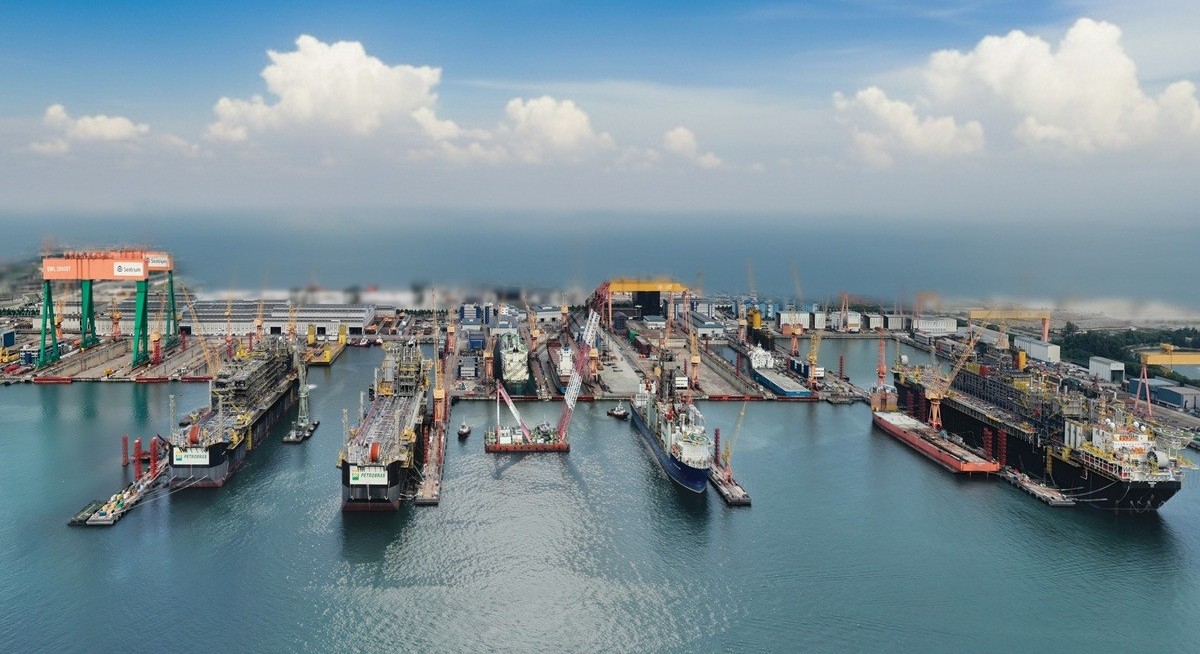


To recap, both government-linked companies were profitable before the O&M bust, which saw revenues plunge and led each to incur losses exceeding $1.0 billion. In June 2021, the companies announced their potential merger to create a “stronger” combined entity that will be more competitive by pursuing “synergies arising from combined scale, footprint and capabilities,” according to a press release.
The promise of the deal has shown up in Seatrium’s financials. For FY2025 ended Dec 31, 2025, Seatrium doubled its y-o-y earnings to $324 million, in contrast to FY2023 — the first year of the merger — when it reported a net loss of around $1.9 billion.
“For the first time, we’ve recorded a positive one-year total shareholder return of 5.2%, as we strive to continue driving lasting value for all shareholders on strengthened fundamentals,” says CEO Chris Ong at Seatrium’s FY2025 results briefing held on Feb 26 and attended by The Edge Singapore.
Ong, who was the CEO of Keppel O&M before leading Seatrium, says that the company has been transforming its business and cost model, making it “stronger and leaner” than before.
See also: Men with a vision
These include a “high quality” order book comprising 95% of Series-Build projects that reduce execution risks for both the company and its customers, with non-floating, production, storage and offloading (FPSO) legacy projects constituting only around 1%.
“We have been disciplined in ensuring we win high-quality contracts from world-class customers, with mid‑teens, risk-adjusted project margins and progressive milestone payments,” says Ong, who adds that the company’s $17.8 billion net order book is more diversified than previously.
In addition to oil and gas asset orders, the company has secured contracts in the renewables sector. These contracts include four from TenneT, the latest being the Balwin 5 project, a 2.2 gigawatt (GW) offshore high-voltage direct current (HVDC) grid connection. According to Seatrium, 40% of its net order book comprises renewables and green solutions.
See also: Marco Polo Marine to spin off shipyards via $139 mil RTO deal with Fuji Offset Plates Manufacturing
Underpinning Seatrium’s operational execution is the One Seatrium Global Delivery Model. Described as a “centralised and coordinated execution platform integrating people, AI and assets worldwide”, the system has delivered cost efficiencies, with CGS International (CGSI) analysts Lim Siew Khee and Meghana Kande, and UOB Kay Hian’s Adrian Loh, noting cost decreases that beat their expectations.
In FY2024, Seatrium quantified the merger benefits and cost savings at $300 million and procurement savings at $200 million. CFO Stephen Lu says that Seatrium has exceeded the targets and that “the proof is in the numbers”.
“As we continue to streamline operations and tighten overheads, we see accelerated pathways for further expansion through our ongoing divestments of non‑core assets,” says Lu.
The company also shares that it is pursuing more than $32 billion in new contracts before the start of the Middle East conflict. Since then, with the Strait of Hormuz “blocked” and thus limiting oil and gas exports from the fossil-fuel-rich Middle East, oil prices have risen as demand outstrips supply. The International Energy Agency has been forced to release 400 million barrels of emergency oil stocks — the largest in its history — to counter supply disruptions from the Middle East conflict.
For Maybank Securities analyst Hussaini Saifee, sustained geopolitical tensions and conflict reinforce the need for energy security and supply diversification through new fossil fuel sources and renewable energy. The way Hussaini sees it, O&M companies, including Seatrium, are likely to benefit as the world aims to balance the energy trilemma.
In the near term, with breakeven prices of US$37 to US$43 ($47 to $55) per barrel, offshore is one of the lowest-cost sources of new oil supply and affordable energy. As such, Hussaini expects this to drive demand for newbuild FPSO vessels and cites industry estimates of a pipeline of 40 to 50 FPSOs up to 2030.
Looking ahead, as the world seeks energy security and environmental sustainability, the development of renewable energy is likely to accelerate, despite rollbacks in some countries. Hussaini believes that Seatrium, with its track record in offshore wind projects, is well-positioned to capture demand in the offshore wind sector, which is estimated to grow at a compound annual growth rate of around 15% through 2035.
Shares in Seatrium have gained nearly 13% since the start of the year.




