




Like most of its peers in O&M, Mainboard-listed Nam Cheong, a shipbuilder based in Sarawak, Malaysia, suffered debilitating setbacks during the period as the industry sank like the Titanic, crashing into an unyielding berg of sustained low oil prices, oversupply of offshore vessels and reduced capital investment by oil majors.
With customers cancelling orders on partially completed newbuilds, Nam Cheong encountered cash flow challenges and had to undertake a restructuring exercise in 2017, as it was unable to make payments on its borrowings, which exceeded RM1.6 billion. The company also had to record an impairment charge exceeding RM2.8 billion and incurred a loss of more than RM3.0 billion for FY2017.
But today, Nam Cheong is thriving, having successfully turned around the business and even attracting attention from analysts, including DBS, CGS International (CGSI) and RHB. For FY2025 ended Dec 31, 2025, Nam Cheong reported earnings exceeding RM275 million ($88.3 million), driven by RM363 million in gross profit and nearly RM620 million in revenue.
From major OSV builder to ship charterer
See also: Men with a vision

Nam Cheong CEO Leong Seng Keat. Photo: Albert Chua/ The Edge Singapore
“Around 2015, we were maybe the second largest producer of OSVs [offshore support vessels] in the world at that time, holding something like 10, 15% of the world market,” recounts Nam Cheong CEO Leong Seng Keat to The Edge Singapore.
See also: Marco Polo Marine to spin off shipyards via $139 mil RTO deal with Fuji Offset Plates Manufacturing
He says that, like other O&M companies, Nam Cheong took on debt to fund capex and opex. “We were all able to borrow quite heavily via bonds at that time and so when that [O&M downturn] hit everybody, of course, we were not spared, and the company had to restructure.”
As part of the restructuring, Nam Cheong’s creditors had to waive a portion of the debt and convert the remainder into equity. In addition, Nam Cheong raised funds by converting debt into shares and undertaking a rights issue, with executive chairman Tiong Su Kouk injecting RM50 million into the company to support the debt restructuring.
With customers cancelling their newbuild contracts, a supply glut, and a drop in offshore activity, Nam Cheong had to either sell the abandoned offshore assets at depressed prices — rubbing salt in its wounds — or use the assets to generate income. Realising the risks of the newbuild business and the weaknesses of its then business model, Nam Cheong pivoted into ship chartering, which required a wholly different field of expertise.
“I still remember the [company’s] key logistics captain saying that the guy who knows how to build a shopping mall typically doesn't know how to run one,” says Leong. “We know how to build OSVs, but it would be a totally different ball game if you were to operate OSVs.”
Since Nam Cheong had no expertise in ship chartering, it had to hire external talent and build up this business segment from scratch in 2017. From 2017 to 2019, revenue for ship chartering more than quadrupled from RM65 million to RM300 million, with the company’s gross profit increasing from RM35 million for FY2017 to RM103 million for FY2019, mostly attributable to ship chartering. Gross margin also increased during the period from 11% to 32%
However, like most other companies in the sector, Nam Cheong was not spared the impact of Covid-19 and had to restructure a second time in less than four years. It was not all doom and gloom for the company, as, unlike in 2017, it did not have to sell assets at low prices in 2020.
“The second restructuring was much more sustainable as the creditors saw that it was not sustainable to sell the vessels at a cheap fire sale,” says Leong who adds that the creditors recognised that the company’s ship chartering business was growing from 2017 to 2019 and this helped them realise that an asset sale at depressed prices was not in their best interest.
To stay ahead of Singapore and the region’s corporate and economic trends, click here for Latest Section
Similar to 2017, the second restructuring in 2020 saw debt converted into shares with Tiong once again providing a capital injection.
Following the exercise, Nam Cheong has gone from strength to strength, with y-o-y increases in revenue from RM286 million in FY2021 to RM685 million in FY2024, and gross profit rising from RM64 million to RM364 million over the same period. The company also secured long-term charter contracts, including RM1.22 billion announced in November 2024, as well as snagging a RM102.5 million contract announced on April 6.
‘Undervalued gem’
Since March 2024, with the restructuring done and dusted, shares in Nam Cheong have risen more than tenfold from around 13 cents to above $1.40 as at end-March 2026, outpacing the growth of the Straits Times Index, which hit a historical high of above 5,000 this year.
According to DBS analyst Ho Pei Hwa, Nam Cheong is an “undervalued gem”. Initiating coverage of the company in July 2025, Ho believes Nam Cheong’s stock will be on an upward trend on the back of the successful execution of its business strategy and structural tailwinds in the O&M sector.
Ho’s confidence in Nam Cheong stems from the company’s earnings quality and visibility, with “captive demand” from Malaysia’s national oil company Petronas and a shift towards 60%–70% long-term charters for its fleet, which she notes in her March 3 report. She also points out that Nam Cheong has been actively expanding into new geographic markets, such as the Middle East and Japan, and increasing its product range to capture rising demand for green offshore solutions. Following Nam Cheong’s announcement of a new charter contract win on April 6, Ho issued another report on April 7 stating that 69% of the firm’s fleet is under long-term charter and evidence of “buoyant” oil and gas (O&G) activities in the region.
Furthermore, with an average age of around 9 years, Nam Cheong’s fleet of more than 30 vessels is relatively young compared with the industry average of around 14 years and Ho notes that this is a competitive advantage. The Edge Singapore also understands from industry sources that charterers prefer younger assets.
For similar reasons to Ho, CGSI analysts Meghana Kande and Lim Siew Khee initiated coverage of Nam Cheong on Jan 30, while RHB analyst Syahril Hanafiah initiated coverage on March 17.
In addition to revenue visibility from long-term charters, Kande and Lim believe that Nam Cheong is well-positioned to seize newbuild OSV opportunities as global OSV fleets age, incur higher maintenance costs and become less efficient. They point out that Nam Cheong handled peak order books exceeding RM1 billion from FY2012 to FY2015, as well as management’s hints that the company is in active discussions for newbuild orders.
In their latest report dated April 7, Kande and Lim noted that CGSI met with Nam Cheong’s management at the end of March and provided insights into demand for OSVs. Kande and Lim note that, despite the Middle East conflict, demand has not “significantly” changed because spending decisions by national oil companies typically have longer lead times. As such, 2026 capex and activity are largely fixed, with uplift from persistently higher oil prices and a greater emphasis on energy security likely to be reflected from next year onward.
For Syahril, years of underinvestment in the sector, combined with limited supply and ageing OSV fleets, could invigorate both the resale market and interest in newbuilds. He believes that strengthening demand for younger vessels could revitalise activity at Nam Cheong’s shipyard in Miri, Sarawak.
Syahril also references the ongoing dispute between Petronas and Petros, the state government-owned Sarawakian O&G company. He expects Nam Cheong not to be materially impacted by the dispute. Instead, he expects the company to benefit from a moderate expansion of offshore activity as Sarawak plans to open additional offshore areas for exploration, which will support sustained OSV demand.
“With Sarawak’s rising strategic importance and Nam Cheong’s deep regional roots, the group remains well buffered against regulatory uncertainty,” writes Syahril.
Projecting Nam Cheong’s revenue to grow at a compound annual growth rate of 15%, Syahril values the company at 11 times FY2027 forecast P/E or target price of $2.05 with a “buy” rating.
The way Ho sees it, Nam Cheong’s valuation “remains undemanding” at around eight times the FY2026 forecast P/E. She believes that Nam Cheong is trading at an “unwarranted, steep” 20%–50% discount to peers and estimates the company's shares at 10 times the FY2026 forecast P/E, which she rates a “buy”.
Meanwhile, Kande and Lim maintain Nam Cheong at “add”, with a target price of $1.92 and a valuation of 11 times the FY2027 forecast P/E. They see potential for future re-rating, with catalysts including higher-than-expected shipbuilding orders, increased capex by oil majors, which would drive higher demand for offshore services, and fleet expansion.

The SK Eonik is a 64.8-metre multi-purpose offshore vessel (MPSV) and anchor handling tug supply (AHTS) ship that has been deployed to Southeast Asia. Photo: Nam Cheong
Building for the future
Despite deriving most of its revenue from chartering, Nam Cheong still owns and operates a shipyard in Sarawak. As noted by the analysts, Nam Cheong has the capacity to seize newbuild opportunities, which came to light on Feb 24 when it announced it had secured its first newbuild orders in more than a decade.
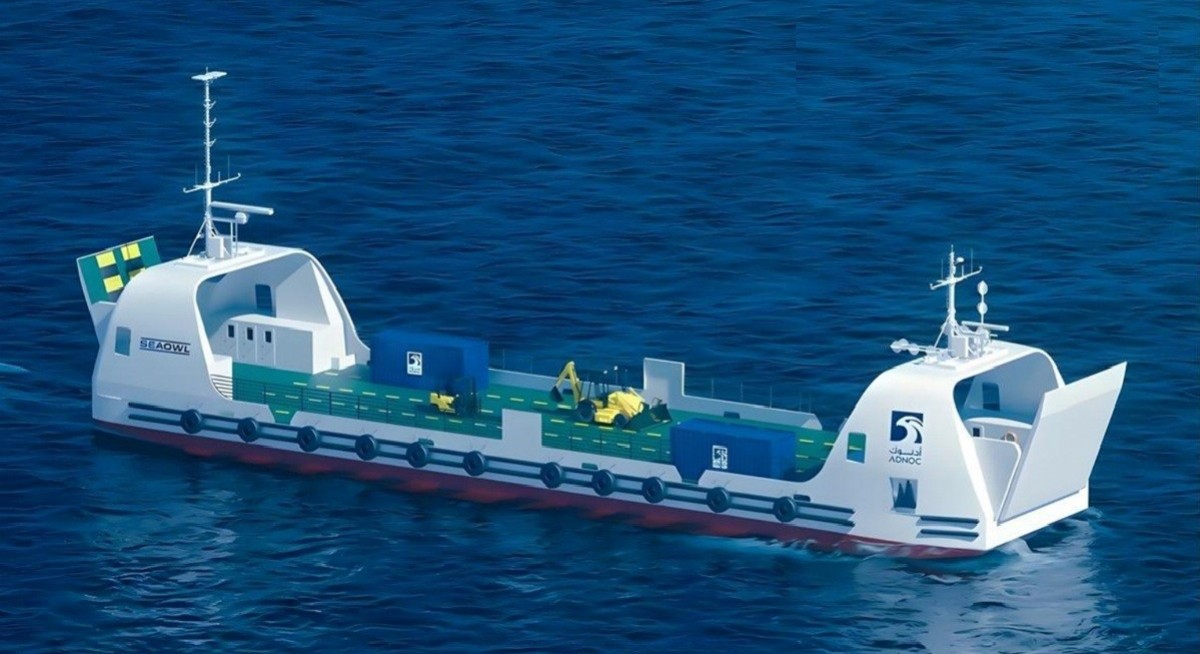
Worth US$64.5 million ($82.19 million), Nam Cheong will build four offshore support vessels (OSVs) — two 60m dive support vessels (DSVs) and two 60m remotely operated landing crafts (ROLCs) — for ADNOC Logistics and Services, a subsidiary of the Abu Dhabi National Oil Company.
According to Nam Cheong, the ROLC is a “cutting-edge” and “first-of-its-kind” vessel to be built in the world, while the DSV is a “highly sophisticated” offshore asset specifically designed to carry out a wide range of complex subsea operations under harsh open-water conditions.
Leong says that Nam Cheong is more of a “product-driven shipyard,” focusing on designing the “next generation” of solutions to meet clients’ needs. To do this, Nam Cheong relies on what it considers its strength — leveraging its deep understanding of the exploration and production (E&P) cycle of the O&M industry to develop vessels that align with industry demand.
“How can we design what we call fit-for-purpose vessels?” Leong shares. “You don't want to design one vessel that can do all things and neither do you want to design a vessel that’s over spec or under spec.”
Acutely aware of Nam Cheong’s strengths, weaknesses, opportunities and threats, Leong notes that Nam Cheong prefers to build more sophisticated, complex OSVs rather than mass-market OSVs. He points out that competitors have an advantage in building standardised, replicable vessels at scale, whereas Nam Cheong's value proposition is the ability to customise and build more sophisticated vessels.
Elaborating on his point about building customised, fit-for-purpose vessels, Leong notes that its vessels are battery-ready rather than battery-powered. He says it is a commercial decision not to install batteries because, first, they are still relatively costly. Secondly, customers do not require vessels to be battery-operated.
However, the company is cognisant of the need to make its vessels more sustainable in line with global sustainability imperatives. “We still have a generator to drive the motors, but it's an easy step for us to upgrade the vessel with a battery fuel cell in the future.”
A decade of growth
From a macro perspective, Nam Cheong’s management and analysts are positive on the company’s prospects. A tight supply drives their confidence. Elaborating, Leong says that around 800 OSVs produced between 2006 and 2008 would become obsolete over the next three years. This means that the global fleet of around 2,500 OSVs would be cut by around 800, with no replacements in sight, as few to no newbuilds have been ordered.
“But with Nam Chong as an operator, I think it's very good for us, because our fleet is young and still growing,” adds Leong. “We have constantly added more vessels, renewed our fleet and also improved our utilisation.”
Despite the pickup in O&G and his optimism about the business, Leong still seems somewhat cautious about market expansion. When asked about entering new markets, Leong says that beyond its home ground of Malaysia and the Middle East, the company sees opportunities in Vietnam, Thailand and Myanmar and is keeping an eye on the Americas and Africa. However, he believes that market expansion must be value-adding and executed with due diligence to meet customer needs.
“We need a longer-term strategic value before we actually go into a country,” he explains. “Because we believe in local content, we need to develop the local capabilities and we cannot centralise everything in Kuala Lumpur and use that team to serve the world. That, to us, is not a formula for success.”
In addition to challenges in developing human capital, other industry challenges include supply chain constraints.
Regarding supply chains, Leong cites vessel engines as an example, noting that the merchant ship market, including tankers and bulk carriers, is booming. “The engine that runs in our vessels can also run in other types of ships and so the demand in those areas is still relatively high,” he shares. “If you talk to most of the shipyards, they are still flush with projects for delivery in 2028 and 2029, and so in that sense, the supply chain is also going to be a challenge.”
Despite these challenges, Leong reiterates his confidence in the sector and the company’s prospects. He says, “The first thing is we learn from the past. We learn from the mistakes we made in the past, so risk is the first thing on our minds.
“I will classify us as being in the phase of growth. This growth is not a one- or two-year growth. It would be a decade of growth.”




