


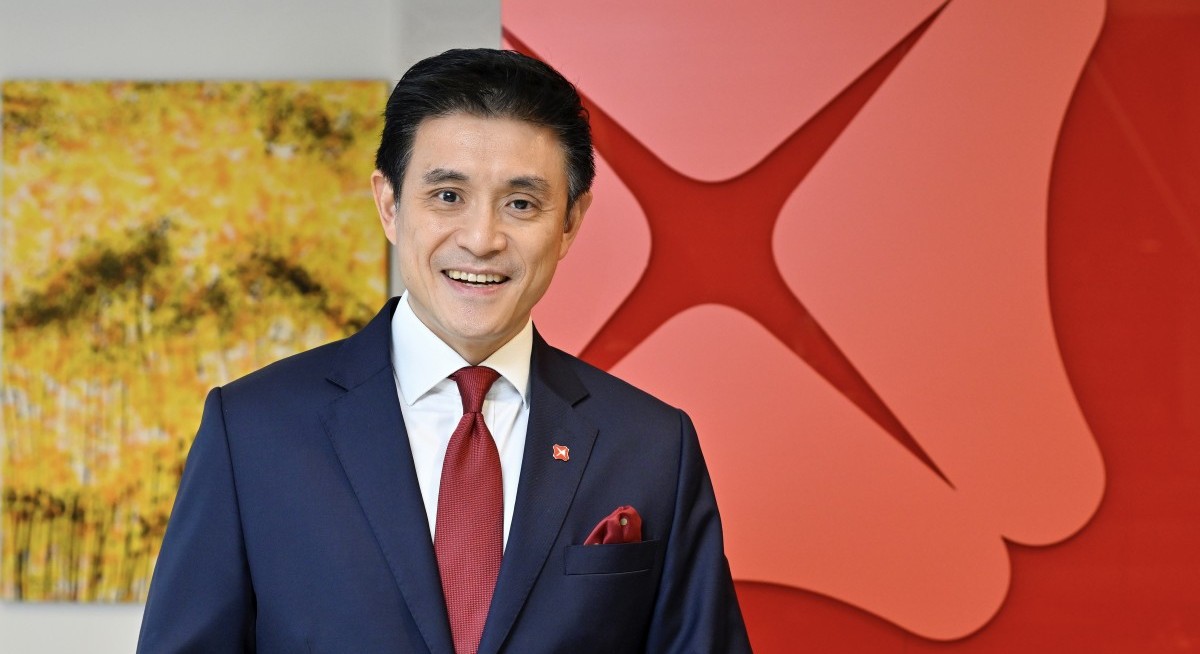


“For me, computer science is a training I have that opens up my logical thinking,” Han told The Edge Singapore about his choice of college major. “When I did computer science, I did a lot of finance and management topics, and I did it with the adjacency of seeing how computer science knowledge can be applied to those.”
Han’s nearly 35-year career in banking has seen him rise through the ranks, from a management associate at Citibank in 1991 to CEO of Citibank Singapore in 2012.
In 2019, he joined DBS, where he first served as a managing director, then country head for DBS Singapore, before taking over as group head of institutional banking when his colleague, Tan Su Shan, succeeded Piyush Gupta as CEO. Along the way, Han found time to earn his MBA from the Nanyang Technological University.
Han’s unique background, which places him at the intersection of technology and finance, makes him the man of the moment as the business world scrambles to harness AI’s value. That was precisely the role he played at DBS as group head of strategy and planning, where he helped drive the bank’s transformation, including integrating data and artificial intelligence into its workflows.
See also: DBS at $100: here is how it could get there
For him, studying computer science isn’t just about having a technical understanding of computers; it is also about developing his problem-solving skills. “As someone trained in computer science, I can zoom out into system-level thinking when I design a system,” Han says. “I always look at what could be the longer-term fix. It’s harder. It takes a longer time and can be very difficult to execute, but it’s always better for the long haul.”
AI isn’t a zero-sum game
Having an eye on the long term has coloured Han and DBS’s approach to AI. Back in 2023, Han was already telegraphing DBS’s ambitions to incorporate AI and machine learning (ML) into everything they did during the bank’s investor day. This meant using AI across all of the bank’s functions, whether for client servicing or for internal functions such as human resources (HR).
See also: Banks' rally pushes market cap of DBS just whisker off $200 bil mark
AI, however, can only be implemented effectively when companies have a firm grasp of the outcomes they are trying to drive, Han says. This ensures that AI is being used to push the organisation in the right direction. For instance, DBS took a first-principles approach to understanding what HR is trying to achieve before layering AI on top.
“The key outcome of an HR department is to be able to produce the talent required when needed. There are several drivers in order to achieve that — making sure your attrition is low; making sure you hire the right people; making sure you have staff mobility so that when a particular job needs to be filled, we have the talent pool available to fill it,” Han says.
“So when you look at it that way, we apply AI and ML models to help us hire, to evaluate resumes, to know based on past hiring that we have done, which universities actually give us the best type of graduates that have the longevity and skills,” he adds.
That same level of thoughtfulness is evident in the way DBS has chosen to retain and retrain its call centre operators, even though AI has reduced their workload. Han says DBS uses a total of four generative AI models to transcribe customer queries, develop responses, summarise conversations and identify the root causes behind customer problems. That has helped to reduce the number of service requests.
But instead of trimming their workforce, DBS has opted to deploy their former call centre operators to new roles, where they now evaluate responses from generative AI models and look out for hallucinations or inaccuracies.
“When we look at the whole disruption of AI, people naturally are afraid that their jobs will be affected. I would like to think about it as a printing press moment,” Han says. “When Johannes Gutenberg invented the printing press, it was a time when scribes were writing stuff down, and what the printing press enabled was the wider dissemination of knowledge.”
“So when you look at generative AI and the whole AI piece, yes, it can be scary when you look at the possible displacement and changes to the nature of the job, but what it also enables is a lot of new knowledge that you could use to create new things. Therefore, it is for our own creativity to use it to create new business models and new ways of doing things that change the very nature of the jobs that we have.”
To stay ahead of Singapore and the region’s corporate and economic trends, click here for Latest Section
For job seekers looking to secure a role amid the turmoil caused by AI, Han recommends focusing on their intellectual and soft skills.
“Number one thing is you’ve got to be curious. You can’t be somebody who is so fixated on what work is. You’ve got to be curious enough to ask questions, to try to understand why we are doing this and why I am asked to do this and how I can do it differently,” Han says.
Curiosity is what drives people to develop new, more efficient ways to get things done. That then needs to be paired with good communication skills and a sense of empathy when working with colleagues and clients. “These are the things that we want our employees to have because by having this, it goes beyond just being able to do the job well, but it also helps to build the right culture and mindset.”
Iran hasn’t sent investors running
The recent military strike on Iran by the US and Israel has left the markets shaken. The S&P 500 is headed for its worst monthly performance since 2022, while the ongoing blockade at the Strait of Hormuz by the Iranians has sent oil prices climbing to levels unseen since Russia’s invasion of Ukraine four years ago. The chaos, however, hasn’t sent investors running for the exits yet, says Han.
Firstly, the bank market is generally still very liquid, Han says. DBS sees continued interest among banks in seeking high-quality assets to finance. Those conversations are still ongoing.
Secondly, the equity market is still going strong. Trading activity has gone up amid government measures to bolster the local bourse. The Singapore Exchange (SGX) said on March 12 that its securities daily average value (SDAV) in February rose 45% y-o-y to $2.1 billion. SGX’s SDAV hasn’t been this high since 2020. “It shows that investors are still looking to invest with the right businesses,” Han says.
Thirdly, the bond market has gone a little quieter, but that could be because investors are looking at the trajectory of interest rates before deciding to deploy their capital.
“At this point, nobody is exiting the market,” Han says. “We don’t see panic selling. They are just simply saying, ‘Let’s hold, wait and see.’ They want to see where the trends are headed from an interest-rate perspective before they commit fresh capital. That’s the nature of the bond market.”
Becoming Asia’s premier IPO destination
Singapore’s IPO activity raised more than $2.4 billion in 2025, its highest since 2019. That’s a far cry from the HK$285.8 billion ($46.9 billion) that IPOs in Hong Kong raised in the same year.
“I think our market and the Hong Kong market are really quite different. The Hong Kong market gets tailwinds from all the Chinese companies. And China being such a large economy, quite naturally, there will be a bigger flow of companies compared to what we have,” Han says.
That said, Singapore still has room to grow in becoming a top IPO destination for the region, he adds. For one, any country that wants to draw listings needs to get their hygiene factors right. This includes having a seamless process for companies to list and meet the exchange’s administrative requirements.
“More importantly, it is about pools of capital as well as the number of companies that are willing to come and list. Singapore is on the right track of looking at expanding the pool of capital that is available with government help and support. More successful listings can create greater momentum to help attract more cornerstone investors to enter the market.”
One lever that could strengthen the city-state’s position is the proposed dual-listing bridge between SGX and Nasdaq. The Monetary Authority of Singapore first announced the measure on Nov 19, and a joint consultation exercise with SGX was completed on Feb 8.
“That opens up the opportunity of having companies in Asia who may want to list on the Nasdaq and yet want a connection back into Asian investors. That bridge will then change the value proposition of what Singapore is,” Han says.




