




What sets this place apart, however, is its clientele. For years, towkays, including those from the construction sector, have favoured this particular outlet, most of them here by word of mouth. So familiar are these regulars with this place that the lady boss knows their orders by heart. Some have even parked their own tins of Chinese tea at the store, ready to be paired with the next pot of bak kut teh.
Instead of popping open a bottle of premium whiskey saved at a bar, one can only imagine these towkays celebrating a successful tender win with a can of abalone or a shared plate of steamed fish.
Given that the construction sector is tipped to enter into a multi-year upcycle, it seems the bak kut teh owner is in for a more roaring business.
A multi-year upcycle
The construction sector is undergoing a bit of a “renaissance”, says Maybank economist Chua Hak Bin.
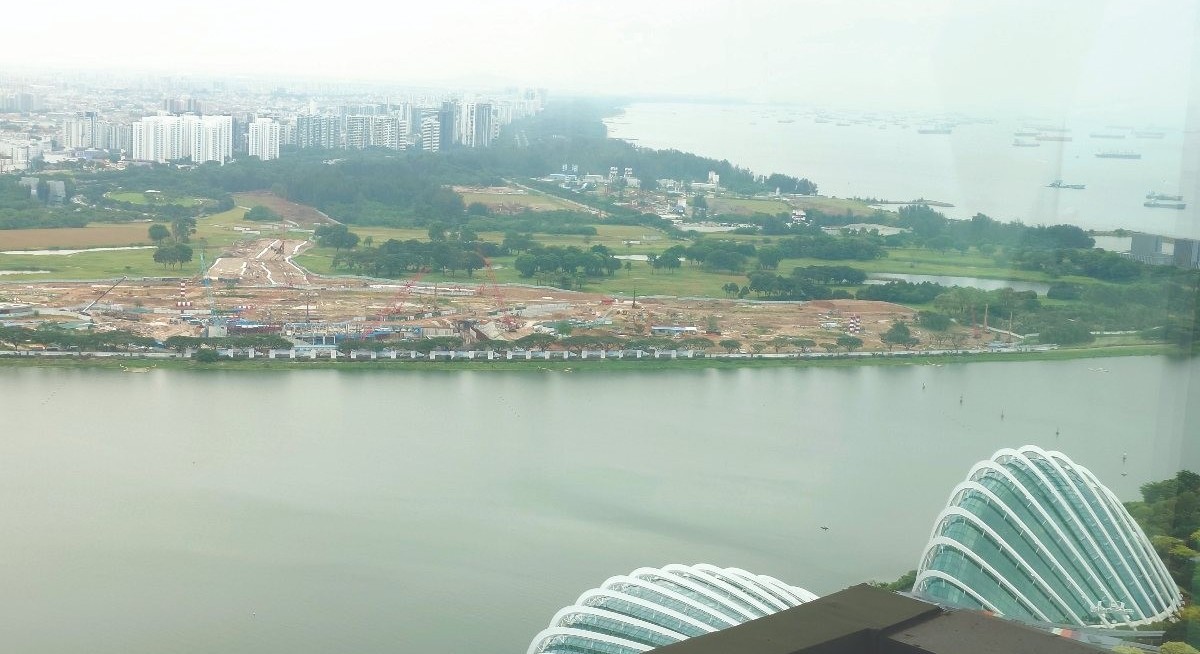
Demand for construction in Singapore is tipped to reach between $47 billion and $53 billion in 2026, according to the Building and Construction Authority (BCA), unchanged from the previous year’s range. The figure is propped up by major projects such as Changi Airport’s Terminal 5, the expansion of Tuas Megaport and the new development at Marina Bay Sands. “These mega projects alone could cost more than $100 billion and last until 2030 or beyond,” says Chua, with fellow economists Brian Lee and Luong Thu Huong in a report dated Sept 24, 2025. In 2025, Singapore’s construction demand reached $50.5 billion in nominal terms.
According to Maybank’s report, Changi Airport Terminal 5 is expected to cost $10 billion. The Tuas Mega Port is expected to cost $20 billion, while the Marina Bay Sands expansion is estimated at $10.3 billion. Other projects, such as NS Square and Founders Memorial Square, are already said to cost $650 million and $335 million, respectively.
See also: Singapore’s built environment must build a collaboration advantage

In September 2025, economists forecast that the construction sector will grow at a real annual rate of above 5% for 2025 to 2030, which is “much higher” than Singapore’s overall GDP growth. The sector’s share of GDP is projected to rise to about 4.2% in 2030 from 3.8% in 2025 and 3.5% in 2024.
In an interview with The Edge Singapore, Chua notes that historically, this is still pretty low. At its peak, the Maybank team noted that construction’s share of GDP reached nearly 6.4% in 1998 and 10.3% in 1984. At this rate, Chua says he won’t be surprised if the proportion reaches 4.5% by 2030. “I presume the construction sector could still outpace the rest of the economy,” he says.
While growth remains on the cards, given that the sector was decimated during the Covid-19 pandemic by border closures that led to material and manpower shortages, Singapore’s construction sector will not return to the highs of the late 1980s and 1990s. Those were the years when the country was still building out its basic infrastructure from scratch. Building contracts for HDB flats may also have peaked last year, given the catch-up work done after the pandemic. The two sub-sectors currently propping up the industry are civil engineering and commercial, notes Chua.
Still, the construction sector is expected to expand by 6% in this year, above its real GDP growth forecast of 3.2%. The sector was off to a strong start this year. According to the official advanced estimates for the first quarter, overall GDP grew by 4.6% y-o-y, down from 5.7% in 4Q2025. Yet, the construction sector surged ahead with 9% y-o-y growth in 1Q2026, up from 4.6% in 4Q2025.
“It looks like there were many orders and work done this year. When you look at the first two months this year, construction contracts are at $8.8 billion, of which about $4.1 billion came from the public sector and $4.7 billion came from the private sector,” he notes.
However, due to the crisis in the Middle East, Chua, while “comfortable” with his forecast, is allowing for some “potential moderation” in growth rates over the next three quarters. He now expects 2026 contracts to come in at around $50 billion. The estimate is still within BCA’s forecast range, but slightly below his previous estimate of contracts ending the year at the “upper end” of BCA’s target.
To stay ahead of Singapore and the region’s corporate and economic trends, click here for Latest Section
Whether there will be further revisions to the economists’ estimates remains to be seen. While the momentum for contracts doesn’t seem to have slowed, the Monetary Authority of Singapore’s (MAS) April 2026 Macroeconomic Review notes that the conflict will lead to indirect spillovers to the sector. “Recent anecdotal reports have also pointed to rising petroleum-based material costs in construction,” the report states.
That said, the conflict may not have a significant impact on the sector, given that other material prices have not risen sharply. Compared to the surge in oil prices, such materials have increased by a relatively modest average of 15% to 20%. Steel, another key material, can also be bought “on the cheap”, given the supply glut from China’s property downturn and the effect of US tariffs diverting supply away from American markets.

Infrastructure boom, not construction boom
To Alan Tay, CEO of Guthrie Engineering, Singapore is going through an infrastructure boom, not a construction boom. Guthrie Engineering, which was acquired by Mainboard-listed Ever Glory United for $46 million in July 2025, is one of the biggest mechanical and electrical (M&E) firms in Singapore and is considered the crown jewel in Ever Glory United’s portfolio.
Speaking to The Edge Singapore, Tay is careful to make that distinction because not all companies, whether in real estate, construction and M&E, will benefit equally from the upcycle.
Guthrie, established in 1951, is uniquely positioned to benefit from multiple aspects of the boom. “Our divisions are structured along infrastructure lines,” he says, rattling off the divisions and the respective projects, such as the ones from Changi Airport, HDB and the Land Transport Authority (LTA), among others. “Every aspect, we are there,” says Tay.
As a testament to its capabilities, the company is currently working on the contract to develop NS Square. It has also won bids to supply power lines and lighting for the Thomson-East Coast Line, among others. Terminal 5, the big trophy, is in his sights, of course. “We are running for it,” Tay confirms.
One reason Phillip Securities analyst Yik Ban Chong is bullish on Ever Glory United is that existing customers already trust it. He notes that for years, Guthrie has been the contractor servicing the runway lights, an obviously “very critical” component. “Runway lights cannot fail. If not, the planes cannot land. That’s why we think that track record is very important,” says Chong.
Healthcare is another component of the infrastructure boom. According to the Ministry of Health, last March, the government plans to add another 13,600 beds to the healthcare system between 2025 and 2030 to meet the needs of Singapore’s ageing population. Two new public hospitals in Bedok and Tengah will be built. In contrast, existing hospitals such as Alexandra Hospital, Singapore General Hospital and the National University Hospital will be rejuvenated and redeveloped.
Guthrie will be part of the Tengah General and Community Hospital project, which will be the first public hospital to implement the healthcare facility design standards (HFDS) fully, says Tay. The hospital is slated to be completed in the early 2030s.
In its FY2025 results release dated Feb 27, Ever Glory United revealed its involvement in major healthcare developments, including the NSC electrical contract for the redevelopment of Alexandra Integrated Hospital. The group expects further upside in future hospital tenders, says Lei Lei, managing director of Sunbeam M&E, a subsidiary of Ever Glory United, who adds that there were three qualifiers for electrical work and two for mechanical work. Of those, Guthrie was the only bidder qualified for both the mechanical and electrical scopes for Alexandra Hospital.
“We think the [healthcare] sector is worth supporting mainly because many hospitals are coming up,” says Tay. He adds that the group put up its maiden tender for the Bedok hospital to test the tender process and the competition before making the bid for Alexandra Hospital.
What makes this sub-sector so attractive is not just the pipeline but the small number of contractors qualified to bid for it, says Lei.
Companies seeing higher earnings
A rising tide lifts most boats. Thanks to the construction upcycle, several companies are now reporting stronger bottom lines.
Ever Glory United reported earnings of $16.7 million for the FY2025 ended Dec 31, 2025, nearly double its previous year’s bottom line of $8.96 million. This was attributed to the acquisition of Guthrie and higher revenue from construction contracts and the rendering of services.
“The successful integration of Guthrie Engineering has structurally re-rated the group’s earnings profile in FY2025. Backed by a record $732.8 million order book diversified across healthcare, hospitality, and public infrastructure, Ever Glory United’s revenue is highly visible through 2028,” says Alyssa Tee of KGI Securities.
To Tay, success means $1 billion in order book within five years, which is “very, very doable”. The figure excludes Changi Airport’s Terminal 5 due to its sheer size. Chong of Phillip Securities is more optimistic. He figures this $1 billion order book can be reached within this year, up from $732.8 million as of Dec 31, 2025.
Similarly, Wee Hur reported earnings of $68.4 million for the FY2025 ended Dec 31, 2025, up 26.6% y-o-y, due to higher gross profit and a one-off performance fee from the partial disposal of Wee Hur’s purpose-built student accommodation (PBSA) portfolio under the Wee Hur PBSA Master Trust.
In 1HFY2026 ended Sept 30, 2025, KSH Holdings reported $5.3 million in earnings, reversing from a loss of $6.5 million in the corresponding period the year before. Revenue for the period rose by 19.5% y-o-y to $63.1 million, thanks to a 22.1% y-o-y increase in revenue from the group’s construction business. As of its latest statement dated March 12, KSH Holdings’ construction order book exceeded $1 billion after signing a letter of acceptance (LOA) for a new construction project worth over $32 million.
Lum Chang Holdings similarly reported higher earnings of $7.3 million for the 1HFY2026 ended Dec 31, 2025, 108% higher y-o-y. The group has four main business segments: construction, restoration and interior fit-out, property development and investment, and investment holding and others. The group’s revenue fell 8% y-o-y during the period, as the construction and investment holding segments declined.
Tiong Woon Corporation, which is in the business of heavy lift and haulage, marine transportation and trading, reported a 13% y-o-y increase in its earnings of $13.6 million. Revenue rose by 14% y-o-y to $89.7 million, mainly due to higher contributions from its heavy lift and haulage and marine transportation segments.
Not every company is riding the wave. Tiong Seng Holdings reported a loss of $33.6 million for the FY2025 ended Dec 31, 2025, from the previous year’s earnings of $5.8 million. The loss was due to the 43% y-o-y decline in revenue of $297.9 million. The result is a reminder that companies without the right project mix, client base or technical credentials face a harder road even as the macro picture brightens.
All hands on deck
The surge in contracts and megaprojects requires a workforce to sustain them.
As at end 2025, the number of foreign work permit holders stood at 483,000, 5.6% higher y-o-y and was well above the pre-pandemic count of 370,000. Yet this growth is insufficient, given that the vacancy rate for construction jobs is also at a multi-year high. “Definitely, there is a shortage of workers,” says Maybank’s Chua.

The increase in the S-Pass qualifying salary to $3,300 from $3,150 for new applications from September 2025 is also a “small adjustment”. The change, which happens every two years, is not such a big deal, adds Chua. More importantly, the government did not tighten the dependency ratio ceiling (DRC), which is currently set at 1:5, allowing firms to hire five foreign workers for one local worker.
Instead of foreign labour costs, Chua points out that material and energy fuel costs are more crucial. On April 7, the BCA issued a circular stating that the government is “prepared to share the cost increases for ongoing critical government projects” due to rising diesel and bitumen prices since the outbreak of the conflict in the Middle East.
“As responsible buyers, government procuring entities (GPEs) will share the direct additional cost incurred by contractors arising from the use of diesel and bitumen from March 1 to May 31 on an ex gratia basis,” reads the circular.
This applies to critical ongoing public-sector construction contracts and will cover 50% of the direct additional cost.
“I guess the silver lining is that the government has the fiscal space to help cushion the impact, knowing that construction projects are critical,” says Chua. “From a policy perspective, it makes sense because this will be a natural counter-cyclical policy. You’re really expecting the world to be affected right now, and you should inject some of these projects and bring them forward. The construction has the highest multiplier effect on the rest of the economy.”
In 2022, every additional $1 of construction demand generated $1.89 in total economic output, according to the Singapore Department of Statistics (SingStat).
Guthrie manages the labour question through a strategic mix of its own workforce and trusted subcontractors. The group has around 410 staff in total, comprising roughly 100 workers and about 300 engineers and professionals. It also works with a core group of subcontractors it has partnered with for years, some of whom were nurtured from a BCA workhead grade of L2 all the way to L5.
The group aims to work on one third of any project with its own workers, while the rest goes to a stable of subcontractors, some of whom have worked with Guthrie for up to 20 years. “If we have any execution issues… my workers are already there and I’ll be able to parachute a new team,” Tay explains very quickly. “We also don’t want to be over-reliant on subcontractors who give us the wrong pricing.”
To be sure, labour shortages can be seen as a happy problem for the construction industry, rather than a dearth of new contracts and idle workers.
Interestingly, the current boom in the construction industry has attracted not just investors; it has also painted a target on the back of the industry. According to data from cybersecurity firm Bitdefender, the construction industry accounted for 33% of all ransomware victims in Singapore in 2025, making it the most targeted sector in the country by a “significant margin”. Just like in the physical world, kidnappers are selective about who their victims should be.
“This points to a potential gap as the sector continues to digitise. Construction projects typically involve large, interconnected networks of contractors and suppliers, often with varying levels of cybersecurity maturity, which can create multiple entry points for attackers,” says Bitdefender. “
Meanwhile, as cranes reshape Singapore’s skyline over the years, and tunnelling machines growl away metres underground, the real pulse of the boom may still be found around a humble table, where deals are sealed over bak kut teh instead of boardrooms.




