


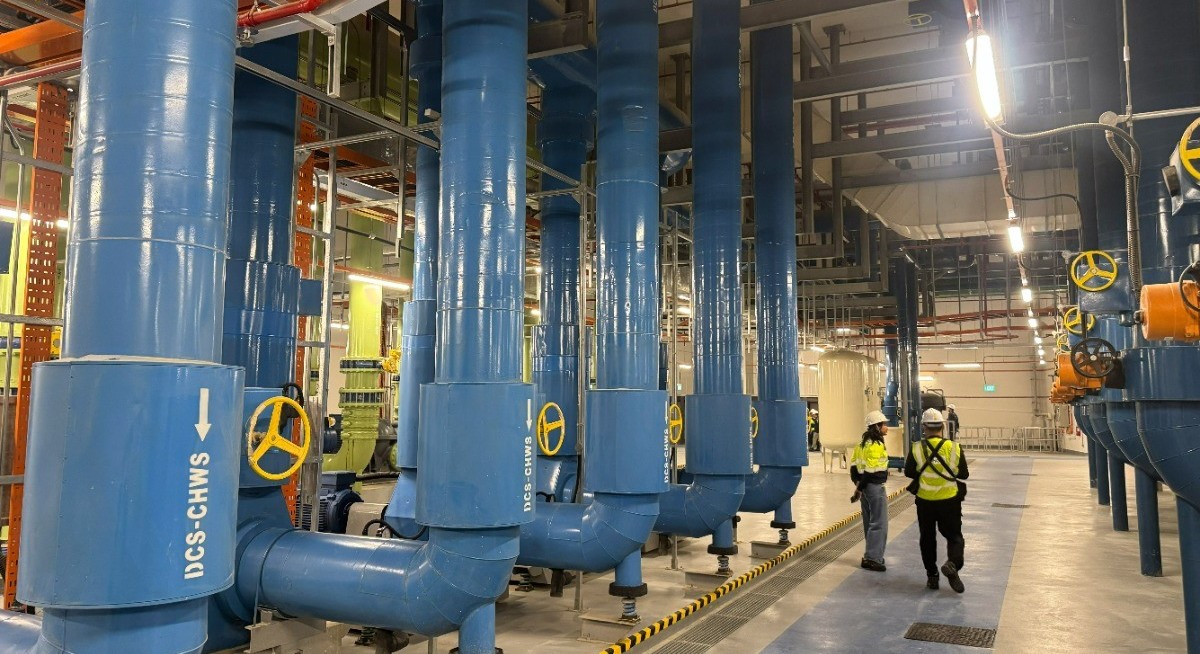


(June 9): Deep underneath Singapore’s northeastern district of Punggol, a 5km network of metal pipes roars as it pumps chilled water to cool offices and classrooms overhead.
The 140-year-old concept known as district cooling is taking root in the tropical island-nation, where temperatures are rising twice as fast as the global average and sharpening the focus on climate adaptation. That the old technology uses less electricity than centralised air conditioners is a major advantage for a resource-starved country that has to import nearly all its energy.
The city-state has laid such pipes beneath at least eight neighbourhoods so far, with the Marina Bay network — the world’s largest underground system — having begun operations in 2006. More buildings will be linked up to that system, and separate facilities are being rolled out in other parts of the city by firms like Keppel EaaS Pte Ltd.
The rollout comes as energy security takes centre stage in countries, including Singapore, that are reeling from energy shortages caused by the US-Iran war, while also bracing for an exceptionally hot summer due to a projected “Super El Niño”. District cooling is a solution that’s gaining traction around the world, particularly in the Middle East, and is projected to grow to a US$60 billion ($77.22 billion) market by 2034 by one estimate.
“Cooling demand is rising with urbanisation, income growth, heat stress and commercial floor-area expansion” across Southeast Asia, said Lee Poh Seng, professor and head of mechanical engineering at the National University of Singapore. Singapore’s playbook will be important if it can “demonstrate district cooling systems that credibly deliver energy, water, carbon, comfort, reliability and economic performance under hot and humid conditions”, he said.
The local market for the technology could double over the next decade from about 323,000 refrigeration tons today, according to Engie SA, which is among the world’s largest operators of such facilities. The firm runs two systems in Punggol district capable of cooling about 8,000 public housing units. It also sees potential to double district cooling capacity in Singapore, Malaysia and the Philippines by the next decade, said Jacques Boonen, Engie’s managing director for local energy infrastructures in Southeast Asia.
See also: Markets fail to price nature: Menon
Singapore has among the highest per capita use of air conditioners in the Asia-Pacific region, meaning it’s stuck in a negative feedback loop as the machines themselves release climate-warming emissions that create the need for more cooling. But the government is keen to kick the habit in favour of more efficient solutions, devising a $100 billion plan to safeguard the city against rising temperatures and sea levels. District cooling is part of those efforts.
The technology itself is relatively simple. Large tanks full of refrigerants chill water down to about 7°C (45°F); the cold water is piped into heat exchangers in buildings where warm indoor air is cooled when it passes against the liquid; the cooler air is then blown back out through air vents. As the water warms, it’s pumped back to the central plant, with excess heat released through a cooling tower.
The first generation of such cooling systems was installed in the US city of Denver in 1889 and used ammonia or brine solutions as distribution fluids, according to research papers. The use of water came about in the 1960s in the eastern US and Europe.
See also: Temasek likely to miss 2030 climate target, CEO Pillay says
“There is a 30% to 50% efficiency gain on the electricity side because of the scale” of district cooling systems versus air conditioners, said Brian Vad Mathiesen, a professor specialising in energy systems at Aalborg University in Denmark.
But, for all their simplicity, the cost of building these cooling networks can run into hundreds of millions of dollars depending on the size, he added.
These systems will also face increasing competition for water as a boom in data centres and overuse have severely dwindled the resource around the world. Already, power- and water-intensive data centres have faced public backlash, including in a Malaysian state neighbouring Singapore, Johor, which had to stop approvals for less-efficient data facilities due to water shortage concerns.
Technical troubles can arise too. After Singapore’s first centralised system for public housing was rolled out in 2023, apartment residents complained of water leaks and units blowing warm air.
To manage such teething issues, engineers back at the command centre of the Punggol network track water temperatures, pump operations, and maintenance needs for the equipment in real-time. There’s a special focus on system efficiency given Singapore’s stringent standards, its focus on energy security, and its ambitious preparations to adapt to a warmer climate.
“Singapore is very well positioned in the region in order to encourage and plan long-term infrastructure,” said Engie’s Boonen.
Uploaded by Chng Shear Lane




