




(May 7): China’s early lead in humanoid robots will help power the next phase of its global manufacturing and export dominance, according to new research from Morgan Stanley.
Much like the early identification of electric vehicles (EVs) as a growth driver a decade ago, China’s investments and early lead in humanoid robotics will see the nation’s share of global manufacturing expand to 16.5% by 2030, from 15% today, economists led by Chetan Ahya wrote in a report.
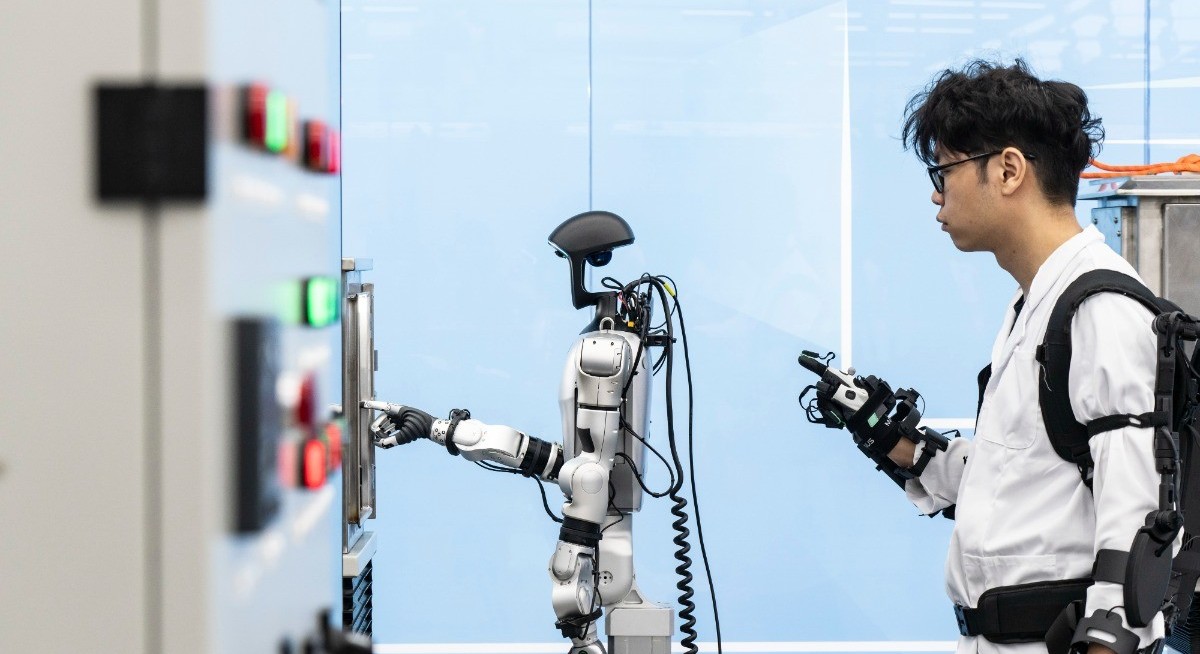
Over the past couple of years, robotics has shifted from the lab to the real world, with Chinese tech parks, factories and universities among those deploying humanoids. Government procurement is also kicking in, the Morgan Stanley economists note, paving the way for broader adoption.
“China has a track record of spotting the next big growth areas early and planning ahead,” Ahya, the bank’s chief Asia economist, wrote in the report, citing China’s now-dominant EV and battery industries. “The robotics industry has followed a similar path.”
Like with EVs, China is building out capacity across the humanoid supply chain. That gives it an edge over competitors including the US, Japan and South Korea, which often rely on Chinese inputs and components.
Almost every week, Chinese media reports on the next leap forward in humanoid robotics. A red humanoid recently completed a half-marathon in 50 minutes and 26 seconds — about seven minutes faster than the men’s world record. Robotics shares jumped on that news.
See also: China asks banks to pause new loans to US-sanctioned refiners
With American firms like Tesla Inc also investing heavily, the race to dominate the humanoid robot market is part of the broader strategic competition between the world’s two largest economies.
The US approach has been to focus on high-cost and high-spec prototypes, with an emphasis on testing before scaling up production, the Morgan Stanley economists wrote. Chinese firms have been quicker to roll out models, with the local market acting as a testing ground.
Protectionism will be a threat. Chinese EVs have run into tariffs and other restrictions around the world. While humanoid robotics is a new industry, meaning there’s less need to protect existing producers and workers, concerns over security and technical dependence could rise, according to the economists.
See also: Chinese consumers open wallets as malaise lifted during holidays
Excessive investment and competition that drags down profits and results in a production glut is another risk for the industry.
“A rapid rise in robot supply is likely to keep prices of automation equipment on a downward trajectory, which is a double-edged sword,” the economists wrote.
“Cheaper robots make faster global adoption possible — potentially boosting productivity and containing inflation for end products. But excessive supply expansion can create the problem of pricing power and returns for the industry.”
Uploaded by Tham Yek Lee




