


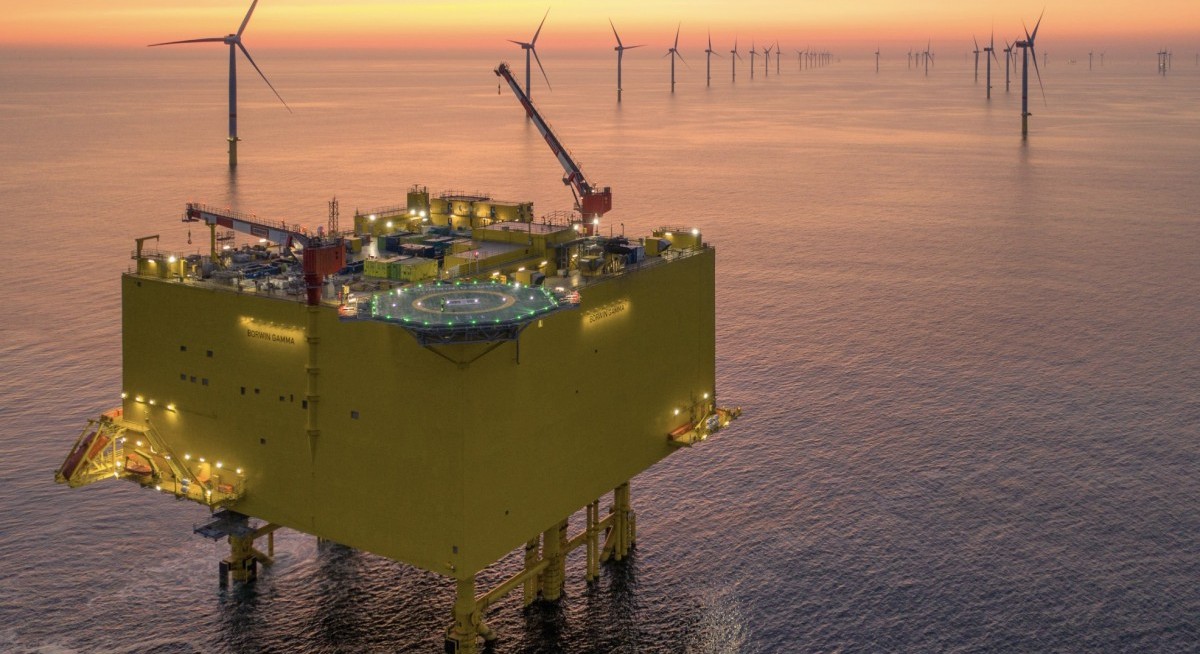


Offshore wind farms in the North Sea are being built further away from the shore (100–150 km). Transporting the electricity generated by the wind turbines over long distances is a challenge.
When a wind farm is within 80 km of the shoreline, electricity can be transmitted to the shore in alternating current (AC) format. However, for wind farms located more than 80 km from the shore, additional equipment is needed to prevent significant power losses during transmission.
This equipment includes an offshore HVDC converter station, a high-voltage cable system, and an onshore high-voltage alternating current (HVAC) converter station.
The offshore HVDC converter station converts the AC electricity generated by the wind turbines to DC electricity. DC electricity has lower transmission losses than AC electricity, so it is more efficient to transmit over long distances.
Once the electricity reaches the onshore HVDC converter station, it is converted back to AC electricity and fed into the grid.
The size of a converter station depends on how many wind turbines are connected to it for power conversion. Converter stations can range in size from 520MW to 2GW.
During power conversion, converter stations produce heat as a byproduct. To keep the system running continuously, the heat-emitting equipment, called thyristors/rectifiers, must be cooled constantly.
The most effective way to cool large HVDC converter stations is to use deionised water in a closed system. The deionised water is then cooled by seawater pumped through a heat exchanger, which absorbs heat from the deionised water. In some systems, chemicals such as glycol are mixed with the water to prevent freezing.




