


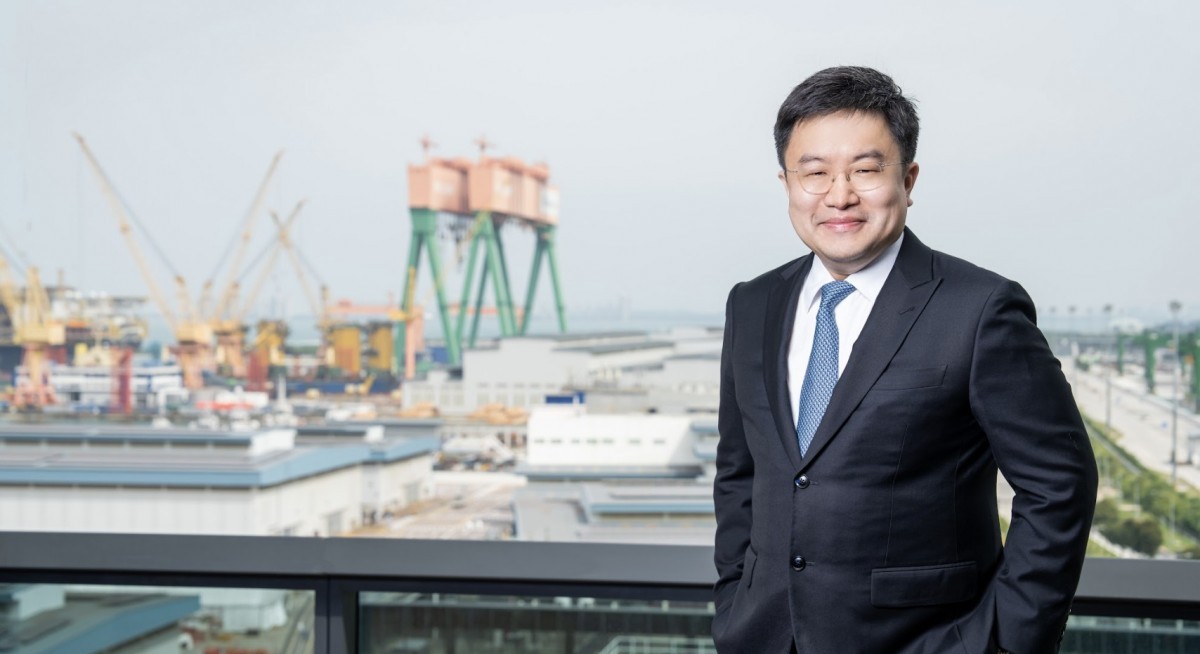


As countries transition to a low-carbon world, Seatrium is likely to remain an important cog in the wheel of that transition. “With projects we have already secured, we’re going to contribute 16 gigawatt (GW) worth of total offshore wind capacity to our clients, capable of powering 20 million households. For the oil and gas side, our projects have a total production capacity of 17 million barrels of oil per day, and more than 55 million tonnes per day of regasification capacity,” Stephen Lu, group CFO of Seatrium, tells The Edge Singapore.
Lu was formerly a brain scientist who moved on to consulting before joining Temasek in 2015. At Temasek, Lu was on the team that worked on the sale of STATSChipPAC to Jiangsu Changjiang Electronics Technology. Lu was also part of Temasek’s portfolio development focusing on total shareholder return (TSR) for its portfolio companies which include Sembcorp Industries and Keppel. Now at Seatrium, Lu will be pleased that his stock has outperformed the Straits Times Index (STI). As of April 6, Seatrium’s share price is up by more than 14% year to date compared to the STI’s 6% gain.
In a nutshell, Seatrium produces equipment used mainly for the extraction of gas such as floating production offloading (FPSO) vessels, floating production units (FPU) and floating liquified natural gas (FLNG) facilities; and HVDC platforms that facilitate the transmission of wind power to the onshore electricity grid (see sidebar). Its FY2025 financial results heartened investors as net profit doubled to $319.9 million, as did dividends, to 3 cents a share. However, the dividend payout ratio is low, at below 32%. But with heightened earnings, group CEO Chris Ong announced that Seatrium’s share buyback programme aims to buy back 2% of shares outstanding over the 12 months to 2027.
Turning the page
As the dark days of the post-oil and gas boom, along with the entire Sete Brasil and Operation Car Wash issue, fade behind us, Seatrium could well attract heightened investor attention due to geopolitics, the case for renewables, and its One Seatrium Global Delivery Model.
Seatrium spent the years in the aftermath of the oil and gas boom, from 2016 to 2023, facing significant challenges. The company was formed from the combination of Keppel Offshore & Marine (KOM) and Sembcorp Marine (SCM) in 2022. To understand the genesis of Seatrium, we need to go back perhaps 20 years, when KOM and SCM were the world’s largest and second largest manufacturers of offshore drilling rigs. As explorers and producers searched for more oil and gas — and before renewables became a “thing” — the oil majors went into deeper waters which required semi-submersible rigs (semis) and drillships.
A major customer for these rigs and floaters was Sete Brasil, formed in 2010 to operate 28 drilling rigs contracted to Brazilian national oil company Petrobas’ pre-salt field.
See also: Yoma’s comeback
In 2024, Sete Brasil was declared bankrupt. In the five years prior to that, SCM had contracts for seven drillships at US$5.6 billion with Sete Brasil. In 2019, SCM had retained five drillships and the costs for two drillships were apportioned between it and Sete Brasil.
“If you go back 10 years, both KOM and SCM made one product: rigs. In the ensuing years, just before the merger and right after the merger, we changed our strategy,” Lu points out.
At the start of the Covid pandemic, both KOM and SCM ran into financial difficulties with the multi-billion dollar Brazilian contracts. Keppel introduced a new business model, Vision 2030, where group CEO Loh Chin Hua announced plans to restructure Keppel into a global asset manager. As part of the new model, KOM had to be divested as rig-building was no longer part of the strategy. The divestment came at a time when Temasek-linked companies focused on sustainability, and less on brown energy.
A proposed “combination” of KOM and SCM was announced in April 2022. Some terms of the combination changed in October 2022. The exchange ratio between Keppel and SCM was 54:46, respectively translating into Keppel receiving $4.5 billion in shares from SCM. These shares were given to Keppel’s shareholders as a distribution-in-specie. For every Keppel share, Keppel shareholders received 19.1 SCM shares with an implied value of $2.33. Seatrium shares were consolidated from 20 shares to one share on May 9, 2024.
In Seatrium’s FY2025 annual report, chairman Mark Gainsborough said in his statement: “During the financial year, we also closed a longstanding chapter with the conclusion of matters related to Operation Car Wash. The outcome allows us to fully turn the page on this legacy matter.” He could just as easily have been referring to the KOM-SCM combination which investors felt disadvantaged the latter unfairly.
Yard competition
Looking back, Lu recalls: “It doesn’t make sense for Singapore, where there isn’t really domestic demand to have two ship- and rig-building yards,” citing anecdotes of clients visiting both KOM and SCM yards, and asking for lower prices.
To stay ahead of Singapore and the region’s corporate and economic trends, click here for Latest Section
In addition to the competition within Singapore, both rig-builders faced competition from Chinese yards which were mushrooming along her eastern coast. At one point between 2010 and 2015, some 3,000 yards were in operation. Those numbers have since dwindled to a couple of hundred. Nonetheless, the Centre for Strategic and International Studies (CSIS) says China dominates shipbuilding with a 58% global market share.
The Chinese yards still command higher margins than Seatrium, but their product range is vastly different, and their competition is with South Korean and Japanese yards who also produce ships. South Korean and Japanese yards are focusing on high-tech, eco-friendly vessels, which could erode China’s dominance in premium segments, analysts note.
“The offshore marine industrial base, globally, over decades, has experienced a decline in capacity ex-China. The Koreans and the Japanese have shrunk their capacity but shipbuilding nations are basically China, Korea, Japan and the US. The Koreans, like the Chinese, focus on standardised ships. We’re building these very large, complex, engineered products,” Lu adds.
As a case in point, Yangzijiang Shipbuilding’s focus is on run-of-the-mill shipbuilding. Seatrium’s products are more sophisticated asset classes such as FPSOs, speciality HVDC platforms, conversions and Seatrium has a share of the cruise market.
“On a product-by-product basis, we give execution certainty. Clients actually being able to get the vessel on time is important to them,” Lu points out. “Being able to deliver a product on time is crucial.
“We have clients that operate cruise ships. We have retrofitted the entire ship — rip out all the carpets, put in new carpets, TVs, everything. There have been examples where we delivered the cruise ship to the client and they picked up customers two days later. So if we’re late, they’re gonna have a big issue on their hands: Thousands of people not being able to go on holiday,” he says.
On March 19, Seatrium announced a new agreement with Royal Caribbean Group, for a significant number of cruise vessels for statutory inspections, repairs and upgrades at Seatrium’s facilities over the next several years.
Despite the transition to renewables, many economies are still reliant on oil and gas. “Offshore energy is critical, because oil and gas production onshore is getting more and more expensive. Reserves are getting depleted and producers have no choice but to move offshore. The extraction of offshore oil and gas is less carbon-intensive,” Lu says.
Harnessing wind from offshore windfarms and connecting the power for onshore use is a growing sector. In December, Seatrium and its partner GE Vernova announced a contract from TenneT to deliver a major part of BalWin5, a new 2.2GW offshore HVDC grid connection designed to transmit electricity from offshore wind farms in the German North Sea to the onshore transmission network in Germany. Once operational, BalWin5 is expected to provide enough renewable electricity to power approximately 2.75 million households.
“Wind resources are much more stable in the sea where there’s more wind anyway. The capacity factor is higher, and the wind turbines and windmills are less of an eyesore. How do we create a champion that can target both of these segments?” Lu asks rhetorically. Seatrium serves both offshore oil and gas, and offshore renewables.

Seatrium and its partner Vernova announced a contract from TenneT to deliver a major part of BalWin5, a new 2.2GW offshore HVDC grid connection
One Seatrium
The One Seatrium Global Delivery Model is a centralised and coordinated execution platform integrating people, AI and assets worldwide. An example is the production of FPSOs, used in the production and transportation of LNG. The topside is fabricated in Seatrium’s China yard where it has access to lower-priced steel, the hull is fabricated by a partner yard managed by Seatrium, and further fabrication and engineering is done in the Singapore yard.
“Right after the merger, we changed our strategy. We said, let’s not just build one product. We planned to build multiple products. We’re building FPSOs and FLNGs for oil and gas. As One Seatrium, we use the most cost-effective plan to execute whatever it is we are building. For instance, if we’re building an FPSO for Petrobras, the topside is principally built in China, in our own yard, and we do a certain percentage of it in Brazil to comply with the local content rule. We’re using all of our facilities in concert, and everything is done in coordination,” Lu describes, likening the process to a central kitchen.
More than that, Seatrium is building different products using the One Seatrium Global Delivery Model and the same facilities, not just the yards, but with the same engineering facilities and artificial intelligence. “We’re an engineering company; the biggest driver is how well we do engineering,” Lu says. Once a drawing is done by a designer, the engineers will put pipes and other fixtures into the design, and the builders will build the vessel or platform.
“We’ve consolidated all the engineers into specific product lines, because there is a little bit of difference between building an FPSO and designing one, and an FLNG versus a substation. We’ve concluded that a build-together strategy garners efficiency, and people are also learning,” Lu explains.
“We aggregate at a company level, and then we gauge if a certain type of steel pipe is the cheapest in China [and if so,] we will use our China entity to buy the product for the group. The big advantage in China is steel production so we partner CIMC Raffles. They do the heavy steel part and we do the highly engineered part,” Lu says.

Seatrium's yard in Brazil
Pricing for the cycle
Project execution and risk management are also paramount for margin efficiency. Over the last two years, Seatrium’s projects are guided by a risk-adjusted hurdle rate of mid-teens project margins when the group tender for projects.
A key difference between Seatrium and SCM is project milestone payments to manage risks, aligning contracts with procurement, and ensuring that all projects are cash flow positive. In FY2025, Seatrium reported operating cash flow of $142 million and free cash flow of $139 million.
Previously, when Seatrium was SCM, clients’ downpayments ranged from 5% to 20%, with the remainder paid on delivery. “This means we [were] carrying the working capital, whereas now we don’t,” Lu says.
After the merger, Seatrium locks in the costs when contracts are signed. After an initial deposit, projects are broken down into milestones, and when a milestone is achieved, the client makes a payment (similar to a progressive payment scheme). This has a positive impact on cash flow as Seatrium is not financing the client.
“We don’t have to fund the working capital. The other part is that the client is also invested, because they’ve been paying along the way,” Lu says. Previously, there were occasions where clients walked away from multi-million dollar projects.
The other part of the One Seatrium model is to focus on strong counterparties and clients. Its clients are the listed oil and gas majors, or the major grid operators such as TenneT. “Stronger counterparties have long-term development plans,” Lu says.
Projects that take three to four years are multi-faceted. How does the company get the risk allocation right? For instance, Seatrium cannot control the price of steel. “We’ll contract to make sure that we don’t get hit when the steel price spikes. But who’s better at taking the risk?” Lu asks. It is the customer because the customer gets to operate the asset for 20 to 25 years, through the cycle, making a return that covers the cost of the asset.
“Clients that generally understand [the way costs are apportioned] are oil majors and grid operators because they have a long-term perspective. And, because we’re using all of our facilities together, we can take on bigger projects that any individual yard cannot take on,” Lu says.
Outlook
Seatrium’s $17 billion (as at end-December 2025) orderbook provides revenue visibility at more than 1.5 times FY2025’s revenue of $11.5 billion. Included in the orderbook are six P-series FPSOs, and three FPUs bound for the Gulf of Mexico (or Gulf of America according to Trump). At the same time, Seatrium is producing four 2GW HVDC substation platforms and two high-voltage alternating current (HVAC) substation platforms.
“The FPSOs are very big and can produce 250,000 barrels of oil per day. A small yard can’t do all that work. That’s the beauty of One Seatrium,” Lu says. Gas is a transition fuel as the world transitions to renewables such as wind, geothermal, hydro, nuclear, solar and other low- or non-carbon power, including ammonia and biomass.
Seatrium has a pipeline of $32 billion for which it is bidding. Of this, offshore wind comprises $7 billion, oil and gas $23 billion, and conversions $2 billion.
In a report titled Offshore Upcycle versus Shipbuilding Peak, Maybank says offshore oil continues to sit low on the global cost curve at US$37–43 per barrel, with 70%–80% of new supply additions coming from offshore projects. “As a result, FPSO (for mainly gas) demand remains strong, with 40–50 units required over 2025–2030. In parallel, we expect offshore wind production capacity to post a 14%–16% CAGR, reaching 325–500GW by 2035. Geopolitical tensions caused by the Iran war further reinforce energy security and supply diversification, supporting both offshore hydrocarbons and renewable investments,” the Maybank report says.
As war rages in the Middle East and geopolitics turn increasingly volatile, Lu is also focused on Seatrium’s financials. “We are very clear in our objectives. We borrow in the currencies that we need, and then minimise the interest rate effect as much as we can. We try to control the amount of debt we’re holding, and then for the debt that we have that we have to refinance, make sure we get better terms,” he says.
Seatrium’s average cost of debt has fallen to 3.4% despite holding USD debt, and its gearing is 0.8 times. “We don’t do complicated instruments. We are very, very simple. We look at the cash flow, ins and outs, and we hedge on the net movement,” Lu says. “This company in small Singapore is helping everybody globally.”




