


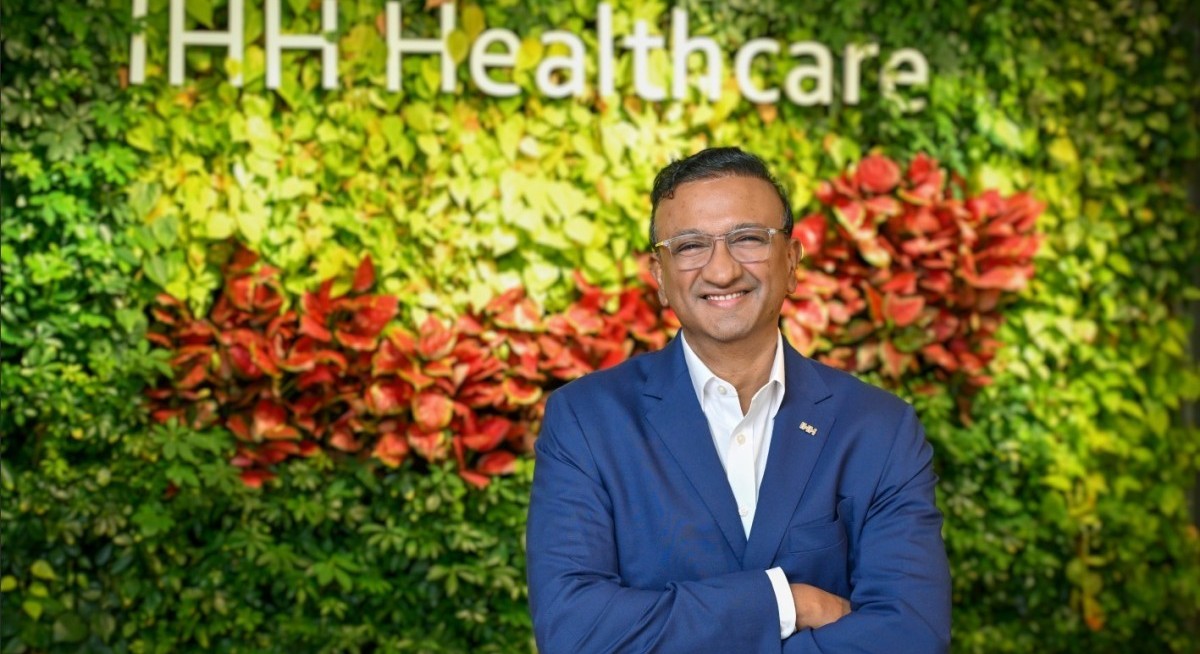


“We still have headroom on our balance sheet. I can still borrow. From a stakeholder perspective, can we do this? Sure, we can think about it. Is it something that we need to do now? We don’t need capital; our cash flows are strong; our debt headroom is high; our debt levels are low, so we still have a lot of leg to run on,” Kadambi says. IHH’s net debt-to-equity ratio as at March 31 stood at 0.4 times. “Never say never, but nothing, at least in the immediate future that I can see.” That could disappoint PLife REIT’s unitholders.
As Kadambi tells it, IHH owns or operates 190 healthcare facilities, including 89 hospitals, clinics and ambulatory care centres in 10 countries.
IHH owns 100% of Parkway Pantai, which, in turn, owns 32.94% of PLife REIT and 31.17% of Fortis. Parkway Pantai has a network of 60 hospitals in Malaysia, Singapore, Brunei, India and Greater China. Fortis remains listed in India.
The healthcare group also owns 90% of Acidadem, Türkiye’s leading private healthcare provider. Through Acidadem, IHH owns and operates 29 hospitals in Türkiye, North Macedonia, Bulgaria, the Netherlands and Serbia.
See also: Yoma’s comeback
“I would probably dare say that IHH is the most global healthcare provider in the world. Fundamentally, each of these businesses in each of these countries has to be a strong and resilient business,” Kadambi says.
IHH’s largest market by revenue and ebitda is Turkey, followed by Singapore, Malaysia and India. IHH is dual-listed in Singapore and Malaysia and its reporting currency is the ringgit.
IHH’s global business came at a cost. IHH acquired India-based Fortis in 2019 and spent several years turning it around. Kadambi concedes that Fortis had been badly managed by the former founders. “We spent a good part of the last three to four years resurrecting the business and turning it around. We’ve got the right management team in place in India to run Fortis and we’re building on it,” he claims.
See also: Balancing risk, returns and customer journeys
In 1Q2026, India’s ebitda margin was 20%, contributing around 14% to total ebitda compared with just 7% in FY2020. “We can grow the business because the need for healthcare in India is undersaturated. The need for private beds is huge and our ability to ramp up capacity in India is strong. We had completed the mandatory tender offer required by the Securities and Exchange Board of India. There were some disputes, for example, with Daichi. All that got settled and this allows us to pump in more capital. We will keep it listed,” Kadambi says.
“We can exercise a preferential placement ourselves at 5% every year. Based on that growth, we can infuse capital. Our stated long-term vision is to increase our stake to 50%,” he adds.
IHH took full control of Global Hospitals in India in 2023 and rebranded it to Gleneagles. “That has stabilised and turned around. Last year, once the mandatory tender offer was done, we got Fortis to manage Gleneagles in India. At some point in time, we would like to merge Fortis and Gleneagles since we own 99.7% of Gleneagles,” Kadambi indicates. Between Fortis and Gleneagles, IHH has 35 hospitals with 6,000–6,500 beds.
Fortis has mapped out a strategy to add another 500 beds, bringing the total to 8,000.
In FY2025, Fortis acquired a 228-bed Shrimann Superspecialty Hospital in Jalandhar, India, now called Fortis Hospital Jalandhar. “In India, we aim to reach 10,000 beds in five to six years. It is a big growth market for us. We would like to deploy more capital. Many brownfield projects of Fortis have ramped up very quickly. Fortis has been doing tactical M&A, such as the one in Manesar near Delhi, which is a big cluster region,” Kadambi says.
Scaling up
Kadambi explains that IHH sees two types of “inorganic opportunities”. Tactical opportunities are small hospitals or small acquisitions such as Timberland Medical Centre in Kuching. “It has a big piece of land where we are currently building a 200-bed facility, Gleneagles Hills Kuching,” he says.
To stay ahead of Singapore and the region’s corporate and economic trends, click here for Latest Section
Strategic acquisitions include Island Hospital in Penang, which cost a tad below US$1 billion ($1.3 billion). This hospital has 600 beds and IHH may add 400 beds. “Island Hospital is just across the road from Gleneagles Penang, which is full. We can grow capacity and Island Hospital has established a name for itself in medical tourism. Almost 60% of the island’s revenue is from medical tourists coming into Malaysia,” Kadambi says. Of the tourists, only 30% are from Medan, with the remaining 30% from Jakarta and Surabaya, he indicates.
Is Penang eating Singapore’s lunch? “If you look at Singapore, I would say at the fringes, there are people from Indonesia who cannot afford Singapore, who would much rather go to Malaysia and get treatment in Malaysia. There are also the top 1%, 2% or 4% of Indonesians, Cambodians, Vietnamese, Filipinos or Indians who still want to come to Singapore to seek treatment because there is cutting-edge technology and very skilled and trained clinicians here,” Kadambi explains.
Compared with Island Hospital, IHH’s Singapore hospitals generate around 16%–18% of revenue from tourism, Kadambi estimates. For IHH, though, it made sense to strengthen its Northern cluster in Penang. “In Malaysia, the healthcare tourism market share is going up y-o-y. Medical tourism is growing by double-digit CAGR in Malaysia compared to 3% to 5% a couple of years ago,” Kadambi says.
Natural hedge
IHH adopts a natural hedge strategy for its foreign subsidiaries, such as Acidadem and Fortis. “All our businesses are run in local currency. I translate all of them into ringgit at the end of each quarter for financial reporting. We don’t repatriate any funds. We would have lost growth by translating one currency into another. Most of our balance sheet and revenue are denominated in the local currency in each country. Our costs are also quoted in the local currency of each country. A lot of equipment, supplies, etc, are all billed in local currency. Our borrowings are also in local currency,” Kadambi says.
In terms of targets, Kadambi has told his shareholders that IHH will reach a double-digit return on equity (ROE) by 2028 from 9% in FY2025. The dividend payout ratio will be lifted to 30% of patmi and Mount Elizabeth Orchard’s performance should stabilise by 2H2026. In a recent report, JPMorgan noted that IHH’s bed occupancy rate in Singapore in 1Q2026 was just 50% compared with 68% overall.
Out of all IHH’s geographies, Singapore appears to be the most challenging. It was the only sector in which revenue and ebitda fell in 1QFY2026. Inpatient admissions fell by 8% y-o-y, reflecting higher public healthcare utilisation and softer medical travel given higher airfares and rupiah depreciation. Also, in 1Q2026 vs the prior year, there were more public holidays, notes DBS Group Research in a report dated May 28.
Medical inflation in Singapore has led IHH to work closely with its ecosystem, including payers such as insurance companies, hospitals and clinicians, to agree on certain fixed-price packages. In 2023, as part of an effort to defray rising medical costs for patients, IHH introduced ambulatory care centre (ACC) services in Singapore with the launch of Parkway Medicentre Woodleigh. Since then, IHH opened Mount Elizabeth Royal Square, providing hospital-equivalent surgical and endoscopic procedures.
DBS points out that IHH’s management “reaffirmed FY2026 revenue growth guidance of 10%–12% and 22%–24% ebitda margin range, underpinned by recovering volumes, tighter cost control and better use of existing assets”.
Cost inflation is also being monitored closely, particularly for drugs, consumables, shipping and insurance. However, one- to two-year rate contracts, group procurement and longer-term energy contracts provide some near-term protection. “Forex remains more of a reporting headwind, as earnings translation is unhedged,” the DBS May 28 report adds.
UBS points out that, on a constant-currency basis, IHH continues to see significant revenue increases in its Turkey, Europe, India and Hong Kong operations of 45%, 18% and 2%, respectively.
“The daycare model remains key in managing payer pressure while improving capital efficiency. Moving lower-acuity, high-volume procedures from inpatient wards to daycare settings helps IHH offer a more cost-efficient care model, which should ease some insurer concerns over medical inflation and rising claims. It also frees hospital capacity for more complex, higher-intensity procedures that can support revenue intensity and margins. In addition, the daycare model also reduces capex intensity, freeing cash for debt reduction and structurally higher ROE over time,” DBS notes.
DBS has a buy rating on the stock, with a 12-month price target of $3.39 and RM10.50 ($3.27). UBS also has a buy rating on the stock with a 12-month price target of RM10.80.




