


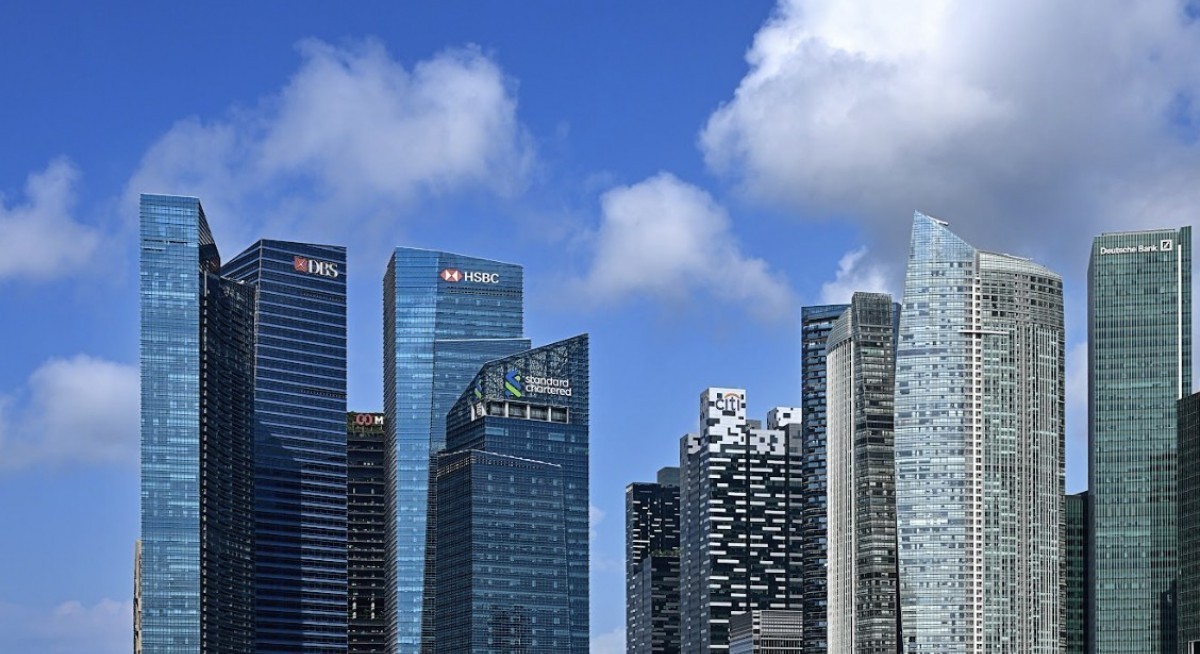


Shares in DBS have been climbing steadily since Covid, except in April 2025, when the Liberation Day tariffs were announced.
Meanwhile, shares in OCBC have been climbing to new highs since November 2025 after it reported a steady 3QFY2025 group net profit of $1.98 billion from higher non-interest income and lower allowances.
For the nine months ended Sept 30, 2025, however, group net profit fell by 4% y-o-y to $5.68 billion
The bank last underwent a two-for-one stock split in August 2005, where it was trading at around $13 at the time.
See also: DBS at $100: here is how it could get there
In its announcement dated Feb 22, 2005, the bank said the split will “increase the affordability of investing in each board lot”.
“With OCBC shares currently trading at above $13, one board lot of 1,000 OCBC shares may represent too large an investment for many retail investors,” said then-CEO David Conner.
“By lowering the absolute price of each share through this exercise, we hope to provide this investment choice to more investors,” he added. “With a broader investor base and potentially better liquidity over time, we believe this move will benefit both existing and new investors in OCBC shares.”
See also: Banks' rally pushes market cap of DBS just whisker off $200 bil mark
Among the analysts on Bloomberg, Goldman Sachs’ Melissa Kuang has the highest target price of $21.20 on OCBC, while JP Morgan’s Harsh Modi has the highest target price of $70 for DBS. Kuang has a “buy” call for OCBC while Modi has an “overweight” call for DBS.
Conversely, Autonomous Research’s Ivan Ng has an “underperform” rating on OCBC with a target price of $17, while Macquarie’s Jayden Vantarakis also has an “underperform” call with a target price of $46 on DBS.
Will UOB return to its high of $39.20?
Of the three banks, United Overseas Bank (UOB) (SGX:U11 ) has been the weakest performer, still trading some distance from its all-time high of $39.20 due to a confluence of factors.
The bank’s shares, which took a hit after the bank announced a pre-emptive additional general provision of $615 million during its 3QFY2025 results, have been climbing steadily as well.
UOB's CFO, Leong Yung Chee, said that the provisions were mainly for loans made in Greater China and the US, while PhillipCapital’s Paul Chew surmised that the spike was due to the disposal of several office assets in New York and Hong Kong, which were collateral, at around 10% below their internal valuations.
Following the bank’s 3QFY2025 results, OCBC Investment Research’s Carmen Lee was the only one to remain positive, noting that any price correction at the time means investors should accumulate into the bank.
To stay ahead of Singapore and the region’s corporate and economic trends, click here for Latest Section
In her report, Lee noted that UOB’s core earnings were steady while wealth and credit card income grew for the 9MFY2025. “While the global outlook is still mixed, risk assets have done well globally this year, which has led to better investment and fee income,” she wrote.
That said, given the broader macroeconomic dynamics, including the recent invasion on Venezuela, foreign investors may have to re-assess their required returns on equities. If the outlook for oil production is increased supply, this reduces inflationary pressure which in turn could lead to lower policy interest rates, and possibly lower risk-free rates.
The relationship between interest rates and equities is complicated as interest rates impact companies in different ways. In a nutshell though, lower interest rates generally drive risk-free rates lower. As such, the weighted average cost of capital (WACC) would probably fall, raising equity prices. The rationale is that a lower WACC lowers the discount rate for future cash flows so that the company can generate more from its investments making it more attractive. Hence, equities are rising in the expectation of falling inflation in the future.
As at 11am, shares in DBS and OCBC are trading at $57.59 and $20.14 respectively, while shares in UOB are trading at $35.78.




