




The loans were also to “very good names in the Middle East” with exposures largely in commercial paper with “good credit links”.
Lee’s remarks come against a backdrop of unprecedented uncertainties since 2022, driven by the Russia-Ukraine war, US-China tensions, tariffs, interest rate movements and the recent conflict in the Middle East.
“Many things are in flux… as a bank we have to handle this,” says Lee.
“The conflict in Iran is actually a huge challenge to the energy situation especially through Asia,” he adds, noting that 20% of the world’s oil, gas and other materials such as fertilisers flowing through the Straits of Hormuz are destined for Asia.
See also: OCBC boosts hiring for Indonesia wealth business as assets rise
“One thing that is very troubling is, all these things are happening at the same time,” he continues, noting that it will lead to a potential slow down in global growth.
On April 15, the International Monetary Fund (IMF) trimmed its global growth projection to 3.1% from 3.3% for 2026 as the world economy could be “thrown off course” by the Middle East conflict.
Given this, OCBC has conducted mandatory stress tests and monitoring both first- and second-order risks since 2023.
See also: Local banks unaffected by revised liquidity coverage rules effective Sept 1
Lee also pointed to the bank’s decision to defer the potential redevelopment of 63 and 65 Chulia Street and 18 Church Street. The development, he notes, would have cost the bank some $5 billion and would leave it “very challenged” amid the current storm.
Instead, $2.5 billion were paid out through dividends and share buybacks, a move which Lee describes as a “wise decision”.
In responses to pre-submitted questions, OCBC says client sentiment has remained “calm” to date with most adopting a “wait-and-see approach”.
The bank also observed some net new money inflows from the Middle East-Dubai International Financial Hub towards the end of March this year.
Pivot to Southeast Asia
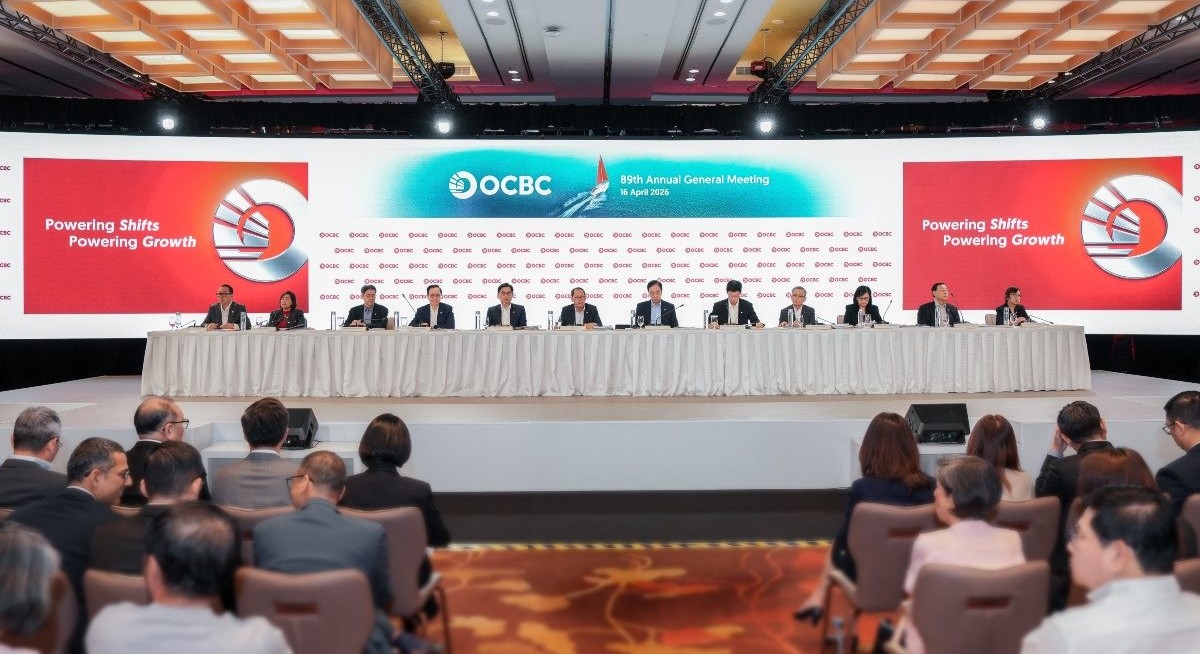
Amid global uncertainty, Southeast Asia is a “pretty good place” to be at compared to the rest of the world, says group CEO Tan Teck Long. This is Tan’s first AGM since he was announced as Wong’s successor in July 2025.
“SEA is still growing. It is predicted to be one of the top four economies in the world by 2030… The biggest economy in SEA is Indonesia,” Tan adds.
To stay ahead of Singapore and the region’s corporate and economic trends, click here for Latest Section
Chairman Lee notes that Indonesia, like China, “cannot be ignored”.
OCBC has steadily expanded its presence in Indonesia. The bank first bought a 22.5% stake in 2004 and raised its stake to 51% in April 2005 and subsequently to 70.62% in June 2005.
In May 2024, OCBC completed the acquisition of PT Bank Commonwealth, which was integrated within the year. “We remain deeply committed to growing our business in Indonesia,” says Lee.
On private credit, Tan says the bank has no direct exposure to private credit funds.
Share price ‘can go higher if everyone buys more’
Addressing questions about OCBC’s share price performance relative to DBS, Lee says the stock's movement is linked to the bank’s performance and external circumstances.
That said, OCBC’s share price “can go higher if everyone buys more,” Lee said, to laughter in the room.
“It’s a serious answer. OCBC as an institution, we don’t go into the market to handle our own shares,” he explains. “For us, our share price is the result of things we do consistently over time [and the] decisions we make.”
The market, which represents the views of investors, determines our share price, Lee adds.
Over the past five years, OCBC’s shareholders have seen returns of about 2.5 times their investment, while 20-year total shareholder returns (TSR) stand at 7.5 times.
The bank also has “no immediate plans” to tokenise its shares or to reinstate scrip dividends.
All resolutions were passed.
Shares in OCBC closed 22 cents lower or 0.96% down at $22.66 on April 16.




