


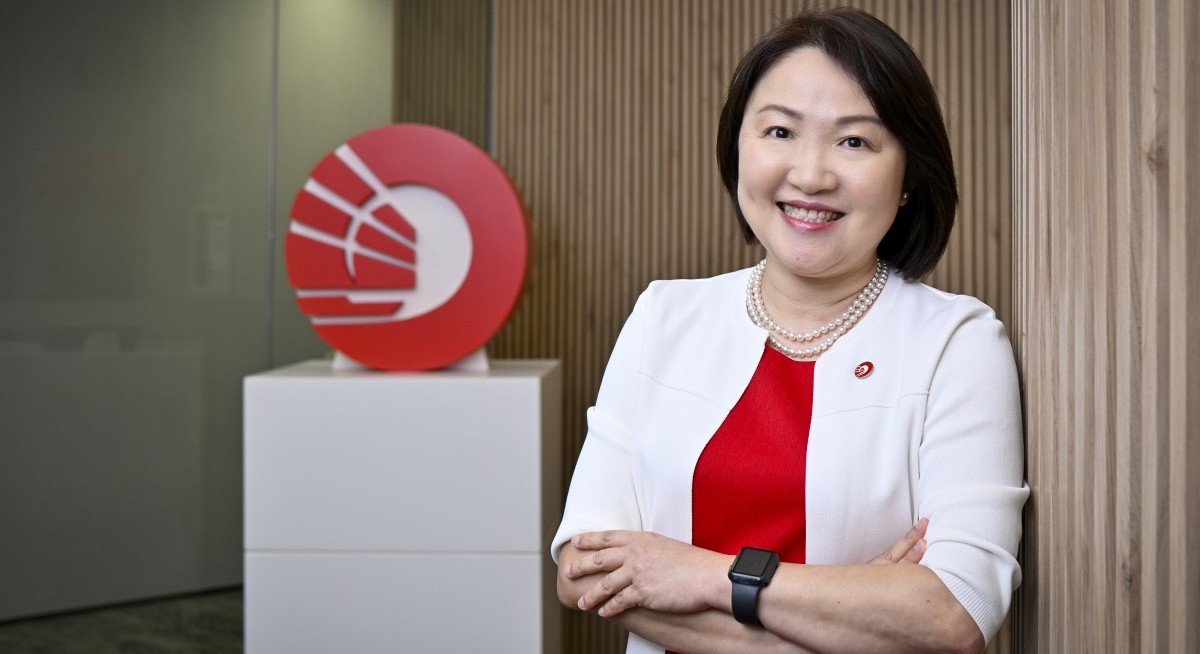


Buying a property is not like buying a dress, says Tok Geok Peng, group head of consumer secured lending at Oversea-Chinese Banking Corporation (OCBC). “I call it an episodic event; it’s needs-based. When there’s less volatility in the market, it addresses the element of fear, because buying a property can be quite daunting.”
Tok oversees home loans as part of her portfolio at Southeast Asia’s second-largest financial services group by assets. With three decades of experience in the field, Tok joined OCBC in 2023 after 28 years at DBS Bank. “What drew me was the opportunities — if you look at OCBC’s regional business, like Malaysia and Hong Kong, I think the growth potential is huge.”
Singaporeans are just as interested in owning a home today as they were in the 1990s, says Tok to City & Country. Their attitudes, however, have matured with the industry. “Many years ago, people saw buying a property as a home to provide a roof over their heads for their families. I think now, as our customers get more savvy, they see beyond a home — they see a potential investment. In fact, some customers now see buying property as a savings plan.”
Following multiple rounds of property cooling measures, Singapore’s housing market has stabilised and “is a lot more mature”, says Tok.
Compared to 6% or even 7% price growth in previous years, the overall private residential price index rose by 3.3% in 2025, she notes.
The index moderated from the 3.9% increase in 2024, with 2025 marking the smallest full-year increase since 2020, according to statistics released by the Urban Redevelopment Authority in January.
See also: OCBC boosts hiring for Indonesia wealth business as assets rise
A mature market means lesser volatility, which should inject confidence among potential homebuyers, says Tok. “Of course, it’s also good for the bank; we don’t need to worry about non-performing loans.”
Sora ticks up after Fed meeting
The Singapore Overnight Rate Average (Sora), or volume-weighted average rate of borrowing transactions, was 1.32% on Dec 31, 2025, compared to 2.31% on Dec 31, 2024. The benchmark interest rate sank below the 1% mark in early February and stayed there for two weeks, ticking up to just below 1.34% on Feb 19 after the US Federal Open Market Committee voted to keep interest rates unchanged — even warning of rate hikes if inflation persists.
See also: Local banks unaffected by revised liquidity coverage rules effective Sept 1
“Typically, in the past, we see what I call 50% pass-through from Fed action. If we see [the] US Federal Funds Rate dropping by, say, 25 basis points, we expect 50% of it to pass through into the ‘Sing-rates’,” says Tok. “When we say ‘Sing-rates’, we look at the three-month Sora, because that’s a common reference point that we use to price home loans.”
However, this “pass-through” effect has been less pronounced in recent months, notes Tok. “The ‘Sing-rate’ has softened quite a fair bit since the second half of last year; that actually has had some impact on our business.”
Already at three-year lows, some say Singapore’s home loan rates could continue to fall in 2026. The three-month compounded Sora continued to fall in February, reaching 1.133% on Feb 20.
While some may be enticed to buy a property today thanks to lower borrowing rates, Tok cautions that buying a property “is easily a 20-year financial commitment”.
“Over the next 20 years, you will have to ride through interest rates going up and coming down. So our view is, yes, while rates have come off, that shouldn’t be the single factor why you should go buy a property; it still must be needs-based,” she adds.

Fixed or floating rates?
When rates were higher back in 2024, “almost every homebuyer” opted for fixed-rate home loans, says Tok. When rates fell below 2.5% — a “hurdle” figure as the Central Provident Fund (CPF) Ordinary Account interest rate — customers began considering floating-rate loans, she adds.
One in five OCBC home loan customers financing completed properties opted for floating rates, according to Tok. “This goes back to my point that there is a lot of fear [among homebuyers]; they do want to be able to fix their monthly instalment payments, so at least there’s certainty in terms of cash flow.”
Customers on fixed rates are also asking for longer terms, from one-year tenures in the past to as far as three years today, says Tok.
Some four-fifths of OCBC’s home loan customers are financing their private residential properties, while the remaining 20% are financing their HDB flats.
OCBC launched in September 2025 a five-year fixed-rate home loan package. Between September and December 2025, one in four HDB homeowners has opted for this package.
Most of these customers have refinanced their loans from HDB, which was charging an interest of 2.6% per annum. Between 2024 and 2025, OCBC logged a tenfold increase in homeowners choosing to refinance their home loans with OCBC from HDB.
Since October 2025, OCBC has allowed customers to request to reprice their home loans via the bank’s mobile app — a first in Singapore. The application takes 10 minutes to complete — shortening what used to be a three-day wait for an offer letter to a single day.
Upskilling mortgage specialists
This conversation came about from an October 2025 announcement, where the bank unveiled its first batch of nine mortgage specialists who had completed a four-month upskilling programme. The training expanded their roles from offering only home loans to recommending a full spectrum of investment and insurance products to bank customers.

OCBC’s mortgage specialists can now “journey with the customer”, says Tok. “Customers who are buying a home — it will affect their future cash flow. Should they also be buying insurance? Those who are trying to downsize or take profit on an existing property — what should they do with the cash? These are conversations that our mortgage specialist can [discuss] with the customer.”
The mortgage specialists have also attained the Capital Markets and Financial Advisory Services (CMFAS) certification, administered by the Institute of Banking and Finance Singapore. This is required of wealth advisers — also known as relationship managers — and will validate their capabilities across portfolio management, asset allocation, client engagement and compliance.
OCBC is currently training a second batch of six mortgage specialists, who are undergoing a longer six-month programme. While OCBC declined to reveal headcount figures, the bank aims to triple the number of mortgage specialists who participate in the programme over the next two years.
Tok noted that mortgage specialists who leave the job typically become real estate agents or mortgage brokers. As such, the programme also helps in talent retention. “If you look at the service that they could offer to the customer — if we limit it to a home loan conversation — their own career growth is also limited to that point. As we enlarge the proposition of us wanting to journey with the customer, that also allows them to upskill themselves.”
Photo: OCBC




