


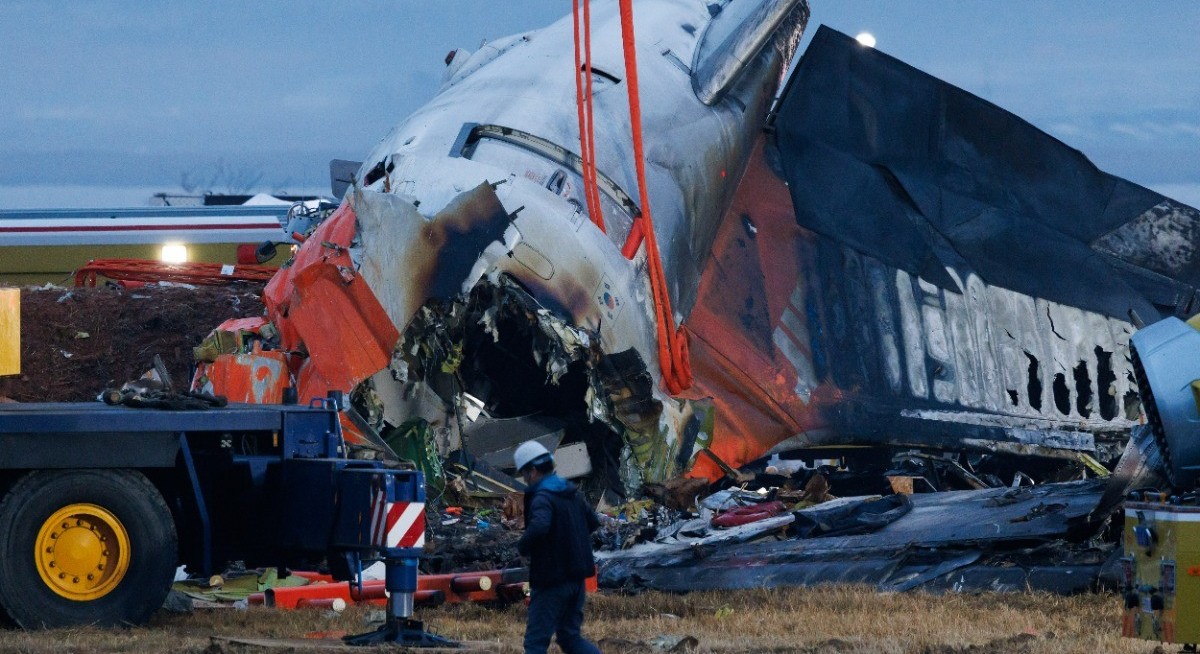


(March 11): South Korea’s deadliest aviation disaster on home soil — which killed all but two of the 181 people aboard a Jeju Air Co flight in December 2024 — was caused by cost-cutting decisions during airport construction that were concealed for 16 years, a government audit found.
The operators of Muan International Airport in the country’s southwest opted against costly ground levelling and scrapped plans to use collapsable materials for a structure housing key navigation equipment, South Korea’s Board of Audit and Inspection said in a 300-page report released late Tuesday. Instead, they built a rigid concrete wall at the end of the runway.
The Boeing 737-800, operating as Jeju Air Flight 2216, overran the runway during an emergency landing, struck the wall and erupted into flames.
Between 2008 and 2024, officials from the Ministry of Land, Infrastructure and Transport falsified documents to state that the structure was made of breakable materials, the audit found. The ministry also reduced the size of the runway end safety area in 2013 rather than remove the wall, it said.
The findings are likely to fuel fresh controversy over aviation oversight in a country long regarded as having strong air-safety standards, after an initial report in January 2025 focused on bird strikes. The crash has already prompted a sweeping review of airport infrastructure nationwide, leading authorities to revise designs and remove similar embankments at several other airports.
Calls to Jeju Air and Muan Airport went unanswered. The ministry said in a statement that it humbly accepts the audit results and is working to improve the embankments at Muan and four other airports.
See also: Boeing delays jet unit profitability goal on spirit cost
Embankment issue
A government-commissioned computer simulation released earlier this year found that the 179 passengers and crew killed in the disaster could have survived had the barrier been made of frangible materials designed to break apart on impact.
The ministry was aware that the wall didn’t comply with international recommendations requiring runway end safety areas to be free of rigid obstacles, according to the report.
See also: Emirates flying near-empty jets to Dubai as locals depart
“The Ministry of Land reduced construction costs at certain regional airports by introducing longitudinal slopes to minimise earthwork volumes,” the government’s audit said. At Muan, steeper slopes were applied to the runway and runway end safety area than are in operation at South Korea’s main Incheon International Airport, near Seoul.
This resulted in embankments rising above ground level, and concrete foundations for the localiser antennas were installed within those embankments.
A consortium operating the airport had initially planned to install a collapsable structure for the localiser system, the audit said. But by the time the airport opened in 2007, a concrete wall had been erected to elevate the equipment, which must sit higher than the runway’s highest point. Levelling the sloped terrain was deemed too expensive.
Uploaded by Chng Shear Lane




