


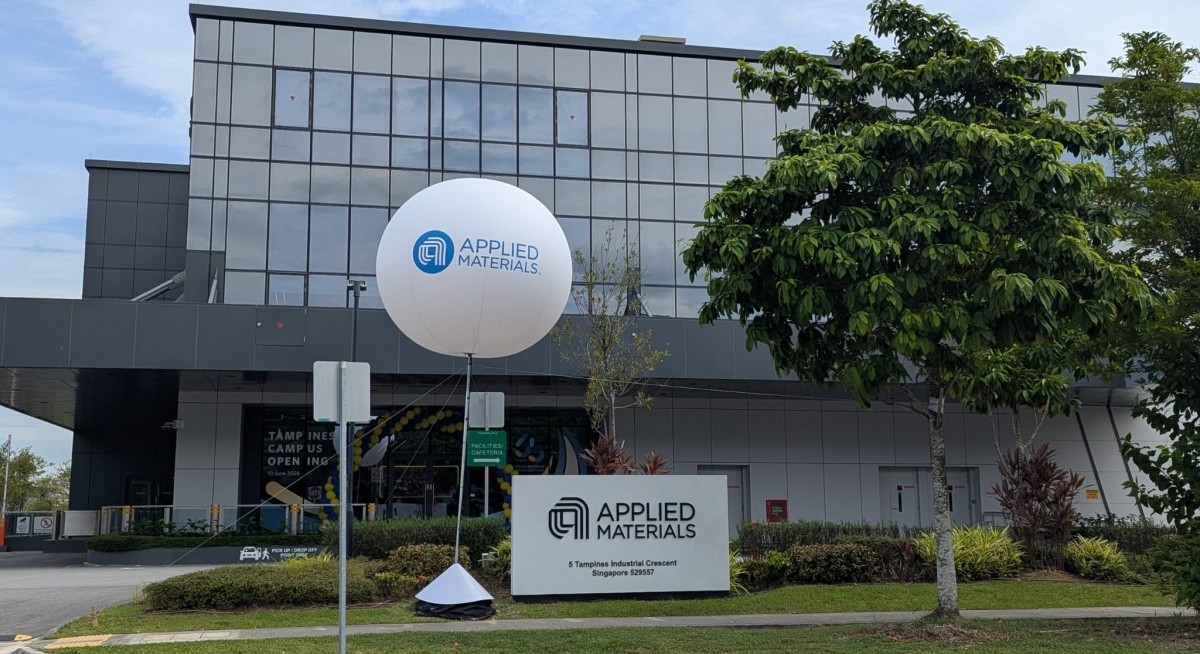


Applied Materials has opened a US$500 million ($644 million) manufacturing and research campus in Singapore to add production capacity as chipmakers expand output for artificial intelligence (AI) chips.
The Tampines Campus more than doubles the company’s advanced cleanroom capacity in the city-state and is already operating at volume production. The site will make semiconductor equipment for chipmakers expanding production to meet AI-driven demand.
As part of the expansion, Applied Materials expects to add about 1,000 local jobs across manufacturing, research and development (R&D) and field services over the next few years.
Speaking at the campus launch, Singapore’s Deputy Prime Minister and Minister for Trade and Industry Gan Kim Yong, says the roles represent more than headcount. "These are good jobs, allowing Singaporeans to work on frontier technologies and gain exposure to global operations.”
The opening strengthens Singapore’s role in Applied Materials’ global manufacturing network at a time when semiconductor equipment suppliers are under pressure to help customers bring new chip technologies to market faster. Gary Dickerson, Applied Materials’ president and chief executive officer, says Singapore and Austin, Texas, are the company’s two major manufacturing centres.
“AI is transforming every industry, creating unprecedented demand for advanced semiconductors. Our expanded manufacturing operations in Singapore strengthen Applied’s ability to deliver semiconductor manufacturing equipment that chipmakers need to bring next-generation chips to market faster,” he says.
See also: Applied Materials taps on NUS and SIT for AI chipmaking push
That pressure is not only about volume. AI chipmakers are trying to improve computing performance while reducing power use and cost, making manufacturing more complex. Dr Prabu Raja, Applied Materials’ president of the semiconductor products group, says customers are focused on power, performance and time-to-market as they move to more complex chip architectures.
To accelerate time-to-market, the Tampines Campus uses autonomous mobile robots, autonomous assembly and testing systems, AI-assisted quality inspection, as well as augmented and virtual reality tools for technician training and maintenance.
The campus is also designed to achieve Singapore’s Building and Construction Authority Green Mark Platinum Certification, the highest tier of the city-state’s green building rating system. It includes an onsite solar panel system, LED lighting, low-carbon concrete construction, a closed-loop water reclamation system for zero water waste, and a smart building management system that monitors energy and water consumption in real time.
See also: UMS plans to set up JV in Vietnam to complement existing facilities in Singapore and Malaysia
Singapore’s packaging role
The new campus is part of Applied Materials’ Singapore 2030 plan, which aims to expand its manufacturing and research capacity, broaden its local ecosystem partnerships and support workforce development.
The company has operated in Singapore for 35 years. Its local operations include R&D in advanced packaging, which is a chipmaking process that connects multiple computing components.
For instance, the company's advanced packaging development centre in Singapore works with the A*STAR Institute of Microelectronics on new materials, process technologies and integration schemes — a collaboration that has spanned 15 years and is now in its third phase. Furthermore, the company partners with the National University of Singapore (NUS) to accelerate the commercialisation of newly researched materials
He adds that customers are working with Applied Materials at the Singapore lab. Singapore also supports the company's manufacturing operations, supply chain integration, and talent development.
Gan says the wider effects matter as much as the investment itself. "When a leading global company like Applied [Materials] deepens its presence here, it creates opportunities for local suppliers, strengthens our advanced manufacturing base, and helps Singapore-based companies plug into global value chains," he says.
(Updated at 4 m to include DPM Gan's quotes)




