




For data centre developers in Southeast Asia, the focus is no longer just land, permits or tenants. We have entered what GE Vernova CEO Scott Strazik calls the ‘decisive decade’, where success will depend increasingly on execution and manufacturing throughput.
As electricity demand rises and energy security is seen as national security, operators are looking for reliable, efficient, and more flexible power. This is the operational reality that GE Vernova’s teams across the region are navigating with customers today.
Rising energy demand is also creating momentum for change. GE Vernova remains relentlessly optimistic about the future and sees gas power playing a big role in providing dispatchable and affordable electricity while helping to firm the grid and support greater integration of wind and solar. Demand from AI data centres, coal-to-gas switching, and the push to firm up renewable-heavy grids is increasing the demand for gas turbines.
While the current manufacturing context is centred on whether equipment can be built, delivered, and commissioned in time, many developers still approach power procurement as a later-stage decision.
A common challenge is linear planning. Developers often wait until the project’s Final Investment Decision (FID) before sourcing power equipment. In a context with limited manufacturing capacity, that approach can create significant delays. If a turbine order is postponed until after permitting, commissioning can already be pushed back by as much as two years or more. The cost is not only the equipment itself, but also the potentially significant loss from AI workloads that cannot operate without power.Ramesh Singaram, president and CEO of GE Vernova’s Gas Power business, Asia

He adds that growing electricity demand, driven in part by GenAI and the expansion of data centres, is accelerating new collaborations aimed at increasing dispatchable generation quickly.
Success, therefore, increasingly depends on strategic collaborations between data centre operators, utilities, and technology providers like GE Vernova to deliver innovative power solutions that support grid connectivity, smart energy management systems, and sustainable financing models.
Power generation moves into the boardroom
Electricity demand is growing three times faster than total energy demand globally, with data centres among the main drivers. In the US, they already account for roughly 60% of incremental electricity demand growth through 2030, a pattern now appearing in different parts of Asia.
Power availability is therefore strategic far beyond the data centre sector. For governments, it is now central to attract and retain hyperscaler investment. For businesses across the region, reliable and more sustainable power is starting to influence where operations are located, where crucial workloads run, and which countries can remain competitive as AI becomes embedded in daily operations.
Southeast Asia is particularly exposed to this dynamic. The region has attracted billions in hyperscaler investment over the past decade, but the power infrastructure underpinning that investment was built for cloud computing, not AI. What was sufficient for a previous generation of demand is now being tested by larger, denser, and more demanding AI workloads. The gap is widening faster than regional grid planning cycles were built to close.
Understanding why requires looking at three pressures arriving simultaneously.
The first is raw capacity: AI workloads have driven initial server rack densities far beyond conventional data centre configurations, with leading-edge AI clusters already reaching much higher levels than traditional facilities. At campus scale, that can translate into demand for more than 100 megawatts (MW), a level at which ordinary grid connections, renewable energy purchase agreements, and diesel backup systems are no longer sufficient as the primary power architecture.
The second is grid reliability: As grids in Southeast Asia absorb more solar and wind, they need more equipment to manage sudden changes in supply and demand. Without that support, networks become more vulnerable to interruptions under the large, fast-moving loads generated by AI data centres. A 100 MW data centre connected to an unstable grid is exposed to interruptions and can also place stress on the surrounding system.
AI infrastructure is, therefore, a grid-planning challenge, not a procurement matter for developers alone. These facilities are operationally unforgiving. They require ‘stability blocks’ — which may include equipment such as Battery Energy Storage Systems (BESS), Synchronous Condensers and voltage-stabilising equipment (known as STATCOMs), among other solutions — to manage bursty, unpredictable load swings that traditional grids were not engineered to handle.
The third is decarbonisation*: Tech giants have pledged to match rising electricity use with more sustainable power. During the first wave of data centre growth, many large hyperscalers connected to the grid and relied on relatively simple backup generators, typically driven by diesel. With AI coming into play, they need more power, stronger resilience, and facilities that can adapt over the long term.
To meet the growing energy needs of both data centres and traditional industry while reducing carbon emissions, operators have been shifting from carbon-intensive conventional sources, such as coal and liquid fuels, to lower carbon power generation such as natural gas, ideally with hydrogen capability — alongside renewables and energy storage technologies such as BESS. The more durable answer is to reduce the carbon intensity of the power stack itself, either by hybridising gas generation with renewable assets or by transitioning gas turbines progressively to hydrogen blends as supply becomes available.
GE Vernova anticipated this new set of demands years ago and has continued to invest in expanding its manufacturing capabilities. That investment matters now more than ever, because the challenge is no longer only technical — it is also one of scale, speed and execution. In this moment, GE Vernova believes it is uniquely positioned to be a leader.
With one of the largest dispatchable power businesses in the world, GE Vernova has a platform that can fuel success. The company is seeing strong interest in new gas build because the system is increasingly requiring a level of reliability that few technologies other than gas can provide.
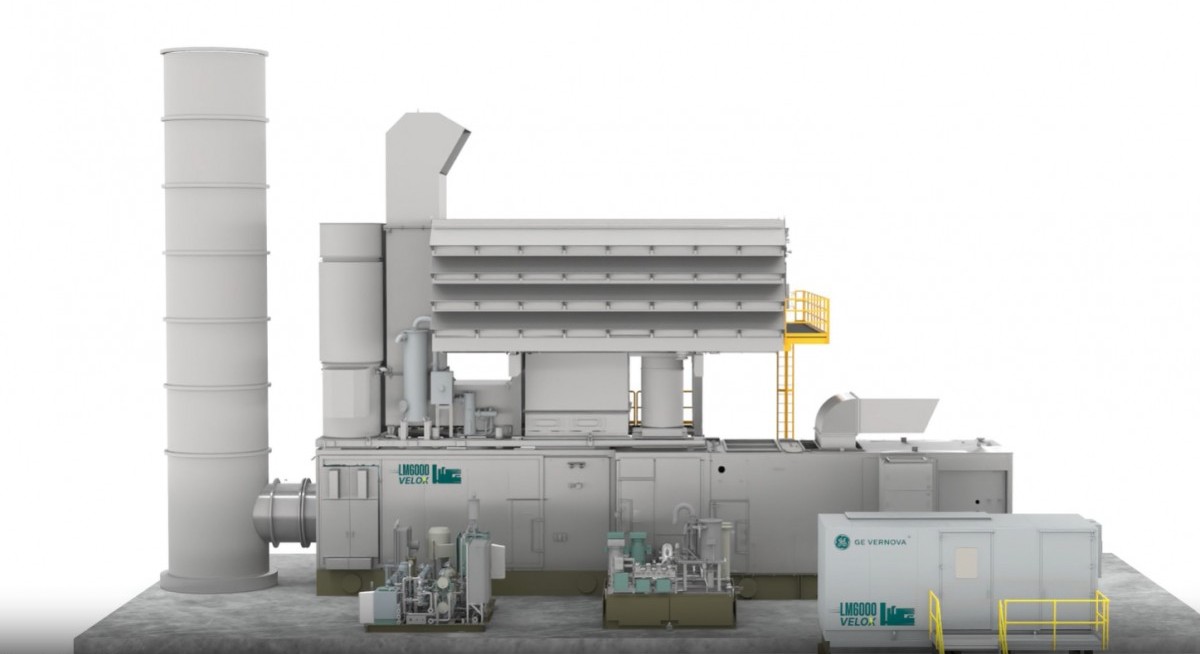
In West Texas, for example, GE Vernova is provisioning LM2500XPRESS** aeroderivative natural gas turbines for a data centre project outside Abilene. These units are modular, fast to install, fuel flexible and well-suited to environments where speed matters. In some settings, they can even be mobile.
A single LM2500XPRESS aero unit with around 35 MW can replace 11 or 12 diesel generator sets, according to a GE Vernova white paper titled The Data Centers AI and ML Trilemma.
Making this one change will enable data centres to save on emissions, real estate, switchgear, transformers, and their overall footprint. By building in such robust backup to each data centre’s capability, an array of aeroderivative turbines can reach the critical mass needed to run AI computing entirely off the grid or even sell power back to the grid. “This is the evolution we are experiencing, along with our customers, to enable future growth,” says Singaram.
While natural gas contributes to carbon emissions, it remains a lower-carbon option than coal and can play an important role in supporting the expansion of renewables over the long term.
The instinctive response is to address these challenges in sequence: secure capacity first, strengthen the grid later, and address emissions when budgets allow. GE Vernova notes that the pace of this approach may not fully align with the scale of AI demand now coming into the region. Power systems for AI must be engineered from the start to deliver firm capacity, grid stability and a lower-carbon future together.
Powering the full stack
GE Vernova’s strategy reflects that thinking. It covers firm power generation, grid stabilisation and facility-level electrification within a single OEM system. By putting the full power stack under one provider, developers can reduce integration risk, schedule exposure and accountability gaps across a mission-critical system. Its validated reference architectures are engineered to help complex systems perform under unpredictable AI load swings, too.
GE Vernova’s aeroderivative gas turbine solutions are the firm-power anchor of that system. They can reach full load in under five minutes, replace banks of diesel generators with a smaller physical footprint, and are already capable of operating on hydrogen blends of up to 100%. For developers making 20-year infrastructure commitments, this matters because the same core asset can support near-term capacity needs while keeping open a route to cleaner fuel as carbon pricing develops.
Meanwhile, the microgrid component links reliability and decarbonisation goals. GE Vernova’s architecture allows renewable assets to run at full capacity while gas turbines firm the output when renewable supply falls short. This can deliver a lower blended cost of electricity than either technology achieves on its own.
GE Vernova is also positioned to support the transition to carbon-free baseload as conversations about small modular reactors accelerate across the region. While Canada and the US are the first movers, countries like Malaysia, Singapore, Vietnam, Thailand and the Philippines are actively exploring nuclear timelines. A realistic pathway to first power involves deploying generation-three-plus models like GE Vernova’s BWRX-300, which can offer the level of reliability AI infrastructure requires.
Local footprint, strategic execution
GE Vernova’s regional footprint strengthens its ability to deliver. The company employs more than 18,000 people across 22 countries in Asia. Its regional footprint includes a Singapore repair hub for high-efficiency air-cooled (HA) gas turbines, a tooling centre in Port Klang and a Vietnam facility that manufactures Heat Recovery Steam Generators (HRSG), which use waste heat from gas turbines to help produce additional power.
It also has more than 1,000 gas turbines installed across the region, often supported by long-term service agreements. This matters for data centre operators because reliability depends as much on maintenance, response time and operating history as it does on the equipment itself. GE Vernova’s technology generates roughly 30% of the total power in many countries such as Malaysia, Indonesia and Vietnam, providing the deep ‘installed base’ data needed to improve data centre uptime.
Two projects show what execution looks like at this scale. In Vietnam, Nhon Trach 3 and 4 are the country’s first LNG facilities, requiring regasification, generation and grid connection to be coordinated in a country still building that capability.
In Singapore, GE Vernova is delivering a 9HA-class plant for YTL PowerSeraya that is engineered for future 100% hydrogen operation. The project shows how firm power can be built with a more sustainable future fuel pathway from the start.
For developers and governments evaluating their options, Singaram distils the advice into two steps: “First, move from a transactional mindset to an infrastructure collaboration mindset. Second, secure your manufacturing reservation agreement immediately. If you wait another 12 months, you aren’t just delaying your project — you are likely behind some other company that secured their power assets while the queue was still open.”
*Decarbonisation as used in this article is intended to mean the reduction of carbon emissions on a kilogram per megawatt hour basis.
**Trademark of GE Vernova and /or its affiliates.




