


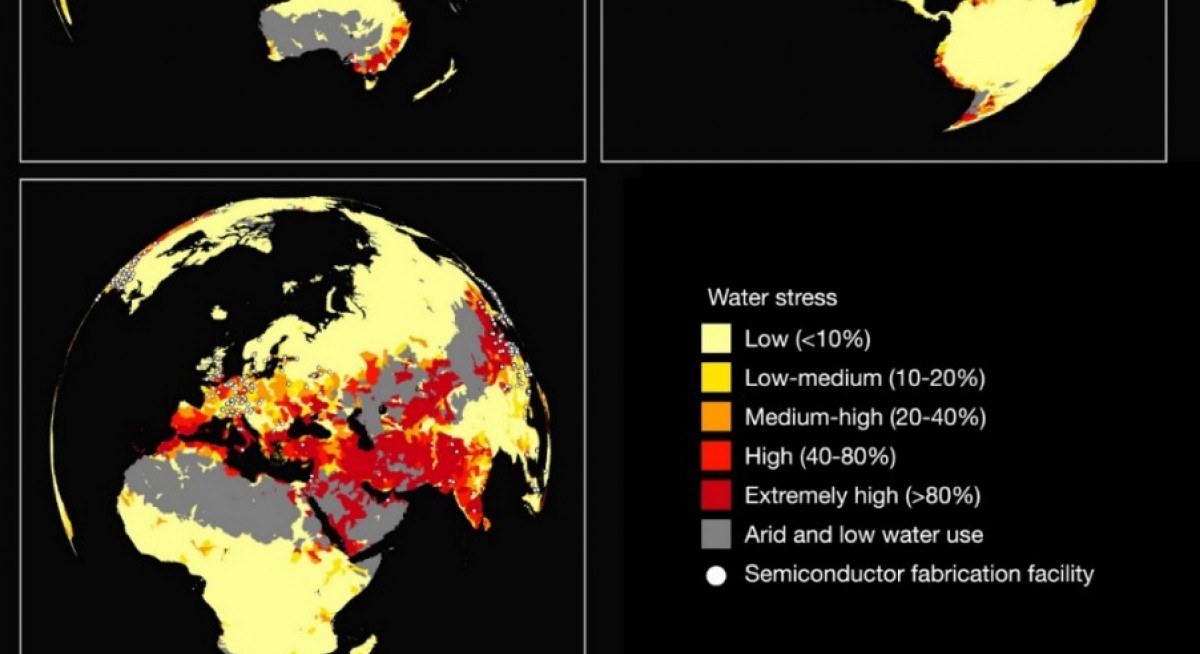


According to a new case study by the Taskforce on Nature-related Financial Disclosures (TNFD), 40% of existing microchip fabrication plants (fabs) and over 40% of new fabs announced since 2021 are projected to be in basins with high or extremely high risk of water stress by 2030.
Data centre operation is very highly dependent on water supply, reads a line from TNFD’s 19-page case study, released in early February. “Water is used directly for on-site cooling and humidification, with many data centres relying on chilled air or water systems in which heat is rejected through evaporative cooling.”
A typical data centre can use 25 million to 770 million litres of water per year (depending on size), while hyperscale facilities may exceed 2 billion litres annually.
In 2023, data centres in the US consumed an estimated 66 billion litres of water, roughly equal to the annual domestic water use of Santa Barbara, California.
See also: TNFD adopters Frasers Property, Seatrium disclose nature-related issues in sustainability reports
Microchip manufacturing is even more water-intensive. Between 2012 and 2022, water use across the semiconductor industry doubled, driven by increased production and demand for advanced microchips.
A single fab can consume around 14 billion litres of ultrapure water (UPW) per year, which is used to repeatedly rinse silicon wafers and ensure they are free of impurities. For every unit of UPW, 1.4 to 1.6 units of municipal water are used.
Globally, the semiconductor industry consumes as much water as a city of 7.5 million people, like Hong Kong.
See also: Singapore targets stronger business competitiveness and value unlocking with listcos
Spotlight on Northeast Asia
Policy incentives, access to cheap, reliable energy and large, seismically-stable areas of land have meant that many microchip fabs happen to be located in water-stressed areas, says TNFD, which is funded by a global coalition of governments and philanthropic organisations like The Rockefeller Foundation.
In Taiwan, industry giant Semiconductor Manufacturing Company (TSMC) accounts for over 60% of global fabrication revenues and 90% of revenues for advanced microchips, with Apple and Nvidia its two largest clients.
Taiwan depends on seasonal typhoons for 70% of its rainfall. However, during the 2020-2021 season, no typhoons made landfall, leading to the most severe drought since 1964 and causing reservoirs to drop below 5% capacity.
Faced with a 15% restriction in water supply, TSMC put aside NT$800 million ($32.2 million) for water trucks to maintain microchip production — 60% over its emergency water truck budget.
Since 2019, Chinese companies have invested over US$63 billion ($79 billion) in 73 fabs, supported by government subsidies. Many fabs are located on the east coast or northern industrial regions of mainland China, which already experience water stress and pollution. This limits the usability of groundwater for an industry that consumes approximately 27% of the total industrial water use in mainland China.
Over in South Korea, microchips are the nation’s largest export. Leading manufacturer Samsung consumes 344,000 tonnes of water per day. The country’s dependence on a small number of river basins increases its vulnerability to drought-related disruptions, says TNFD.
Combined impact
Microchip production and data centre operation have high rates of water withdrawal and consumption. Together, their impact is magnified when using water from the same basin.
Over two-thirds of data centres built in the US since 2022 are in areas of high water stress, with the majority (72%) in a few states, notes a May 2025 Bloomberg report.
Arizona, a predominantly arid, landlocked state in the Southwest US, for example, has about 146 data centres and eight operational fabs.
In the US, data centres run by companies for their own use (internal) dominated the landscape in 2014 and had the largest water consumption. The trend has shifted to most water being consumed by colocation centres (leasing services for companies to host their hardware off-site) and hyperscale centres (large-scale facilities operated by major technology companies such as Microsoft, Google and Amazon).
Hyperscalers are expected to consume 60 to 124 billion litres of water annually by 2028, according to the 2024 United States Data Center Energy Usage Report. For scale, Singapore consumes roughly 2 billion litres of water per day.
In the western US, water pricing and supply are governed by a complex set of arrangements, says TNFD. Water from the Colorado River basin is allocated among seven states under a framework of laws and agreements known collectively as the Law of the River, resulting in “significant disparities” in water pricing, adds TNFD.
Some districts in California pay up to seven times more for water than those in Arizona. Reforms to water pricing have been recommended as a means of incentivising conservation and could expose semiconductor fabs and data centres in the region to policy risk.

Response strategies
Next-generation data centres used by Microsoft and the public-private venture Stargate are integrating cooling systems that do not use evaporation; instead, they circulate water between servers and chillers through a closed loop. Microsoft reports this system saves 125 million litres of water per data centre annually.
TSMC recycles up to 85% of water in its Taiwan fabs. Treatment techniques include chemical precipitation, membrane separation, reverse osmosis and evaporation.

Investing in water recycling can reduce costs; according to industry association Water Europe, EU fabs could save over EUR1 billion ($1.4 billion) annually by investing in advanced recycling and purification technologies.
In 2024, TSMC signed an agreement to purchase 45,000 cubic centimetres of desalinated water per day from government-backed plants to alleviate pressure on Taiwanese watersheds. While desalinated water is an increasingly important part of the water mix supplied to fabs, desalination has high capital and operating costs, energy use and impacts on the marine environment, notes TNFD.
To achieve its 2030 water target, Intel funds community projects for water restoration and offsetting, such as rainwater harvesting, wetland and forest restoration, wastewater reclamation and agricultural conservation.
As of 2023, Intel claimed to have achieved its goal in the US, India, Costa Rica and Mexico, restoring over 3.1 billion gallons of water. However, reliance on offsets has been criticised for lacking transparency and measurable impact. Also, offsets do not necessarily restore water to the source from which it has been lost, notes TNFD.
The TNFD published in September 2023 its recommendations for disclosure of nature-related issues. The market-led initiative is now accepting feedback via its website on its final sector guidance for companies in the technology and communications sector, which it will issue by June 30.




