




Concrete underpins modern life as a key material in our built environment, from the buildings we live and work in to the roads and infrastructure we rely on every day. And because of the scale of its use, there is now “increasing pressure” to reduce the carbon footprint of concrete, says Clarisse Loh, director of sustainability at YTL Cement Group.
These “innovative” building materials promise lower embodied carbon — or the total greenhouse gas emissions generated from manufacturing, transporting, constructing and disposing of building materials — among other benefits. Sustainability, however, is not the only consideration when assessing alternatives, adds Loh at The Edge Singapore’s Sustainable Construction Symposium 2026 on April 29.
In her presentation to nearly 260 built environment professionals, Loh says that sustainable materials coming to market, such as blended cement and limestone calcined clay cement (LC3), are also judged for their performance and constructability.

These alternatives must be strong, have a long service life and be consistent in quality. They must also be fast and easy to install, with labour-saving and/or cost-effective benefits.
“Sustainability alone is not sufficient, because for a material to really qualify as a sustainable building material, we have also to consider its performance; it has to be fit for safe and durable construction,” Loh explains. “[It also] has to be suitable for construction use.”
See also: More Singapore residents target more than $1 mil and retirement in their 40s: CIMB-NTU study
Presently, the combination of concrete with blended cement and admixtures offers the best overall balance, according to Loh. Admixtures are additives added during concrete mixing to enhance specific properties of the fresh or hardened concrete. Fly ash, silica fume and ground granulated blast-furnace slag are some examples of additives used to increase the durability of concrete.

Beyond the materials themselves, new industry practices are also helping to drive sustainability efforts. The increasing “industrialisation of construction” means factory-based production is replacing cast-in-situ, says Loh. This refers to concrete that is poured, formed and cured directly at its final location.
See also: Global fragmentation drives flows to Asean
“With factory-based production, there’s better quality control. At the same time, some of those [alternative] materials — while they are not so suitable for cast-in-situ uses, they are possible when used in factory-based production,” says Loh.
Higher-strength concrete can even be thinner than regular slabs, allowing engineers to optimise structural design and reduce overall material use — reducing total embodied carbon.
The politics of it all
With the Trump administration rolling back support for renewables and climate change pacts, where is corporate sustainability headed, asks Loh. “The fact is, we still see that fundamental demand for sustainability will still be there, because everyone still wants materials that are lower in embodied carbon; we still want materials that enable us to reuse, to enable circularity; we still want to have materials that enable us to reduce waste. So, that means there will still be a lot of focus on developing new products that will meet these criteria.”
On a subsequent panel moderated by Au Foong Yee, editor emeritus at The Edge Malaysia, one panellist says the political impact of the Trump administration in the US “was a big knock-back to the whole climate change” momentum.
“But I’m quite hopeful,” adds Tan Loke Mun, the Malaysia-based founder of DTLM Architect. “I’m actually a ‘MUAGA’ supporter: Make Us All Green Again. I think that’s the only way forward.” Tan also served as the president of the Malaysian Institute of Architects (PAM) from 2005 to 2007.

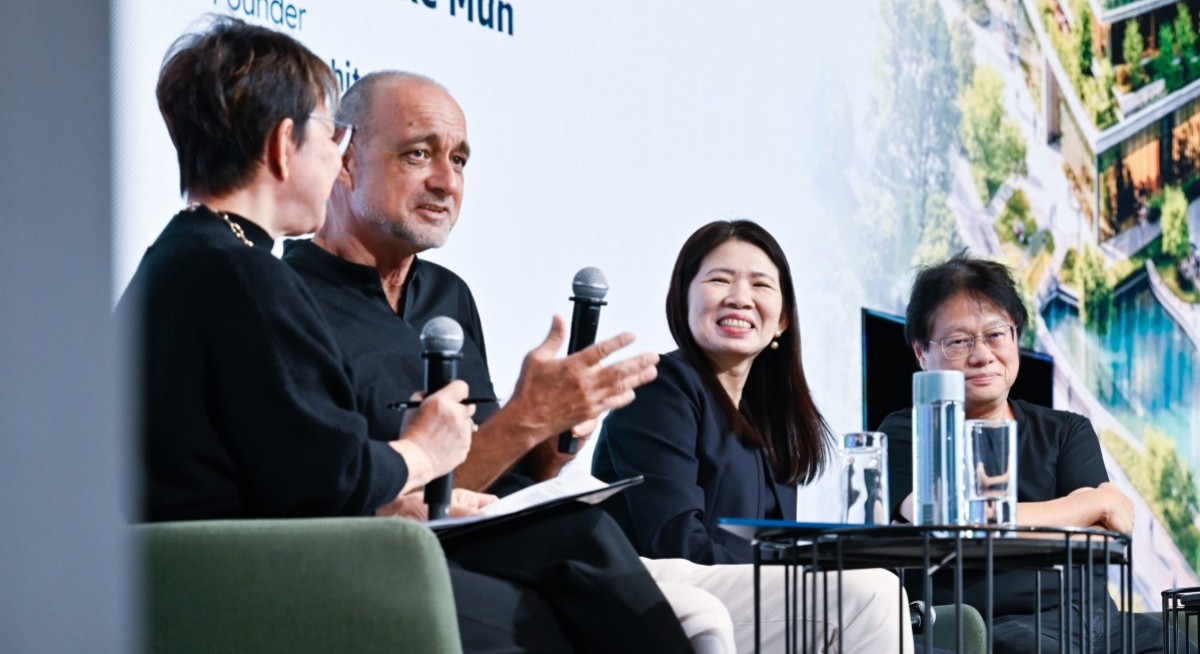
From left: Panel moderator Au Foong Yee, editor emeritus at The Edge Malaysia; Markus Roselieb, founder of Chiangmai Life Architects and Chiangmai Life Construction; Clarisse Loh, director of sustainability at YTL Cement Group; and Tan Loke Mun, founder of DTLM Architect
The panel also explored alternatives outside of concrete. Markus Roselieb, founder of Chiangmai Life Architects and Chiangmai Life Construction, showcased his firm’s award-winning Bamboo Sports Hall project in Chiang Mai’s Panyaden International School. Completed in 2017, the hall is covered by bamboo trusses measuring 17m. The 782 sqm space hosts courts for basketball, volleyball, badminton and futsal.

“[Bamboo] has a higher tensile strength than steel. It is lightweight, so I can design things with this material that simply cannot be designed with steel, because steel would make it too heavy,” says the Austrian self-taught architect.
Unlike steel, which is susceptible to supply chain pressures and trade crises such as the ongoing Strait of Hormuz blockade, bamboo is native to the tropical region and costs are more stable. “I’m not a proponent of war, so I’m always glad if these things are over,” says Roselieb. “What’s interesting in this world is that a guy who is totally against sustainability gave sustainability such a boost.”
Roselieb says the sustainability features in his firm’s work are just “icing on the cake”. “For me, it was never my initial idea to go into this material. My idea is always functionality; as an architect, you start with that. I just was so convinced that this material is superior because it’s lighter, stronger and more beautiful.”

Tan, who identifies as a “great proponent and promoter of bamboo”, says Roselieb’s work “will become very relevant in the years to come”. “I think when SpaceX lists in July, this guy will be highly sought after, because there’s no rot in space and there is no gravity in space… [Bamboo] grows one foot a day in the right climate. All you need to do is put it in a tube, put a light at the top and feed it with fertiliser. Six months in space — and you have [bamboo as strong as] a steel tube.”
Calling for the bill
Are sustainable alternatives typically more expensive than regular products? Loh offers her perspective. “When we choose a healthier lifestyle, we say we want to buy organic [products]. [Going] organic costs more because it costs more to produce,” she adds. “When we want to be fitter, like I did last year, I signed up for physical training, and that cost me more money, but I like the result.”
Similarly, because of how certain materials are produced, their production costs are higher, says Loh. “As a result of that, you find that certain choices are higher in terms of their price per unit. But I think we should not be comparing on that basis alone. What do we want to achieve with that alternative… It’s really about choosing the right materials, doing it the way that will give you the best result, not merely on a price-per-tonne basis.”
Architects may wish to stuff their projects with cutting-edge materials and boast of sustainability feats, but are clients willing to pay? Tan says: “My clients come to me because I do green architecture; they expect that.”
According to Tan, his clients “actually save a lot of money”. His work emphasises architecture itself as the design, shunning bright paint and other ornamental finishes. “I don’t believe in decorating the building; I believe that the architecture is the structure, and I think that’s where it should be heading to… My buildings, especially private houses, sometimes cost half as much as those by some other architects. I get a bad name out there because I quote [lower] construction costs [compared to] other architects.”
Photos: Albert Chua/The Edge Singapore
Infographics: YTL Cement Group
Read more from The Edge Singapore’s Sustainable Construction Symposium 2026:
- New mindsets and materials for sustainable construction in focus at The Edge Singapore’s symposium
- BCA sharpens focus on Super Low Energy Buildings in decarbonisation push
- Coffee or kopi? Contractors aboard sustainability bandwagon, but standards should harmonise: SCAL president
- Vietnam’s MIA Design Studio showcases projects at the nexus of architecture, climate and landscapes
- Unlocking built environment opportunities in the green transition
Read more in our curtain-raisers prior to the symposium:
- Solving the ‘quadrilateral’ dilemma of cost, deadlines, quality and sustainability in construction
- Concrete, bamboo and clay: How future building materials can be more sustainable
- MIA Design Studio exemplifies Vietnam’s cultural identity and environmental sensitivity
- YTL Cement balances business, sustainability and ecosystem-building
- Transforming Singapore’s construction industry through mindsets, innovation and value creation




