




The built environment is undergoing one of its most significant transformations in decades, says YTL Cement Group executive director Michelle Yeoh. “The question is no longer whether the green transition will happen, but how quickly, and how effectively, we can deliver it.”
Speaking at The Edge Singapore’s Sustainable Construction Symposium 2026 on April 29, where YTL Cement is the event partner, Yeoh says Singapore stands as one of the world’s leading examples of sustainable urban development.
After three successful runs in Malaysia, YTL Cement has brought its annual symposium to Singapore. “This move to Singapore is both a natural progression and an important step forward,” says Yeoh to nearly 260 industry professionals at Pan Pacific Orchard, Singapore.

In her welcome speech, Yeoh says YTL Cement has a “long-established presence” in Singapore through several of its businesses, including YTL Cement Singapore, NSL, Alliance Concrete, Jurcem, NSL OilChem Waste Management and Eastern Pretech.
“Together, these companies support the construction value chain — from cement, aggregates and ready-mixed concrete to industrialised building systems and responsible waste management,” adds Yeoh. “Over the years, we have contributed to many of Singapore’s key developments, including [the Resorts World] Sentosa integrated resort, East Coast Integrated Depot, Deep Tunnel Sewerage System Phase 2 and Tekong Polder.”
See also: Solving the ‘quadrilateral’ dilemma of cost, deadlines, quality and sustainability in construction
Sponsored by YTL Cement, the symposium series will continue to evolve across the region, says Yeoh. The Edge Malaysia and YTL Cement’s Sustainable Construction Symposium will return for a fourth edition this August, this time in Kuching, Sarawak. “We hope these platforms will continue to strengthen dialogue and collaboration across the construction industry,” she adds.
Balancing competing priorities
Buildings contribute about 20% of Singapore’s carbon emissions, and green buildings can contribute a “big part” in our transition to a low-carbon and climate-resilient future, says Ang Kian Seng, group director of environmental sustainability at the Building and Construction Authority (BCA).
See also: Concrete, bamboo and clay: How future building materials can be more sustainable
Singapore’s climate actions take into account realities while balancing competing priorities, adds Ang, delivering the symposium’s first presentation. According to the Singapore Green Building Masterplan 2021, Singapore is aiming for “80-80-80 by 2030” — namely to green 80% of buildings by 2030, certify 80% of new developments with the Super Low Energy (SLE) standard from 2030, and improve energy efficiency by 80% from 2005 for best-in-class buildings by 2030.
As at January, about 66% of Singapore’s buildings (by gross floor area) have been greened, while 33% of new buildings have been certified SLE, and best-in-class buildings are 72% more energy-efficient compared to 2005 standards.
BCA’s Green Mark building certification scheme, which assigns ratings like Green Mark Platinum with SLE, was last refreshed in 2021. According to Ang, BCA is in the process of refreshing the scheme, and the seventh edition will be unveiled in September.

“We heard [from] the industry that the standards have been ratcheted up rapidly over the years,” says Ang. “So this round, what we will plan to do is to make sure the standards stay the same but there are opportunities for the frontrunners to aim higher.”
Does BCA have any plans or schemes to encourage adaptive reuse or refurbishment over newbuilds? Responding to this audience question, Ang says there is a “huge stock” of “highly-valued historical [and] cultural buildings”. “The idea is to see how we can keep them. I think in the end, we need to balance economic versus some of these other considerations.”
Ang adds: “In my own personal opinion, sometimes I think it’s better to rebuild because you have a clean slate to improve the energy performance of the building. And I think one of the other reasons for newbuild is because the density in the past may not be the same as what we can afford now. If you can increase the density of the developments, actually, you kind of preserve some of the forested area in Singapore.”
See also: YTL Cement balances business, sustainability and ecosystem-building
Meanwhile, BCA is keeping its construction demand outlook for 2026 unchanged at between $47 billion and $53 billion, despite the outbreak of war in the Middle East. “For now, there is no revision,” says Ang.
The bulk (32%) of this year’s construction demand is expected to come from the institutional segment, with likely major projects like the Changi Airport Terminal 5 development, the Marina Bay Sands expansion and the New Tengah General & Community Hospital.
Singapore’s built environment sector is set to maintain its momentum in 2026, says BCA, with the 2026 forecast range unchanged from that of 2025. As at end-2025, preliminary actual construction demand reached $50.5 billion in nominal terms, within BCA’s earlier forecast of $47 billion to $53 billion.
Leave no SME behind
Today, markets are very demanding and regulatory requirements are rising, says Lee Kay Chai, president of the Singapore Contractors Association Limited (SCAL). “Our BCA colleagues have just showcased all the requirements in terms of Green Mark requirements, as well as the kind of decarbonisation effort that we need to do.”
The industry needs a mindset shift, says Lee, “from treating sustainability as a compliance exercise to embracing it as a business imperative”. Since January 2025, Singapore has implemented a policy where up to 5% of tender evaluation criteria for public sector projects are dedicated to environmental sustainability.
Most small- and medium-sized enterprises (SME), like subcontractors, do not have a dedicated team to manage sustainability issues and carbon accounting frameworks, notes Lee in his presentation. “Smaller firms risk being left behind.”

Hence, the transformation of the built environment industry requires active alignment from every stakeholder in the ecosystem, says Lee, in order to become “more sustainable, more resilient and more competitive”. “Collaboration must begin upstream at the design stage — consultants, engineers and architects must embed their green requirements from day one, not retrofit at the end of the projects or during handover.”
This must also extend across the supply chain, so that the green transition does not stop at the main contractor level, but flows all the way down to every subcontractor and every supplier, adds Lee. “It must be strengthened across the industry and with [the] government, so that policies, procurement frameworks and incentives are coherent, calibrated, fair and forward-looking… Together, we can build a construction industry that is more sustainable, more resilient and more competitive.”
Architect showcase
Presenting on their respective projects in Vietnam and Thailand were Nguyen Hoang Manh, founder and principal architect of MIA Design Studio; and Markus Roselieb, founder of Chiangmai Life Architects and Chiangmai Life Construction.
Nguyen, whose home country is undergoing one of the fastest-growing developments in the region, is responding to high density in residential and commercial areas by designing with nature and the surrounding environment in mind.
MIA Design Studio’s residential, hospitality and public space projects accentuate their immediate surroundings instead of resisting Vietnam’s tropical climate.
In 2025, MIA Design Studio racked up a handful of awards for The Park, a quintet of community centre buildings that emerge from rice fields in Vietnam’s Nghe An Province. The grass-covered facade of the development visually connects the architecture with the surrounding gardens. This allows the building to almost disappear into the landscape when seen from a distance. At the same time, the green roof helps reduce heat gain and creates a cooler microclimate for the public spaces below.
The Lotus Clubhouse, another project by MIA Design Studio, combines green landscape surfaces, concrete roof structures and transparent glass facades to create a building that is both environmentally responsive and visually connected to its surroundings.
“Vietnam is going to be a testbed [of] whether Asia accepts climate change or we have totally turned away from it, because that country is developing at such a place — you wouldn’t believe it,” says Tan Loke Mun, the Malaysia-based founder of DTLM Architect.
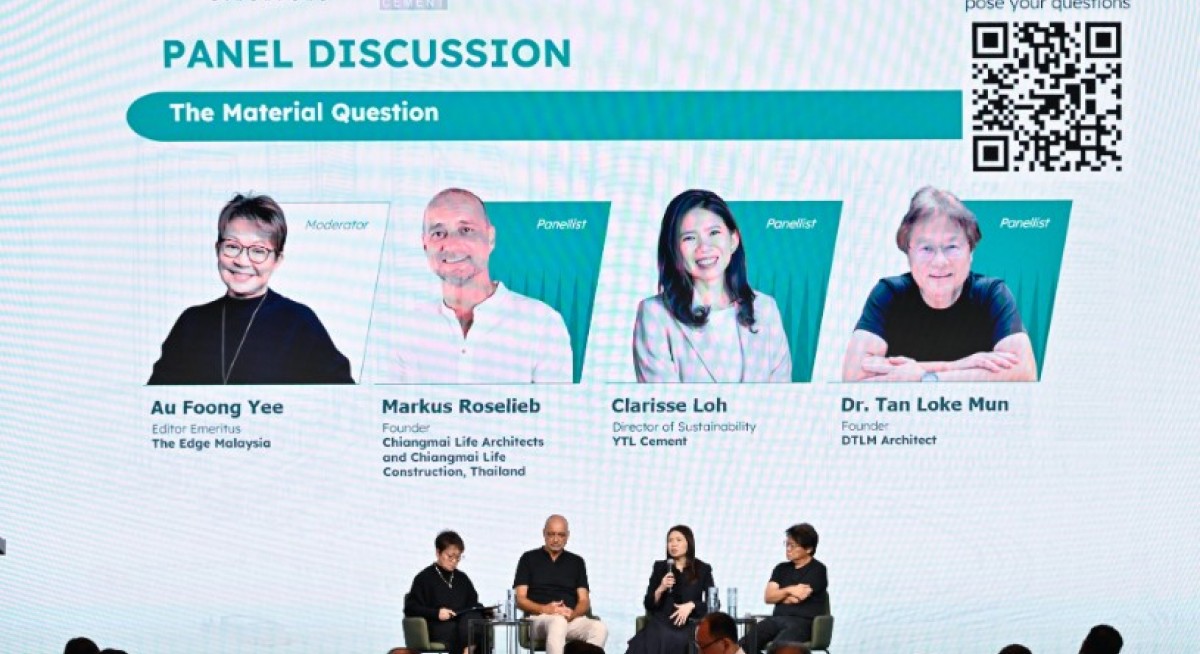
Speaking on a subsequent panel moderated by Au Foong Yee, editor emeritus at The Edge Malaysia, Tan says the political impact of the Trump administration in the US “was a big knock-back to the whole climate change” momentum.
“But I’m quite hopeful,” says Tan, who was president of the Malaysian Institute of Architects (PAM) from 2005 to 2007. “I’m actually a MUAGA supporter: Make Us All Green Again. I think that’s the only way forward.”
Meanwhile, Roselieb showcased his firm’s award-winning Bamboo Sports Hall project in Chiang Mai’s Panyaden International School. Completed in 2017, bamboo trusses measuring 17m span the 782 sqm hall, which hosts courts for basketball, volleyball, badminton and futsal.

“It has a higher tensile strength than steel. It is lightweight, so I can design things with this material that it simply cannot design with steel, because steel would make it too heavy,” says the Austrian self-taught architect.
Tan, who identifies as a “great proponent and promoter of bamboo”, says Roselieb’s work “will become very relevant in the years to come”. “I think when SpaceX lists in July, this guy will be highly sought-after, because there’s no rot in space and there is no gravity in space… It grows one foot a day in the right climate. All you need to do is to put it in a tube, put a light at the top and feed it with fertiliser. Six months in space — and you got a steel tube.”
Making the case for concrete and precast tech
In their respective panels, Clarisse Loh, director of sustainability at YTL Cement, and Matti Mikkola, group CEO of Eastern Industries, made their case for concrete as the dominant building material today.
That said, there are ways to ensure concrete use can be more sustainable now and in the future.

Advances in cement and concrete formulations can reduce embodied carbon while maintaining structural performance, says Loh. Higher-strength concrete can even be thinner than regular slabs, allowing engineers to optimise structural design and reduce overall material use.
But why are the prices of sustainable alternatives typically higher than those of regular products? Loh offers a different perspective.
“When we choose a healthier lifestyle, we say we want to buy organic [products]. [Going] organic costs more because it costs more to produce,” she adds. “When we want to be fitter, like what I did last year, I signed up for physical training, and that cost me more money, but I like the result.”
Similarly, because of how certain materials are produced, the cost to produce such materials is higher, says Loh. “As a result of that, you find that certain choices are higher in terms of their price per unit. But I think we should not be comparing on that basis alone. What do we want to achieve with that alternative… It’s really about choosing the right materials, doing it the way that will give you the best result, not merely on a price-per-tonne basis.”
Approaches such as Design for Manufacturing and Assembly (DfMA) and other industrialised construction systems allow building components to be manufactured in controlled environments before being assembled on-site with greater precision.
“Within the very well-controlled production environment, we can concentrate on developing the concrete, we can concentrate on embodying less carbon and that, obviously, then also leads to durability, so building lifespan also increases,” says Mikkola.

Joining Mikkola on a panel moderated by Goola Warden, executive editor of The Edge Singapore, were Farizan d’Avezac de Moran, board member of the Singapore Green Building Council; Tan Sew Guan, executive director, RSP Architects Planners & Engineers; and Dharmasurendranath Tharmasirirajah (Suren), project director, Kajima Corporation.
“When we have conversations about sustainability, it’s fundamentally different, right?” says Suren. “In the past, we spoke about green buildings [like] it was a choice, but now with the carbon tax at, I believe, around $45 per tonne [of carbon dioxide equivalent], and it’s on the rise. Green buildings are no longer a choice, so we construct buildings in order to fulfil these requirements.”
Despite political pressure in the US, the green movement “has been so much stronger than it ever was” in this region, says Mikkola — “and that has continued”. “I think we’re diverging — let’s put it this way — from many of the things that the US is doing currently; Europe and Asia are moving in a different direction.”
With the Singapore Green Building Council as knowledge partner for the event, the Sustainable Construction Symposium 2026 offered attendees four Continuing Professional Development (CPD) credits each.
Photos: Albert Chua/The Edge Singapore
Read more from The Edge Singapore’s Sustainable Construction Symposium 2026:
- BCA sharpens focus on Super Low Energy Buildings in decarbonisation push
- Coffee or kopi? Contractors aboard sustainability bandwagon, but standards should harmonise: SCAL president
- Vietnam’s MIA Design Studio showcases projects at the nexus of architecture, climate and landscapes
- Are sustainable building materials better and cheaper?
- Unlocking built environment opportunities in the green transition
Read more in our curtain-raisers prior to the symposium:
- Solving the ‘quadrilateral’ dilemma of cost, deadlines, quality and sustainability in construction
- Concrete, bamboo and clay: How future building materials can be more sustainable
- MIA Design Studio exemplifies Vietnam’s cultural identity and environmental sensitivity
- YTL Cement balances business, sustainability and ecosystem-building
- Transforming Singapore’s construction industry through mindsets, innovation and value creation




