


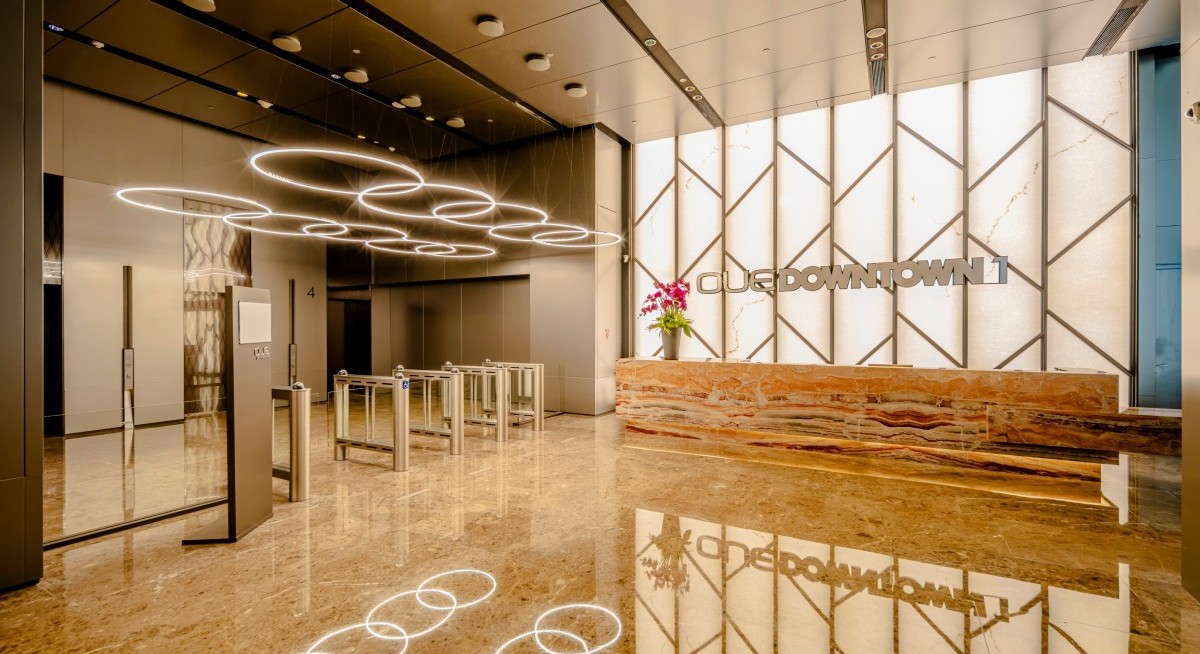


As of 3QFY2025 ended Sept 30, 2025, 48% of gross rental income is from the office. As of the end of September 2025, the committed occupancy for the office component of OUE Bayfront was 99.4%; the committed occupancy of ORP was 95.2%, while the committed occupancy of ORP retail was 99%; and the committed occupancy of OUE Downtown was 92.6%.
The office component of OUE Downtown comprises the 35th to 46th storeys of OUE Downtown 1, and the seventh to 34th storeys of OUE Downtown 2. Although the building is over 40 years old, it has undergone significant upgrades. It is certified Green Mark Gold by the Building and Construction Authority (BCA).
In addition, the software has been upgraded to include facial recognition for entry into the lift lobbies of the office towers. The upgraded OUE Downtown Office is home to an established blue-chip tenant base, including reputable insurance, financial, information and technology, and multinational corporations.
Additional facilities include the new Shenton Way MRT Station and the upcoming Prince Edward MRT Station, which is expected to open by June. In the 3QFY2025 results release, OUE REIT’s manager said OUE REIT’s Singapore office portfolio continued to record a positive rental reversion of 9.3% for office lease renewals in 3QFY2025.
See also: Core CBD office rents rise 1.2% in 2025, set to rise 2%-4% in 2026: Colliers
OUE REIT’s average expiring rents in 2025 and 2027 are $11.57 and $11.28 psf per month, respectively, compared with market rents of $12.20 psf per month.

According to Maybank Securities, transitional vacancies led to occupancy slippage for OUE REIT’s commercial assets while mid- to high-single-digit positive reversion continued for the quarter.
See also: ESR-REIT to buy five Melbourne logistics assets from Frasers Property for A$276.8 mil
“Management is in active discussion with tenants for large leases coming up for renewal in FY2026 (20.3% of gross rental income), though frictional downtime and additional capex may not be ruled out,” Maybank Securities said following a results update on Nov 1, 2025.

OUE Bayfront, completed in 2011, is an 18-storey premium Grade A office tower that was formerly the Overseas Union House. It is evenly owned by OUE REIT and a fund managed by Allianz Real Estate
Trends to attract tenants
One way OUE REIT is making its offices more attractive is by providing fitted units on the lower floors. Rents are about $1 to $1.20 psf per month higher than non-fitted units. The advantage is that tenants save on capex as they will not have to pay for the fitouts themselves.
Unlike in the US and Australia, where landlords pay for fit-outs and/ or provide extensive rent-free periods, in Singapore, tenants pay for fit-outs.

David McKellar, head of office services in Singapore at CBRE, says landlords are accelerating leasing by offering fitted solutions, such as move-in-ready spaces and speculative fit-outs for smaller units, to attract tenants needing quick occupancy.
“Landlords should consider subdividing larger spaces into 2,000–5,000 sq ft units to cater to a wider range of tenant requirements and delivering turnkey solutions ensures tenants can move in immediately without additional setup, reducing downtime and increasing leasing velocity. Landlords should tailor the type and level of incentives to the specific tenant profile they aim to attract,” McKellar suggests. “With tenants placing greater emphasis on ESG compliance and wellness features, older Grade B buildings will need to undergo asset enhancement initiatives (AEI) to remain competitive,” he adds.
According to Knight Frank, landlords currently hold a slight advantage in the office market, as most occupiers remain conservative. “Many tenants continued to favour lease renewals to avoid fresh capital expenditure, electing to maintain operational stability. Even larger occupiers from the technology and professional services sectors that had previously explored relocation increasingly chose to stay put, given the limited availability of suitable quality alternatives and tight supply.”
This dynamic allowed landlords to secure marginally positive rental reversions while boosting already healthy occupancy levels. “At the same time, proactive landlords offering speculative fitted-out spaces have also been stoking healthy interest, as companies prioritise minimal upfront investments when considering any relocation,” according to Knight Frank.
Co-working operators were observed to be expanding cautiously. The Executive Centre expanded at Frasers Tower; JustCo’s new co-working centre, The Collective at Labrador Tower, is set to open in January; and The Great Room’s newly announced openings at Shaw Tower and Stamford Court are also slated to open this year.
“Co-working operators will continue to remain on the lookout for space opportunities in the year ahead,” Knight Frank says.
Major anchor tenants with substantial footprints may find their options constrained within the core CBD, Knight Frank points out. This is because smaller space users have used the opportunity to backfill vacated spaces when large occupiers right-sized.

Rental outlook
Tricia Song, head of research, Singapore and Southeast Asia, CBRE, says: “The office market is expected to remain landlord-favourable in 2026 amid steady demand and constrained new supply. Net absorption is projected to be led by financial services, technology, asset management and emerging AI-driven firms. Large contiguous floor plates remain scarce, and new completions are minimal, with Shaw Towers as the only major delivery in 2026. Given the limited availability of high-quality space, vacancy could fall below 4%, sustaining upward pressure on rents. With active flight to quality requirements and tight CBD Grade A supply, rental growth is expected to approach around 5% y-o-y.”
Last year, the Singapore office market continued to demonstrate resilience despite global macroeconomic and geopolitical headwinds, according to Song.
Core CBD Grade A rents rose 2.9% y-o-y to $12.30 psf per month in 2025, marking the fourth consecutive quarter of rental growth, underpinned by resilient occupier demand and a tightening supply pipeline, Song says.
The low vacancy environment supported performance, with Core CBD Grade A vacancy declining from 5.9% in 1Q2025 to 4.5% by end-2025. PhillipCapital expects OUE REIT’s office rental reversions to moderate to mid-single-digits, as the low base from the Covid-19 period has already been phased out.
Deloitte, currently a tenant at OUE Downtown occupying four floors and contributing 7.5% of the commercial segment’s gross rental income, will have its lease expire in December 2026.
“We believe it will be difficult for Deloitte to find another office unit for leasing, given Grade A office supply constraints. New CBD Grade A office supply will largely be limited to Shaw Tower, scheduled for completion in mid-2026, and Newport Tower, scheduled for completion in 2027. This new supply only meets around 33% of historical leasing demand for Grade A office space,” PhillipCapital notes.
Going Down Under?
On Jan 8, OUE REIT’s manager said it had been exploring opportunities in key gateway cities, including Sydney, Australia, which offer strong real estate fundamentals and stable long-term growth prospects.
“In this regard, while the manager is in exclusivity with Mitsubishi Estate Asia with respect to the acquisition of a partial stake in Salesforce Tower, Sydney, negotiations between the parties are currently still ongoing and parties have yet to enter into any binding agreement for the acquisition,” OUE REIT says.
PhillipCapital says the core CBD office segment in Sydney seems attractive. The upcoming core CBD office supply is limited. No significant development is expected to come to market in 2026. In 1H2027, supply addition is limited to a 63,000 sqm office skyscraper called 55 Pitt Street.
In 2H2027, Chifley South Office Tower, with a net leasable area (NLA) of 42,000 sqm, and Atlassian HQ, with an NLA of 57,000 sqm, will be completed.
“The limited supply in the near term will help support rental growth and property valuations, with 2027 supply additions likely to be absorbed by prevailing market demand,” PhillipCapital says.
Meanwhile, yields have tightened by 25 basis points to 5.75% in 3Q2025 for the core Sydney CBD office sector. Sydney CBD vacancy rates crept up from 12.8% in January 2025 to 13.7% in July 2025, mainly due to additional office supply.
“It is expected that vacancy rates have reached the top of the cycle and will trend downwards in the future,” PhillipCapital says.
Elsewhere, Maybank Securities upgraded OUE REIT on Nov 1, 2025, from “neutral” to “buy” mainly because of lower interest expense in the next couple of years.
Photos: OUE REIT
For more property trends and breaking news, visit City & Country’s microsite at theedgesingapore.com/cityandcountry




