


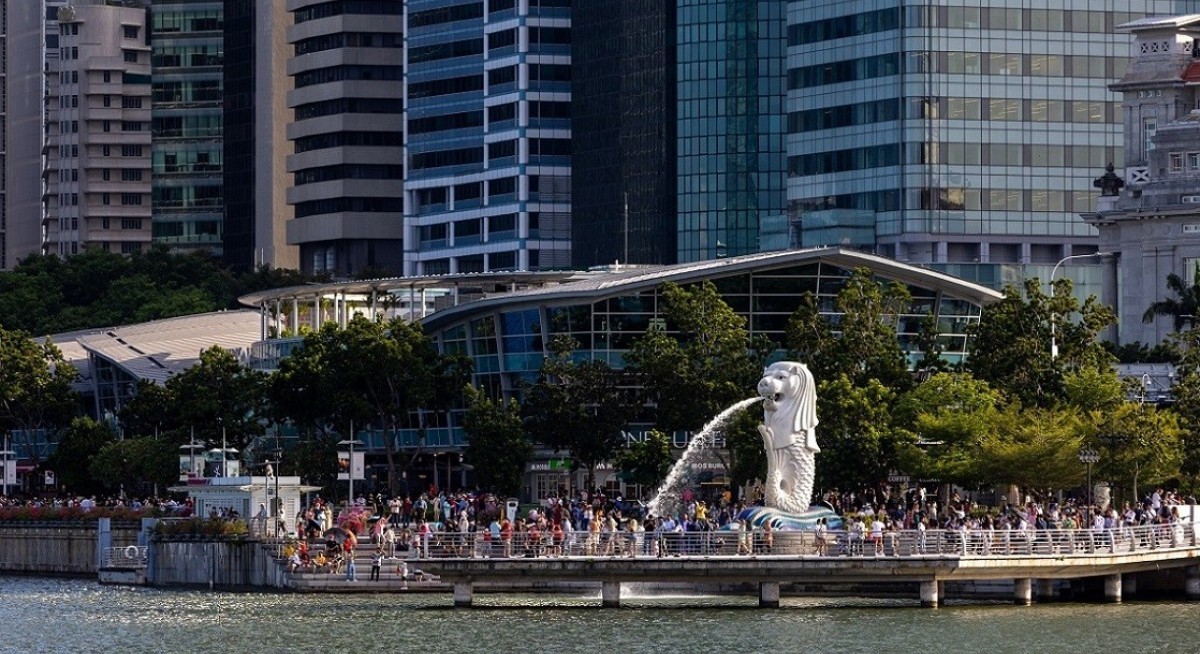


Some 3.1 million Chinese tourists made up the city-state’s largest source market– the figure represents 85.5% of 2019 levels and marked a slight increase from 2024’s 85%. Tourists from Indonesia and Malaysia made up the rest of the podium with 2.4 and 1.3 million visitors, respectively.
In 2026, the STB is forecasting international visitor arrivals of between 17 to 18 million.
Lim writes in her Feb 10 note: “We expect Singapore to meet this quite easily, supported by a steady pipeline of Meetings, Incentives, Conferences and Exhibitions (MICE) events and concerts. This is barring any black swan events – with developments around the Nipah virus warranting close monitoring, in our view.”
Retail underpinned by tourism
See also: Broker's Digest: OUE REIT, HPH Trust, JustCo, CapitaLand Investment, Addvalue, CICT
In December 2025, Singapore’s retail sales moderated from a revised 6.2% y-o-y pace the month before to 2.7% y-o-y, which was a miss of both the street’s and OCBC’s respective forecasts of 7.8% and 8.2% y-o-y.
Excluding motor vehicles, December retail sales eased from a revised 5.7% y-o-y in November to 1.7% y-o-y. For the full year, retail sales expanded 2.8% y-o-y, double the 1.4% pace in 2024 and the fastest growth since 2022.
“Our house view is for retail sales to expand another 2% to 3% y-o-y in 2026, underpinned by a strong pipeline of new products and experiences, as well as a supportive macroeconomic backdrop,” writes Lim.
See also: Citing defensive yield, Beansprout initiates coverage on United Hampshire US REIT
Tourism spending meanwhile remains crucial, coming in 6.5% higher y-o-y at a record $23.9 billion in the 9M2025. This propelled the sector past STB’s expectation of between $29 billion to $30.5 billion for the full-year.
Visitor spending in the sector was driven by sightseeing, entertainment and gaming as well as the food and beverage (F&B) categories. In particular, Chinese tourist spending grew 3% y-o-y over the period.
Lim cites her readthrough from Starhill Global REIT’s 1HFY2026 results that Chinese travellers remain hesitant on “big ticket item” spending such as luxury goods, as compared to the trend pre-pandemic.
On this, she writes: “This could be driven by a shift in consumer preference from material goods towards experiences. The relative strength of the Singapore dollar may also be a deterrence when Chinese consumer sentiment is still weak. STB expects tourist receipts to reach between $31 billion to $32.5 billion in 2026.”
Hospitality sees softer spending
Singapore’s hotels saw a challenging 2025, with revenue per available room (RevPAR) slipping 0.4% y-o-y to $224, weighed down by a 1% y-o-y decline in average room rates even as occupancy improved 0.5 percentage points (ppts) to 81.9%.
The industry-wide softness also impacted Singapore REITs with exposure to the hospitality sector.
For more stories about where money flows, click here for Capital Section
Lim writes: “OUE REIT’s FY2025 RevPAR was down 6.6% y-o-y at $255, in part due to execution misses and greater supply in the Orchard Road area, which weighed on the performance at Hilton Singapore Orchard.”
“For CapitaLand Ascott Trust , Singapore RevPAR was stable y-o-y on a same store basis,” she adds.
Both REITs are guiding for a firmer FY2026, in part due to “a more exciting” calendar of events.
The OCBC analyst adds that new hotel supply in the near future is expected to be limited– with global real estate company Cushman & Wakefield expecting an average hotel room supply growth of 1.3% from 2025 to 2029, “significantly below the pre-pandemic average of 4.6% from 2015 to 2019. This, she notes, “should be supportive” of room rates.
Headwinds in aviation
Within the aviation industry, Lim indicates a preference for upstream players.
Aircraft availability remains a significant constraint of industry growth, with data from the International Air Transport Association (IATA) pointing to a global order backlog of over 17,000 aircraft. This is almost equal to 60% of the world's active fleet.
Engine availability has also been a critical bottleneck, due to not only delivery delays, but also tightening existing fleet availability as active planes require extended grounding while waiting for replacement parts.
On this, Lim writes: “Although production is expected to accelerate in 2026, the backlog will likely require multiple years to be resolved, and normalisation is unlikely before 2031 to 2034.”
With older planes required to stay in service longer, this translates to more maintenance visits which bode well for maintenance, repair and overhaul (MRO) shops.
“Notwithstanding headwinds such as flare-ups in geopolitical tensions and immigration policy uncertainty, we expect airline passenger traffic to remain resilient. However, more intense competition and moderating yields limit upside potential for carriers, in our view,” writes Lim.
The analyst sees that flag-carrier Singapore Airlines group (SIA) has performed well ahead of its 3QFY2026 ending March business update at the end of February, returning 5.2% year-to-date (ytd).
In December 2025, SIA enjoyed firm year-end travel demand, with group passenger traffic rising 4.8% y-o-y to 3.8 million, outpacing a 2.6% increase in capacity. Passenger load factor (PLF), however, softened 0.6 ppts to 87.9%.
On the cargo side, the airline saw increased freighter activity thanks to the usual year-end demand. Cargo loads grew 4.5%, outpacing the 1.6% expansion in capacity. With this, cargo load factors rose 1.6 ppts to 55.2%.
Conversely, aviation maintenance player SIA Engineering Company (SIAEC) lost 4.2% ytd, while SATS Group gained 1.8%.
Lim opines: “At current levels, we are starting to see value emerge in SIAEC’s shares. On the sidelines of the Singapore Airshow, SIAEC– through Singapore Aero Engine Services Limited (SAESL) – signed two memoranda of understanding (MOUs) to strengthen its talent pipeline.”
The first MOU signed by SIAEC is with the Singapore Economic Development Board (EDB) to develop a training academy to boost hands-on engine maintenance capacity and technicians’ capability levels, while the second MOU with Singapore Polytechnic (SP) aims to strengthen alignment between SP’s curriculum and real world MRO requirements. This will provide early-industry exposure for students and create applied learning opportunities through industry-based projects.
China Aviation Oil (CAO) meanwhile continued to extend gains with total returns of 8.4% ytd, driven by tailwinds from China’s ongoing outbound travel recovery.
The analyst writes: “As a constituent of the iEdge Singapore Next 50 Index, CAO may also benefit from ongoing inflows from the Equity Market Development Programme (EQDP), especially if it begins to deploy its substantial net cash position for accretive acquisitions or to support a higher dividend payout ratio.”
Although she remains “constructive” on CAO’s long-term outlook, she is cautious in the near term amidst the ongoing corporate restructuring between CAO’s parent China National Aviation Fuel Group (CNAF) with Chinese oil and gas firm Sinopec, due to a lack of clarity over how the restructuring will impact the combined entity’s ownership in CAO, as well as implications on its license to import and distribute jet fuel in China.
Developments in SAF
With regards to sustainable aviation fuel (SAF), Lim notes several “encouraging” developments this late January.
Keppel announced that its Infrastructure Division, together with energy and infrastructure firm Aster have entered into an agreement to jointly assess the development of one of Asia’s first commercial-scale ethanol-to-jet SAF facilities on Jurong Island, Singapore.
The proposed plant is expected to have a planned production capacity of up to 100,000 tonnes of SAF per year.
Separately, the Civil Aviation Authority of Singapore (CAAS), the Singapore Sustainable Aviation Fuel Company (SAFCo) and nine companies including Changi Airport Group (CAG), DBS Group (DBS), Singapore Airlines and Scoot have signed a MOU to launch Singapore’s first trial for central procurement of SAF.
Globally, IATA is projecting SAF production to rise from 1.9 million tonnes in 2025 to 2.4 million tonnes in 2026, covering 0.8% of total fuel consumption.
Altogether, the names in Singapore hospitality and hospitality-related stocks under Lim’s coverage are Genting Singapore, CapitaLand Ascott Trust, OUE REIT, Starhill Global REIT, Singapore Airlines group, SIA Engineering Company, China Aviation Oil and SATS Group.
As at 3.010 pm, units in CapitaLand Ascott Trust, OUE REIT and Starhill Global REIT are trading at 98 cents, 35.5 cents and 57.5 cents respectively. At the same time, shares in Genting Singapore, Singapore Airlines group, SIA Engineering Company, China Aviation Oil and SATS Group are trading at 76.5 cents, $6.88, $3.48, $1.78 and $3.96 respectively.




