


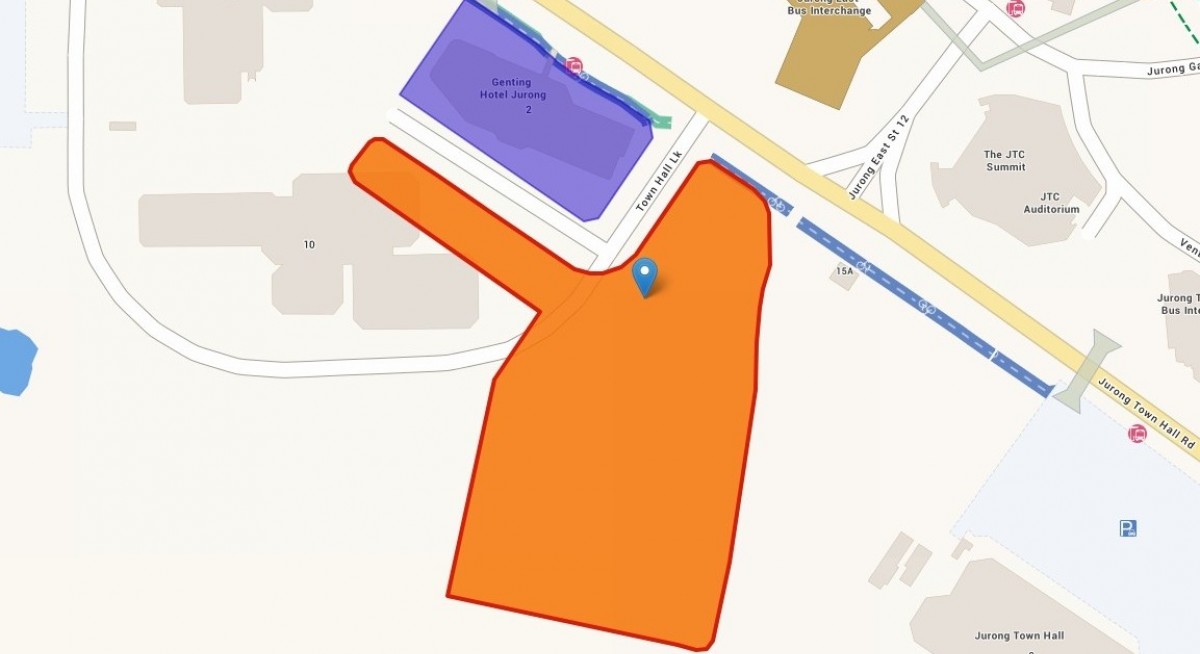


The Urban Redevelopment Authority (URA) has released the 99-year Town Hall Link site in the Jurong Lake District (JLD) for sale under the Reserve List of the 1H2026 Government Land Sales (GLS) programme.
The 3.7-hectare white site, which allows developers to integrate commercial, residential and hotel uses within a single development, will “catalyse the next phase” of growth in JLD as it evolves into Singapore’s largest mixed-use business node outside the city centre, reads URA’s March 16 announcement.
The site is projected to yield a total gross floor area (GFA) of 186,139 sqm. This will include a minimum of 40,000 sqm of office space, about 1,200 private residential units and approximately 44,000 sqm of space for complementary uses such as retail, serviced apartments, hotels, sports and recreational facilities, community spaces, medical clinics and attractions.
The future integrated development will also benefit from strong connectivity, says URA. It will be linked to four MRT lines and is expected to serve as a key anchor within the new JLD precinct.
Compared with the earlier Master Developer site — which was about twice the size and was not awarded in September 2024 — the Town Hall Link parcel has been scaled down to around half the GFA.
This site is also “similar in size… [relative] to the tender at Paya Lebar Road awarded in 2015 for $943 psf ppr,” according to Mark Yip, CEO, Huttons Asia. “That site was developed into Paya Lebar Quarter, PLQ Mall and Park Place Residences.”
See also: Freehold five-storey shophouse at 42 South Bridge Road for sale at $33.4 mil
According to URA, the adjustment in size lowers development risks and allows developers to undertake the project with greater confidence, while still maintaining sufficient scale to catalyse the next phase of development in JLD and support medium-term demand for housing and office space.
The development will also incorporate district-level infrastructure, including a district cooling plant and a district pneumatic waste conveyance system central station. These systems will enable future developments in the area to connect to shared infrastructure, improving energy efficiency, enhancing the quality of the living environment and supporting the sustainability goals for JLD, says URA.
In light of the recent geopolitical uncertainty, Yip notes that “the current conflict in the Middle East may affect the global and Singapore economy”. “Hence, office occupiers are likely to stay cautious. Decentralisation efforts by the government have not gained much traction over the years [and] many office occupiers still prefer a central location. Demand for office space in the Outside Central Region contracted by 54,000 sqm in 2025, pushing the vacancy rate to 14.9%, the highest since 1Q2023.”
See also: S’pore property sentiment index plummets into ‘pessimistic territory’
However, “the residential and retail market segments in JLD [will] likely see a positive response from consumers, [while] the office component might discourage developers from triggering the site”, Yip adds.
Largest mixed-use business node outside the city centre
According to URA, the development of JLD has advanced progressively over the years, with the area around the Jurong East MRT Station establishing a critical mass of about 185,000 sqm of office space and around 2,000 homes.
These developments are supported by a range of retail, healthcare and institutional facilities, laying the foundation for JLD’s transformation into Singapore’s largest mixed-use business node outside the city centre.
Over the next few years, several new projects are expected to further enhance the vibrancy of the district. These include the completion of the new Science Centre and Jurong Gateway Hub, an integrated transport hub next to Jurong East MRT Station that will incorporate a bus interchange, library, community club, sports facilities, offices and retail spaces.
Some government agencies are also studying plans to move their offices to JLD, which could further strengthen the district’s role as a key employment centre in the west.
To drive JLD’s transformation and make the precinct more attractive to businesses, workers and residents, the Government has invested significantly in key infrastructure and development projects. These include the revitalised 90-hectare Jurong Lake Gardens and the addition of two new MRT lines — the Jurong Region Line (JRL) and the Cross Island Line (CRL). The JRL is expected to begin operations in stages from around mid-2028, while Phase 2 of the CRL connecting to JLD is slated for completion in 2032.
Together with the existing North-South and East-West MRT lines, the new rail lines will provide JLD with strong connectivity within the west region and to the rest of Singapore, including the city centre and the future Changi Airport Terminal 5. The CRL is expected to shorten travel time between JLD and Pasir Ris Central by about 20 minutes compared to today.
Further enhancements to connectivity are also planned. Construction to extend the CRL further west from JLD is expected to start in 2027, improving public transport links to Jurong and the western industrial areas. In addition, the Land Transport Authority has announced plans for the West Coast Extension, which will extend the JRL to connect to the CRL at West Coast MRT Station by the late 2030s, and to the Circle Line at Kent Ridge MRT Station by the early 2040s. When completed, these connections could reduce travel time between the West region and the city centre by up to 20 minutes.
The upcoming development at Town Hall Link is poised to catalyse the next phase of growth in JLD. The site will feature a mix of residential, commercial and lifestyle components designed to support a vibrant live-work-play environment. By integrating quality homes and workspaces with retail and food and beverage offerings, recreational spaces and strong public transport connectivity, the development will contribute to JLD’s transformation into a major regional centre anchoring economic activity in the western part of Singapore.




