


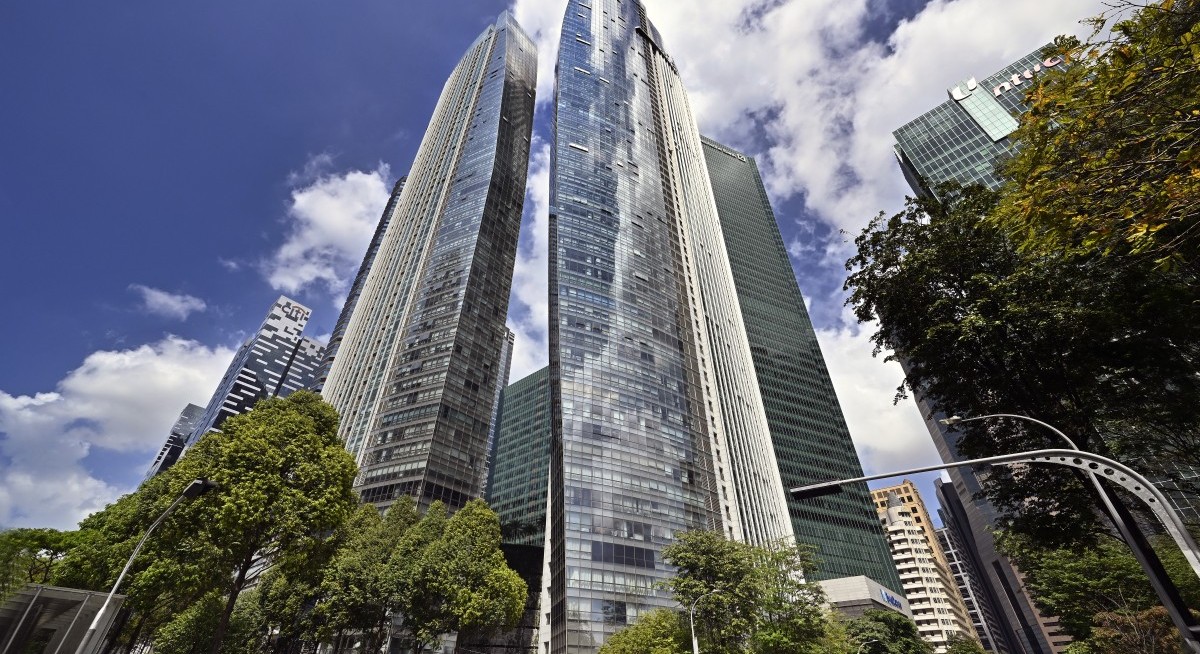


Encompassing the downtown core and Singapore’s high-end residential enclaves, the Core Central Region (CCR) is widely regarded as housing some of the country’s most prestigious addresses. At its heart lies District 1 — home to Marina Bay, Raffles Place and the financial centre.
By reputation alone, one might expect the district to command some of the strongest demand and deliver the most resilient price growth. Yet the performance of homes in the district tells a different story.
While Singapore’s prime residential market has enjoyed steady growth in recent years, properties located in the financial core itself have not always kept pace with developments.

Over the past five years, prices of non-landed residential properties in the CCR have risen by about 17%, according to the private residential price index from the Urban Redevelopment Authority (URA).

See also: Holland Plain GLS site in D10 draws sole bid from Sim Lian
However, homes within Singapore’s financial district have not mirrored this upward trajectory. Between 2021 and 2025, the median resale psf price in District 1 slipped 7.8%, easing from $2,158 to $1,989, based on URA Realis data compiled by City & Country. This decline comes despite the district’s prestige and proximity to the largest cluster of financial institutions.

The new-launch market shows a similar pattern. Median prices for new launches in the district slipped by almost 5%, from $3,166 psf to $3,014 psf, over the last three years, according to URA data compiled by City & Country.
See also: MOP for ECs to be doubled to 10 years, with greater priority for first-time buyers
Uneven performance among District 1 condominiums
A closer look at transaction records compiled by City & Country across District 1 developments reveals a divergence in profitability outcomes.
Older or smaller developments, such as Riverwalk Apartments (completed in 1985) and Emerald Garden (completed in 1999), have seen a higher proportion of profitable deals, with more than 70% to 90% of resale transactions closing with gains.
In contrast, the same data shows that several newer projects in the financial district — including Marina Bay Suites, Marina One Residences and V on Shenton — have recorded a majority of loss-making transactions, with profitable deals accounting for less than 30% of resales in some cases.
Even larger and more established developments have also shown mixed performance. At The Sail @ Marina Bay, 154 resale transactions were profitable, with gains ranging from $2,480 to $2.7 million, while 98 deals recorded losses of between $1,100 and $1.18 million in absolute terms, as at Mar 16.
Christian Oh, director of investments at JNA Investments — the investment advisory arm of JNA Real Estate, which is under PropNex Realty — attributes this divergence to structural characteristics of the district. JNA Investments focuses on portfolio structuring and acquisition strategies on buy-side residential transactions.
Oh points to structural factors within District 1 that have weighed on resale performance, particularly in newer developments.
“A lot of [sales] in District 1 are investor-driven,” he says. “When the buyer pool is mainly investors, they tend to be more price-sensitive; they look at yield and entry price, [which] naturally caps how much prices can move [in the] resale [market].”
He adds that this dynamic is compounded by limited owner-occupier demand. “Most Singaporeans don’t typically choose to live in the CBD — there are fewer schools and family-oriented amenities. So demand is narrower compared to other prime districts like Orchard or Bukit Timah.”
Tenancy data shows investor dominance
This investor-driven dynamic can be seen in tenancy data shared by Oh, which shows a high proportion of units being rented out rather than owner-occupied.
In an extensive spreadsheet that he updates daily, Oh’s data shows that an estimated 90% of Marina One Residences’ one-bedroom units and 80% of two-bedroom units are tenanted, based on rental contracts from 2024 to 2025.
Even among larger units, tenancy remains significant, at around 59% for three-bedders and 50% for four-bedroom and penthouse units.
A similar pattern is observed at The Sail @ Marina Bay and V on Shenton, according to his data.
Oh notes that such high rental concentrations reinforce the investor-heavy nature of the district. “When most of the development is rented out, it shows that the majority of buyers are investors rather than owner-occupiers,” he says. “That affects how prices behave, because investors are more focused on returns than lifestyle.”
Foreign demand pullback, historical development
The district’s performance has also been affected by a sharp decline in foreign demand following the 2023 increase in additional buyer’s stamp duty (ABSD) rates.
Before the hike, foreigners accounted for an “estimated 13%–14% of transactions in District 1”, says Oh. This has since fallen to “around 0%–2% recently, significantly reducing a key demand segment”, he adds.
“When foreign demand drops, the impact trickles down to permanent residents as well,” says Oh. “That has significantly affected overall demand in District 1.”
He notes that despite a large number of listings on the market, transaction activity remains subdued. “We have been marketing over 110 listings, but enquiries are only a few per week — especially for one-bedroom units.”
Part of the explanation for the district’s performance lies in its historical development.
Unlike residential enclaves such as Orchard Road or Tanglin, which have long-established residential communities, the area around Singapore’s downtown financial district was historically built around offices, commercial activity and hotels.
Large-scale residential projects only began appearing in the early 2000s, when policymakers sought to introduce a live-work-play dynamic to the CBD and bring activity to the area after office hours.
As a result, the district’s buyer pool tends to “differ from lifestyle-oriented CCR districts such as District 9 (Orchard/River Valley) and District 10 (Bukit Timah)”, says Jack Sheo, senior associate division director at PropNex.
Case study: Marina One Residences

Oh’s own investment in Marina One Residences reflects the situation faced by property owners in District 1. He had purchased a one-bedroom-plus-study unit around 2020, drawn by what appeared to be a relatively low psf price and strong rental prospects. However, he notes that “psf [prices] can be misleading”.
“Back then, the psf [price] looked attractive, but the units were larger, so the overall quantum was still high,” he says. “A one-bedroom-plus-study could be around 700 sq ft, which actually pushed the price quantum up.”
Subsequent market changes — including tighter ABSD measures and competition from newer projects with more efficient layouts from area harmonisation — weighed on resale prospects.
“When newer projects came with smaller, more efficient units at a lower quantum, it became difficult for older stock to compete directly,” he explains.
Oh eventually exited the investment after incurring a small capital loss over a holding period of four years. “I restructured my portfolio into assets with stronger growth potential,” he says. “In today’s market, total quantum and exit demand are more important than just focusing on psf [price].”
Gains still possible with longer holding periods
Despite weaker overall performance, there are still profitable transactions, particularly for units held over longer periods.

Among the top gains in 4Q2025 was a unit at Emerald Garden, according to data provided by Sheo. The 1,055 sq ft apartment changed hands in October 2025 for a profit of $538,400 after being held for nearly three decades, translating to an annualised return of 1.1%.
Meanwhile, a 732 sq ft unit at Marina Bay Residences generated a $415,700 profit when it was sold in December 2025 after an 18-year holding period, translating to an annualised return of 1.5%.
Strong rental demand
While capital appreciation has been uneven, rental demand in District 1 remains resilient. The region remains one of the most sought-after locations for expatriates working in the nearby financial district, as well as senior executives who value proximity to the office.

Data from an interactive heatmap on Sheo’s site shows that the average rental in District 1 stands at $6.63 psf — about 9.2% higher than Orchard/River Valley (District 9) at $6.07 psf and 22% higher than Bukit Timah (District 10) at $5.42 psf — underscoring the premium that tenants are willing to pay for CBD living.
In 4Q2025, the highest rental recorded in the district was at Marina Bay Residences, where a unit was leased for $33,500 per month, translating to $8.50 psf, according to data provided by Sheo.
The same dataset shows the highest rental on a psf basis was achieved at The Sail @ Marina Bay, where a unit fetched $10.40 psf, or $7,000 per month.
Cautious outlook, but with potential catalysts
Looking ahead, it appears the trajectory of District 1 remains uncertain.
Singapore is expected to take in between 25,000 and 30,000 new citizens annually over the next five years, according to Deputy Prime Minister Gan Kim Yong.
This could provide some support to demand, notes Oh. “There may be some spillover demand from newly naturalised citizens, especially those already residing in the CBD.”
At the same time, new launches — including One Marina Gardens, Union Square Residences and W Residences Singapore – Marina View — could attract a fresh pool of buyers. Skywaters Residences has also begun VIP previews.
Sheo adds that the Marina Bay area is still evolving. “The live-work-play ecosystem is still developing,” he says. “As the area matures and attracts more residential activity, demand dynamics may gradually shift.”
Whether these factors will reverse the district’s recent performance trends remains to be seen.
Data: URA Realis, Christian Oh, Jack Sheo
Photos: Albert Chua/The Edge Singapore




