


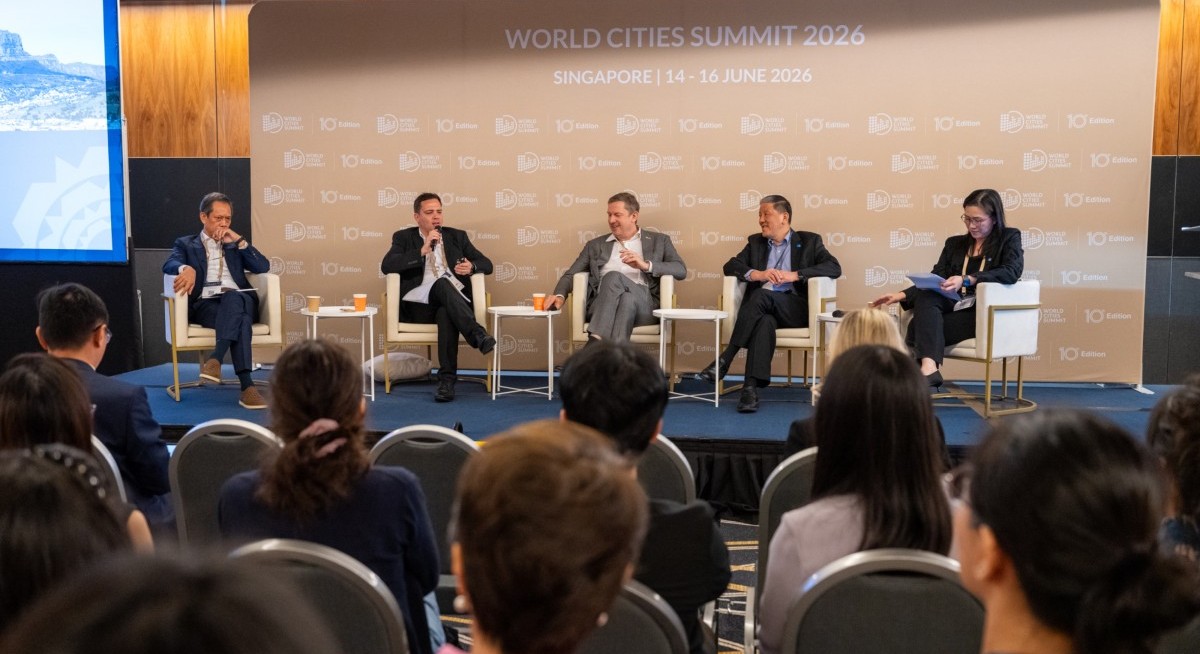


Speaking on a panel at the World Cities Summit on June 15, Tan points to Punggol Digital District (PDD) as a blueprint for how industrial development is moving beyond the conventional industrial estate model.
The first phase of the 50ha PDD combines a university campus, business parks, retail amenities, a hawker centre, a hotel and public transport infrastructure — both an MRT station and a bus interchange — within a single development designed to support Singapore’s digital economy.
For JTC, PDD represents a shift from the traditional industrial estate towards an industrial ecosystem that combines industry, talent, research and community uses within a single district, says Tan.
According to Tan, Singapore’s industrial estates should no longer serve solely as places for manufacturing and production. Instead, “[they] should comprise land [for other uses], including commercial and educational [facilities], creating environments where people can work, learn and innovate within the same district”.
See also: $1 bil ‘well-being destination’ Therme Singapore breaks ground at Marina South
At PDD, manufacturing activities are complemented by research and development, corporate headquarters, logistics and supply chain management and talent development. The aim is to create a high-value industry ecosystem rather than one that focuses on manufacturing.
“Within those industrial estates, it should comprise a high-value industry ecosystem, [where] the ecosystem is not just purely manufacturing and production, but also [comprises] R&D, HQ functions, production, logistics, supply chain and so on,” says Tan.
Opened in phases starting in 2024, PDD houses companies operating in cybersecurity, AI, robotics, fintech and smart-city technologies. The district currently has an occupancy rate of about 65%.
See also: Sunway MCL, CSC Land JV tops four bids for River Valley Green (Parcel C) GLS site at $1,730 psf ppr
The district is designed to encourage collaboration between industry and academia. “It is a place where we consciously design our facilities to [foster] collaboration and partnership, while also allowing the space [to serve as] a living laboratory for testing with a diverse mix of tenants,” says Tan.
One example is JTC’s requirement that the district’s hotel operator provide internships to students from the adjacent autonomous university, Singapore Institute of Technology (SIT). Hmlet is set to take over Habyt’s 224-key hotel in Tower 98 of PDD, scheduled to launch in 2027.
“Students can study in the morning and work in the afternoon by simply [crossing] a 38m campus boulevard. They don’t even have to take public transport or walk very far,” adds Tan.
PDD and Jurong Innovation District (JID) operate under Singapore’s Enterprise District Framework, which enables a “live-work-learn-play” environment that integrates advanced manufacturing facilities with research institutes, training providers and green public spaces.
The framework allows industrial facilities to be co-located with educational institutions, unlike the traditional zoning models that separate different land uses.
Digital backbone
Beyond physical infrastructure, PDD serves as a testbed for digital innovation. Tan says one of the district’s defining features is an open digital platform that allows different systems across buildings and infrastructure to communicate through a common operating layer. “We have developed an open standard multi-protocol middleware that [is] essentially like an operating system for a smart district.”
The platform is also integrated with a digital twin that provides a virtual representation of the district. The digital twin allows operators to visualise district-wide activities, analyse performance and run AI and machine learning models to improve efficiency and automate processes, adds Tan.
The same digital infrastructure model will also be implemented at Jurong Innovation District (JID), where JTC is building a larger advanced manufacturing ecosystem in partnership with Nanyang Technological University (NTU).
‘Building the building twice’
PDD’s digital twin infrastructure reflects a broader shift towards virtual planning and operations. The concept is already being adopted by manufacturers such as Siemens.
Fellow panellist Thai-Lai Pham, president and CEO of Siemens Asean, shares how the company is applying digital twin technology to a new manufacturing facility currently under construction in Singapore.
“We always say that we are building the building twice — one digital and [the other] physical,” says Pham, highlighting how Siemens is applying the digital twin technology to their new manufacturing facility currently under construction in Singapore.
The 4ha factory in Tuas will produce programmable logic controllers (PLCs), one of Siemens’ flagship automation products used extensively in industrial systems worldwide. Construction is expected to be completed in 2027, with production beginning in 2028.
The technology allows Siemens to simulate manufacturing operations, optimise workflows and test production systems before equipment is installed, notes Pham. “The beauty of the digital twin is [that] later on, when the building is up and running, there’s a continuous connection with the virtual twin, which allows us to continuously optimise [our] processes, manage [our] building, and so on,” says Pham.
Additionally, the “highly automated factory” will also maintain the same level of productivity with “much [fewer] manpower than we would without technology”, adds Pham. “The facility will deploy around 400 [employees] with automations; without advanced automation technologies, we would probably need more than 1,000.”
The Singapore plant is the third Siemens facility globally producing PLCs, alongside existing factories in Germany and China.
Managing trade-offs
The push toward industrial development raises questions about environmental sustainability. “There are always trade-offs in everything that we do,” says JTC’s Tan. “When an area is developed, [one] may need to sell some trees or to remodel the land, but resilience in sustainability is [still] very important to us. So we have a few strategies to mitigate [that] trade-offs.”
To mitigate environmental impact, JTC adopts a landscape replacement strategy, under which greenery removed for development is replaced entirely through a combination of ground-level landscaping, rooftop gardens and sky terraces. “We believe that having a green industrial estate is actually very helpful in many ways,” adds Tan.
Separately, JTC is also increasingly relocating infrastructure underground to optimise scarce land resources in Singapore.
At JID, logistics loading and off-loading, as well as heavy vehicle traffic, are moved underground, while the ground level is freed up for pedestrian and public amenities. JID will also boast Singapore’s first “car-free sky corridor” — an 11km link that connects buildings and transport nodes.
The trade-off is not unique to Singapore. Gareth Morgan, executive director for future planning and resilience for the City of Cape Town, says even the land-rich capital of South Africa must resist the temptation to expand endlessly.
“Natural environment is exceptionally important [to us], it is one of the reasons [why] we are an iconic city blessed with beautiful mountains; so we have a lot to look after that makes us a very unique place,” adds the fellow panellist.
Cape Town’s approach to land use is rooted in conservation as much as development. The city’s ecological heritage — home to one of only six floral kingdoms worldwide — means every industrial allocation “must be balanced by ‘swaps’”, says Morgan.
“We expect developers to allocate land which is protected in perpetuity. If you are going to disturb land [of] important conservation value, then there will need to be set-asides of land of equivalent size, which will be dedicated to conservation [thereof]. That is the one way we do it, and it seems to work very, very, very well,” he adds.
Photos: World Cities Summit 2026




