


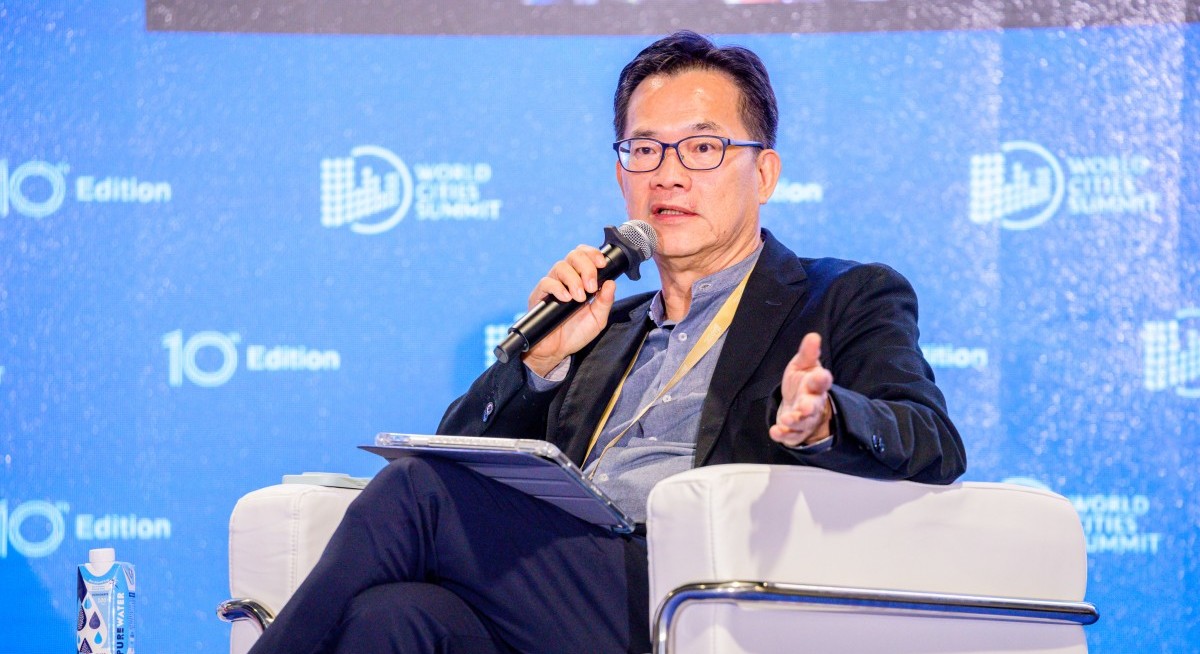


As an architect and urban strategist with nearly 40 years of experience, Yeo challenges Singapore to design new towns with a more diverse demographic in mind. “Can we then now design the new town looking at a profile of a family that is maybe 70 years old? Because I still want some social space [and] I can still move around, but it’s no longer the way I want to… The question is: ‘Should we still use the same template that we used in the 1960s, 1970s, 1990s [and] today, in the future?’”
Yeo, formerly chief executive of Buildings+Cities at SJ Group (formerly Surbana Jurong) and SAA Architects, acknowledges that public housing in Singapore has looked inward “over the last 10 years” from building the heartlands to focusing on “software”. “We used to house people, but these people have grown older. Ageing buildings, ageing communities, ageing people — [these are] a lot of issues and for all cities, you’ll face that.”
One notable step has been building social spaces around sports facilities in neighbourhoods, he adds. “Stadiums are now a hub — a hub means you bring the library in there, you bring food in there, and you bring offices in there.”
Cities must move away from the “car dependency” that dominated urban planning in decades past, says Yeo, who is also director of NUS Cities, a university-wide, interdisciplinary entity. Through a sustainability lens, cities must also now contend with the carbon footprint of construction works.
See also: $1 bil ‘well-being destination’ Therme Singapore breaks ground at Marina South
“You can’t continue to do what was planned 100 years ago. Looking to the future, the carbon issue; 40% of our carbon emissions come from the built environment, so that itself is compelling for us,” says Yeo.
The city centre, in particular, holds gravity in urban planning. “We always say Singapore is small, but no matter how big a piece of land [is], even in a very large country, there’s only one city centre,” says Yeo. “The city centre doesn’t grow bigger, so we need to rethink how cities are going to be in the future.”
Yeo adds: “The people are the ones who stay on [in a city]; they define what the city can become.”




