


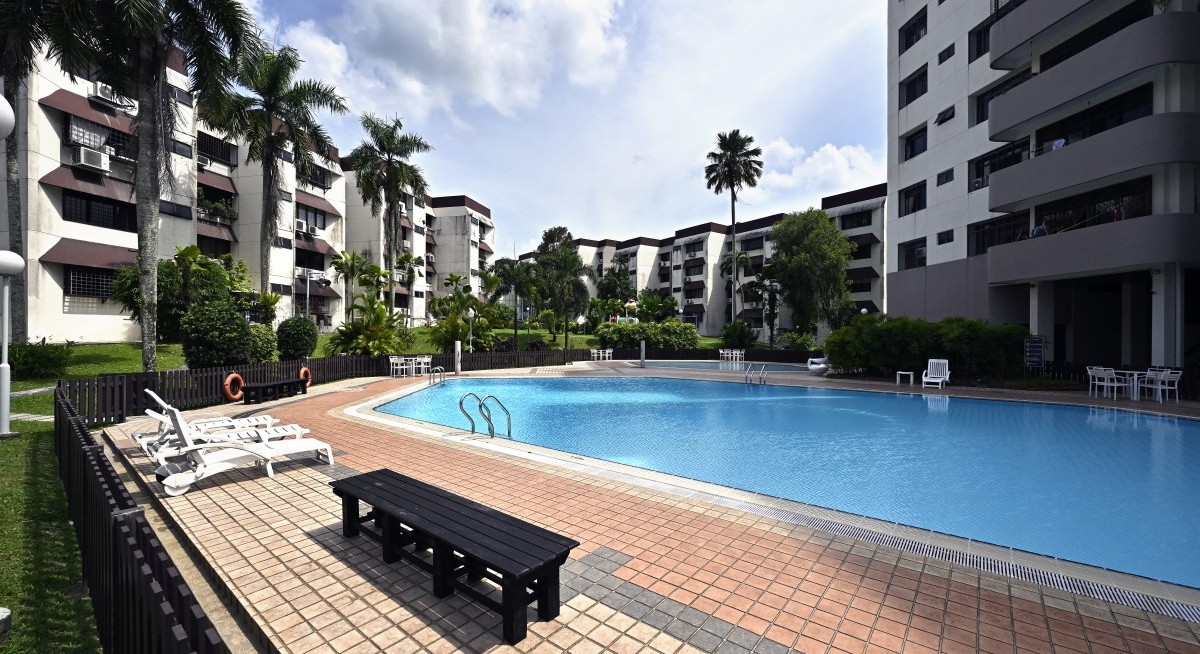


The 43-year-old Cashew Park Condominium offers a glimpse into today’s en bloc market, where ageing estates wrestle with rising maintenance costs and the challenge of rounding up enough owners for a collective sale
A successful en bloc sale can turn an ageing condominium into a multi-million-dollar windfall for its owners. Yet in today’s property market, many collective sale attempts fail to reach that stage. Even as speculation mounts over a potential lowering of Singapore’s en bloc consent threshold, the question remains: Will easing the rules be enough to revive a market that has remained largely dormant since the 2017-2018 boom?

The city-state last saw a surge in collective sale activity in those years, when developers aggressively sought redevelopment sites, and a wave of ageing condominiums were successfully sold en bloc.
One of the high points of the cycle came in 2018, when 46 developments worth a combined $10.5 billion were successfully sold. According to data from the Urban Redevelopment Authority (URA), this marked the second-largest collective sale cycle on record, after the 2007 peak of $12.3 billion in en bloc transactions.
Since then, the en bloc market has cooled sharply. Transaction value fell to just $22 million in 2025 — less than 1% of the 2007 peak — while 2024 saw no collective sale activity, based on URA data.
See also: Freehold five-storey shophouse at 42 South Bridge Road for sale at $33.4 mil
The slowdown followed the introduction of property cooling measures in July 2018, which tightened financing conditions. Among the changes was a lowering of the Total Debt Servicing Ratio (TDSR) cap to 75% for first housing loans and 45% for second loans, effectively tempering demand in the private housing market. Collective sale activity then dropped sharply after 2018 as developers grew more cautious in bidding for redevelopment sites.
Lower en bloc consent threshold rumours
Late last year, a letter circulated to residents of Neptune Court referenced the possibility of the government lowering the consent threshold to “70%, [which is] expected to take effect between 1Q2026 and 2Q2026”. The letter reignited speculation about a possible review of the en bloc framework.
See also: S’pore property sentiment index plummets into ‘pessimistic territory’
Under the current rules set out in the Land Titles (Strata) Act, developments that are more than 10 years old must secure at least 80% owner consent — by both share value and strata area — before a collective sale can proceed. For developments less than 10 years old, the requirement is higher, at 90%.
Any reduction in this threshold “is particularly relevant for ageing developments”, says Swee Shou Fern, head of investment advisory at ETC, a member of Realion Group. “Many older projects face rising maintenance costs, ageing infrastructure and increasing difficulty in funding major upgrading works due to fragmented ownership.”
While a lower consent threshold could bring more ageing developments to market, would it be enough to revive the dormant en bloc market? Lowering the bar for owner consent may only address one side of the equation; the other depends on developers’ appetite to bid for these sites.
Pearl Lok, director of capital markets and investment sales at ERA Singapore, says “market conditions, land pricing expectations and developers’ risk appetite will continue to play a decisive role in determining whether a collective sale ultimately succeeds”.
Big developments struggle to hit 80% threshold
In recent years, several developments have garnered strong support for collective sales, with owner consent in some cases reaching 75%, says Laurence Wong, head of collective sales at PropNex. Yet many of these attempts did not progress to the next stage, as they “still fell short of the current 80% threshold”.
One such development is High Point in the Orchard area. The 57-unit freehold development, completed in 1974, has gone through four rounds of collective sale attempts. “In its most recent attempt in 2023-2024, the collective sale exercise came within a single unit of the required consent level,” says Low Choon Sin, managing partner of capital markets at Singapore Realtors Inc (SRI).
On the final day of the collective sale agreement period, the collective sale committee (CSC) had secured only 78.69% consent by share value and 78.81% by strata area — just shy of the 80% consent threshold required under the Land Titles (Strata) Act.
“Some owners [at High Point] were reluctant to sign the collective sale agreement and cited concerns that the proposed payout would not be sufficient to fund a comparable replacement property in the same area,” notes Low.

For larger estates, the challenge can be even more pronounced. Mandarin Gardens — the 1,006-unit leasehold development completed in 1986 — has launched multiple attempts at a collective sale; all failed to secure the 80% statutory level of owner support. In the 2023 attempt, the collective sale agreement eventually lapsed after only about 42% of owners signed.
Ageing estate and rising costs drive Cashew Park collective sale bid
Another development currently undergoing a collective sale attempt is Cashew Park Condominium, located along Cashew Road in District 23 (Bukit Batok, Bukit Panjang, Dairy Farm and Choa Chu Kang) within the Outside Central Region (OCR).

Developed by Hong Leong Holdings and completed in 1983, the 999-year leasehold condominium is 43 years old and comprises 148 residential units ranging from 893 to 1,819 sq ft. Of these, 112 units across seven blocks are walk-up apartments, while 36 units in a single tower are served by lifts and enjoy unblocked views of Bukit Timah landed enclaves.
The development also includes two 506 sq ft commercial units, located on the ground floor of the tower. Roland Ng, chairman of the CSC at Cashew Park and a 35-year resident there, tells City & Country that the current exercise is effectively the development’s first formal en bloc attempt. “There were earlier discussions about a potential collective sale, but a marketing agent was never appointed.”
After the second extraordinary general meeting on April 26, 2025, the CSC appointed Cushman & Wakefield as marketing agent and Terra Law as legal adviser. As of March 7, the CSC has secured 72% consent by share value and 68% by strata area, says Ng. The deadline to reach the 80% statutory threshold is April 26.
Ng hopes the proposed lowering of the consent threshold, if implemented, will apply to developments already in the midst of the collective sale process, such as Cashew Park. “This could help developments like ours move closer to securing the required mandate from owners.” But time is running short, he adds. “If we do not meet the statutory consent threshold by then, we will not be able to proceed to the next stage of the collective sale exercise.”
The motivation for the collective sale is clear. Ng says the sinking fund is in deficit and no longer enough to cover rising upgrade and maintenance costs. As a result, each household may need to fork out an additional $12,000 to $15,000 for upgrading works, based on a rough estimate provided by Ng in response to queries on the potential costs involved. “The repainting of the development — required under the Building Maintenance and Strata Management Act — is already overdue by nine years and will cost between $600,000 and $700,000,” he says, noting that this excludes the development’s monthly Management Corporation Strata Title (MCST) fees.
In addition, lift upgrades are expected to cost about $400,000 per lift, says Angella Cheng, chairperson of the management council and a 16-year resident of Cashew Park. Currently, two lifts service the tower housing 36 residential units and two shop units.

The estate is also facing infrastructure constraints. “Cashew Park is experiencing an electricity shortage, which may necessitate shutting down one of the lifts,” she says, adding that electricity is also required to pump water to the tank in the tower block, resulting in higher overall power consumption, a design feature from when the development was built more than 40 years ago. The cost of upgrading works is divided among the development’s 582 share values, with each four-share unit expected to contribute about $5,500.
Despite the additional expenses required for upgrading, “resistance to the collective sale remains strong among some long-term residents”, says Ng. “This is largely due to the emotional attachment to the estate, as well as the difficulty in finding comparable units in the market, particularly for residents residing in the larger 1,819 sq ft apartments.”
Cashew Park currently has a reserve price of $510 million. If the collective sale succeeds, estimated gross proceeds for owners are expected to range from $2.15 million to $4.66 million per unit. This translates to about $2,353 to $2,613 psf for the development’s 148 residential units, based on figures provided by Ng.
At the reserve price of $510 million, the implied land rate works out to about $1,326 psf per plot ratio (psf ppr).
Higher replacement costs?
Concerns over higher replacement costs are one of the key reasons some owners remain resistant to collective sales. While an en bloc payout can deliver a significant windfall, many homeowners worry that the proceeds may not be sufficient to purchase a comparable replacement property in today’s market.

Over the past decade, the median resale price psf of freehold private non-landed homes in the OCR has risen by 59%, from $1,000 in 2016 to $1,585 in 2025, based on URA data compiled by ERA Research and Market Intelligence.
Meanwhile, prices in the Rest of Central Region (RCR) increased by 45% over the same period, rising from $1,239 psf in 2016 to $1,798 psf in 2025. Elsewhere, the Core Central Region (CCR) recorded a more moderate increase of 36%, with median prices climbing from $1,658 psf to $2,253 psf.
The same dataset shows that price growth has been even more pronounced for 99-year leasehold private non-landed homes in some regions.

In the OCR, the median resale price of 99-year leasehold homes rose by 75%, from $865 psf in 2016 to $1,516 psf in 2025. The RCR recorded a similar increase of 75%, with prices climbing from $1,125 psf to $1,981 psf over the same period.
In contrast, the CCR saw a more modest growth of 9%, with median prices increasing from $1,873 psf to $2,046 psf.
Against this backdrop of rising property prices, owners who sell their homes through a collective sale may find it increasingly difficult to secure a replacement property of comparable size without topping up additional funds.
However, taking Cashew Park as an illustration, the estimated $2.3 million payout for a 900–1,000 sq ft unit could allow owners to upgrade to a new 1,000–1,200 sq ft four-bedroom unit in the West, where median prices are also about $2.3 million, according to ERA Research and Market Intelligence and URA data as of Jan 8.
The flip side
Lowering the threshold for owner consent allows the CSC to proceed to the next step — launching a public tender or auction. Ultimately, the success of the collective sale hinges on whether developers are willing to submit competitive bids.
Recent tender outcomes suggest that developers remain cautious amid cost uncertainties and development risks.

Loyang Valley, a 99-year leasehold condominium comprising 362 units, was relaunched for tender at a reserve price of $880 million in January this year, after its September 2025 tender closed without any bids. Based on reports, developers had expressed concerns about potential hidden costs tied to off-site works, access requirements and infrastructure obligations.
Another development that failed to attract bids was the People’s Park Centre. The mixed-use development was launched for collective sale in July 2022 at a reserve price of $1.8 billion — its third attempt — but the tender closed without any offers from developers. With the high capital outlay required and the potential for elevated construction costs, developers have remained risk-averse.
Huttons Group says developers are also facing higher construction and financing costs in the post-Covid-19 environment. “The harmonisation of gross floor area [since] June 2023 has also reduced the saleable area,” the firm adds. As a result, developers are less willing to bid aggressively for land, needing to keep new home prices affordable. Large sites with higher price tags are therefore less appealing.
Freehold site scarcity could push developers to the en bloc market

While pricing challenges persist in the en bloc market, they are not insurmountable, says Wong Xian Yang, head of research, Singapore and Southeast Asia, at Cushman & Wakefield. “Developer interest is expected to remain selective, but the recent decline in interest rates may incentivise continued landbanking. Developers unable to secure sites (for residential) through the GLS programme may increasingly turn to the en bloc market as an alternative.”
Early this year, URA announced the release of 1H2026 land set aside for private housing on both the confirmed and reserve lists. The confirmed list comprises eight private residential sites and one commercial and residential site, yielding 4,575 private residential units. This includes 635 executive condominium units.
Meanwhile, the number of units on the reserve list will rise to 4,610 units, up from 4,475 units set aside in 2H2025, says the Ministry of National Development. Compared with the confirmed list in 2018 — the most recent peak of the en bloc cycle — the number of units on the confirmed list in 1H2026 is about 65% higher.
This suggests that developers will have a wider range of land options even if the consent threshold is lowered. While more collective sale sites may come onto the market, their success will depend on the other side of the equation — whether developers are willing to bid for these sites.
GLS sites are typically offered on 99-year leasehold tenures, which may still drive some developers towards the en bloc market. Developers seeking freehold or longer-tenure sites may find such opportunities only through collective sales.
Given the scarcity of freehold development sites, developers are often willing to pay a premium for them, notes Wong. He adds that “well-located mid-sized sites with unanimous owner agreement are also expected to attract developer interest, given the relative ease and certainty of completing the transaction”.
But even if the consent threshold is lowered, the revival of the en bloc market will hinge not only on owners’ willingness to sell but also on developers’ confidence in the wider market.
Data: URA Realis, ERA Research and Market Intelligence
Photos: Albert Chua/The Edge Singapore




