


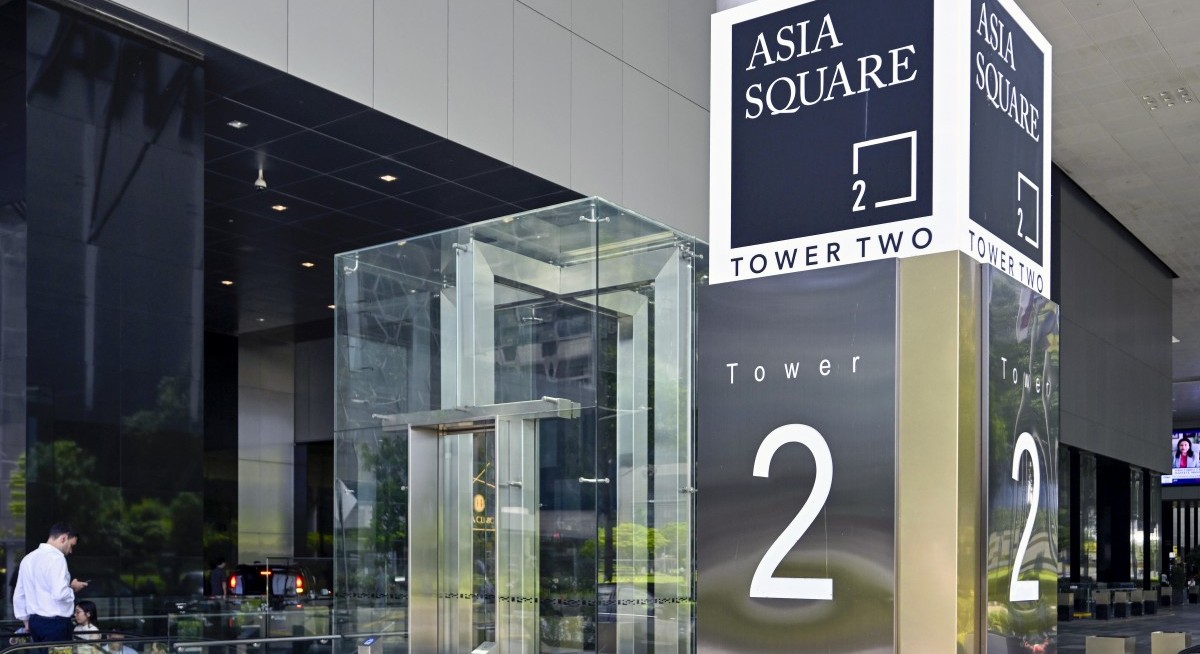


This figure comprises the nearly $2.5 billion IOIPG has agreed to pay CapitaLand Integrated Commercial Trust (CICT) for full ownership of Asia Square Tower 2 (AST2), announced on April 20; its landmark project, IOI Central Boulevard Towers (ICBT), completed in 2024 and valued at some $4.2 billion; and mixed-use development South Beach Tower, valued at around $2.8 billion.
IOIPG fully acquired the latter in September 2025 by buying out former joint venture partner City Developments’ 50.1% stake for RM2.75 billion ($834.22 million). The entire development comprises South Beach Tower, South Beach Avenue and the JW Marriott Hotel Singapore South Beach.

Collectively, these three assets boast a net lettable area (NLA) of 2.57 million sq ft and account for more than 70% of IOIPG’s investment property portfolio, cementing the group’s position among the top 10 commercial landlords in Singapore, notes DBS in an April 24 report.

What is behind IOIPG’s aggressive push into Singapore’s prime CBD market, and what are the group’s likely next steps? Taking a broader view of IOIPG’s Singapore-listed peers, who else could be playing the same game?
Buying AST2
See also: Fewer GCB deals in 1H2026, but larger quantums lift average psf near record: PropNex
CICT announced prior to the market open on April 20 that it would divest AST2 for $2.476 billion and acquire Paragon for $3.9 billion, a move that RHB Bank Singapore analyst Vijay Natarajan praised as “swapping leasehold prime office for freehold prime retail”.
IOIPG’s subsequent announcement, released when trading commenced that same day, reports that the price represents a $50 million discount to an independent valuation conducted by Savills on April 12.
In contrast, CICT’s announcement cites a valuation report by Cushman & Wakefield, which valued AST2 at $2.252 billion as of Dec 31, 2025. This places the agreed property value at a 9.9% premium to valuation, according to CICT’s bourse filing.
CICT, which has held this property for nine years, says it will book a net gain of $199.9 million from this sale.
Completed in September 2013, AST2 is a premium Grade-A office asset with approximately 773,460 sq ft of NLA. The then-CapitaLand Commercial Trust acquired AST2 from BlackRock in 2017 for $2.09 billion. CapitaLand Commercial Trust was merged with CapitaLand Mall Trust and renamed CICT in November 2020.
As at March 31, AST2 has an average occupancy rate of 95.8%. Mizuho Bank, Mitsui Group and KPMG are key tenants of AST2. The five-star luxury business hotel The Westin Singapore is also situated within the building.
In a statement, IOIPG group CEO Lee Yeow Seng calls Singapore a “cornerstone market” for the group, due to its stable socio-political environment and strong global standing as a premier financial and business hub in Southeast Asia.
“Singapore attracts multi-national corporations, global institutions and top-tier talents, reinforcing its long-term economic resilience. This latest acquisition reflects IOIPG’s continued conviction in prime Singapore assets, which offer stable recurring income streams supported by strong market fundamentals,” adds Lee. “In particular, assets located within the Marina Bay precinct are well-positioned to benefit from sustained demand, limited supply and ongoing urban transformation.”

GenAI tilting balance towards prime office
IOIPG’s move to consolidate ownership of prime office space in Singapore could be buoyed by a flight to quality amid a supply crunch until 2028, says DBS.
According to DBS analysts, the rise of generative artificial intelligence (GenAI) “does not appear to undermine demand for best-in-class office space”. Instead, it will likely accelerate a “structural bifurcation” within the office market, they add.
“While AI and automation may drive incremental efficiency gains (e.g. lower space per employee over time), this is being offset by a parallel need for higher-quality, better-designed workplaces,” write the DBS analysts.
Similarly, JLL observes that companies are reconfiguring office strategies around “magnet assets” — premium buildings that draw employees back and enhance productivity, rather than simply reducing footprint indiscriminately.
As workflows become more digitally enabled, the office increasingly serves as a hub for “higher-value activities” such as driving team collaboration, problem-solving, client engagement and culture-building, says DBS. “This is particularly relevant for sectors at the forefront of AI adoption (e.g. technology, financial services), which remain among the largest occupiers of Grade-A space globally.”
IOIPG’s continued capital deployment into Singapore reflects its strong conviction in the long-term fundamentals of the real estate market, adds DBS. “Core CBD office supply remains constrained, with limited new completions in the near-term, while demand continues to be supported by Singapore’s status as a safe haven and a flight to quality trend… AST2 presented a rare acquisition opportunity in a tightly held market.”

Rents for CBD Grade-A office spaces in Singapore rose for the fifth consecutive quarter in 1Q2026. Data from Knight Frank, JLL, Colliers and CBRE place the average monthly rent for Singapore’s premier office spaces at between $12 and $12.70 psf. Compared to 4Q2025, the four firms place the q-o-q increase in average monthly rent at between 0.5% and 1.5%.
At $12.04 psf per month, the average gross effective rent for CBD Grade-A offices is at its highest level since 1Q2009, according to JLL.
Large, contiguous floor plates exceeding 20,000 sq ft are expected to remain scarce, especially in the core CBD, notes CBRE. Shaw Towers stands as the only major office completion scheduled for 2026. Newport Tower, slated for 2027, is the only other CBD Grade-A completion on the horizon. Further ahead, Singapore Land (SingLand) is redeveloping The Clifford, formerly Clifford Centre, into a mixed-use tower with Grade-A office space, which will be completed in 2028.

Ducks in a row
A short walk near Shenton Way MRT Station will reveal the synergy behind IOIPG’s plan: AST2 is directly linked to ICBT via an elevated pedestrian bridge. The group’s luxury residential and hotel development, W Residences Marina View – Singapore (currently under construction), is also situated nearby.

Adding to that is the ageing Shenton House, which Lee acquired in 2023 for some $538 million in his personal capacity via private company Shenton 101. Lee was the sole bidder for the property, which spans 3,377 sqm and is designated for gross floor area (GFA) 11.2 times the total land area.
The site, located just opposite AST2, has a 99-year lease from June 2, 1969. It is one of the last buildings from the 1970s that remains along Shenton Way. Across the road sits the extensively refurbished OUE Downtown, which was previously known as DBS Towers 1 and 2 and was completed in 1975.

Lee told the IOIPG board that the size of the acquisition and a tight timeline set by the committee in charge of the sale process necessitated that he go through with the acquisition alone.
Lee then attempted in June 2024 to sell Shenton House from Shenton 101 to IOIPG and have the two entities jointly redevelop the project. IOIPG declined the offer in August 2024, but its subsidiaries were appointed to be the sole project manager and property manager for the redevelopment of the commercial property.

Later that year, Lee withdrew a proposal seeking shareholders’ consent over the potential conflict of interest. The resolution was to be tabled at an extraordinary general meeting (EGM) on Nov 7, 2024, but he withdrew a day earlier as institutional shareholders had already voiced their opposition.
Neither Lee nor IOIPG have commented on the redevelopment plans for Shenton House since then. The initial plan was for works to commence in 1Q2027, introducing commercial and hotel components, and conclude by 1Q2031.
After a year of silence in 2025, a post on an online forum from January claims a design competition had been called for the redevelopment of Shenton House and two architectural firms were shortlisted: NBBJ and Denton Corker Marshall.
NBBJ is credited with the redevelopment of Keppel Towers into Keppel South Central, while Denton Corker Marshall’s track record includes Asia Square Towers 1 and 2 and Guoco Midtown.
Denton Corker Marshall’s website even features renderings of its proposal, listing Shenton 101 as the client. The Melbourne-based architectural practice envisions “two dramatic 220m-high shafts clad in a deep white shade grid”, creating a “distinctive twin tower appearance”. The towers will contain a 400-room hotel above 12 office floors, adds the firm.

Meanwhile, NBBJ is proposing “vertical urban living” by stacking workplace, hospitality, wellness, childcare, food and beverage and public amenities, according to renderings uploaded in a Jan 14 post on Instagram.

Following press time, City & Country understands New York City-based architectural firm KPF has been chosen for the redevelopment of Shenton House.
Options beyond REITs
On April 11, IOIPG filed its draft prospectus for its REIT of Malaysia-based assets, seeking to raise some RM1.98 billion on Bursa Malaysia. Market-watchers are eager to see if IOIPG’s long-awaited Singapore REIT will materialise soon. Based on previous reports, IOIPG’s Singapore REIT is expected to list between 2027 and 2029.
However, punters who are hoping for a stake in the three office assets — and possibly even Shenton House — should consider whether there is sufficient appetite for another S-REIT.
The landscape has become more challenging, especially for commercial assets, says DBS. “Increasingly large ticket sizes of CBD office assets, coupled with volatile capital markets, have made injections into listed S-REIT platforms more uncertain. Sponsors are therefore faced with a trade-off: either hold assets on [the] balance sheet longer, tying up capital and increasing gearing as a result, or price assets more attractively to ensure DPU-accretive acquisitions for their REIT platforms.”
According to DBS, “purer-play” Singapore office REITs are trading at around 0.7 to 0.8 times their book value, implying market cap rates “meaningfully above” private market transaction levels.
“This disconnect suggests public markets may be overly discounting the underlying value of prime office portfolios, particularly those with strong occupancy, long weighted average lease expiries and high-quality tenant covenants,” adds DBS. “As a result, traditional REIT injections at book or market value become increasingly dilutive or difficult to execute without structural enhancements.”
Could property owners take the private route? DBS thinks the high-profile launch of Hongkong Land’s $8.2 billion Singapore Central Private Real Estate Fund (SCPREF) in December 2025 marks a paradigm shift.
“This structure effectively replicates key features of a typical REIT, offering investors regular income distributions but operates within a private capital framework, allowing for greater flexibility on entry pricing, leverage and exit timing,” add analysts. “Importantly, it taps into deep pools of global institutional capital, including sovereign wealth funds and pension capital actively seeking exposure to Singapore’s core office market amid global uncertainty.”
Playing the same game
DBS thinks developers who could be exploring the private funds or REIT route to monetise balance sheet value include City Developments (CDL), UOL, Ho Bee Group and GuocoLand.
“By monetising stabilised assets, whether through private funds, joint ventures or forming seed assets for an eventual REIT listing, we believe these developers could see a narrowing of their discount to revalued net asset values (RNAVs) over time,” adds DBS.
For UOL, the unveiling of its plans for a “hyper-mixed development” on the existing Marina Square complex “will kick-start a multi-year value-unlocking journey to optimise returns”, says DBS. The separately listed SingLand, which is 50.37%-owned by UOL, will also benefit from this trend, adds DBS.
Meanwhile, DBS expects CDL management to share its “strategic value realisation roadmap” in 2Q2026.
More mega-deals could be on the horizon. In January, media reports emerged that Malaysian sovereign wealth fund Khazanah Nasional and Singapore’s Temasek could soon sell Marina One’s office and retail components at an asking price of between $5 billion and $6 billion. The rumoured transaction would put some 1.88 million sq ft of premium Grade-A office space on the market.
In February, a bourse filing by OUE REIT indicated that its subsidiary OUB Centre and United Overseas Bank (UOB) are gauging market interest for One Raffles Place, which is expected to be priced at between $2.3 billion and $2.4 billion.
OUB Centre holds an 81.54% interest in One Raffles Place, while UOB holds the remaining 18.46%. The two-tower commercial development contains nearly 1.3 million sq ft of gross floor area.
OUE REIT is “testing the market”, says DBS. “We understand there is strong interest for this property and if sold, could mean a significant war chest for redevelopment and/or potential capital repayment to unitholders.”
Photos: Albert Chua/The Edge Singapore, Denton Corker Marshall, NBBJ
Tables: DBS Group Research
See also:
IOI Properties scales new high on REIT plan, analysts say watch Singapore next
IOI Properties’ REIT listing could unlock special dividend in FY2027




