




Dubai’s growing appeal to high-net-worth individuals (HNWI) and ultra-HNWI (UHNWI) is also reflected in its swelling millionaire population, which has nearly doubled since 2014 to exceed 81,000, according to London-based investment migration consultancy Henley & Partners. Together, these trends have cemented the United Arab Emirates’ (UAE) most populous city as a leading destination for mobile global capital.
But recent geopolitical tensions in the Middle East are beginning to test that narrative. As uncertainty deepens, global investors are reassessing their risk exposure, with some planning to relocate their capital and explore alternative safe havens to preserve their wealth.
Against this backdrop, Singapore is increasingly coming into focus. Widely regarded as a premier global safe haven, real estate players City and Country spoke to say the city-state’s longstanding reputation for stability, strong governance and currency resilience continues to anchor its appeal.

See also: Landed shophouse transactions hit decade low in 2025, but ERA sees rebound in 2026
Lee Sze Teck, senior director of data analytics at Huttons Asia, says the recent conflict has “shattered the image of stability in the Middle East”, prompting wealthy individuals to build contingency plans.
“It would not be surprising to see more wealth flowing into Singapore in the coming months, contributing to property demand,” adds Lee. “Some UHNWIs may consider commercial properties such as strata office units or shophouses on land zoned [for] commercial [use].”
For now, however, the data suggests a more nuanced reality.
Transaction volumes in Singapore’s shophouse market have shrunk from a peak of 253 deals in 2021 to just 89 in 2025. In 2026, only eight deals were recorded based on URA caveats lodged.
See also: Three freehold corner shophouses at North Bridge Road up for sale

At the same time, median psf prices have remained resilient. The same dataset shows that median psf prices rose from $3,599 psf in 2021 to a peak of $5,071 psf in 2024 before easing to $3,502 psf in early 2026.
Yap Hui Yee, executive director of investment sales and capital market at Savills Singapore, highlights that pricing is driven less by demand cycles and more by structural supply constraints. “Shophouses are tightly held… and transactions tend to be ‘event-driven’ rather than ‘market-driven’.”

This explains why “volumes can appear sporadic”, adds Yap, even as “benchmark prices remain firm”.
In periods of global uncertainty, this dynamic becomes more pronounced, says Yap — sellers are rarely under pressure, while buyers grow more selective.
As such, “the market does not necessarily see more transactions”, she adds. “But when deals do happen, they are typically for very specific, conviction-driven assets.”
Foreign buyers are also more commercial-minded. “There is a noticeable shift in how the foreign buyers think about the asset,” says Yap. “It is less about acquiring a ‘heritage piece’ and more about how the property can be positioned — whether as a flagship store, a brand space or part of a wider lifestyle portfolio. In that sense, the asset is being evaluated not just on price, but on what it can become.”
Capital arrives but stays on the sidelines
Even if HNWI choose Singapore as their next destination, actual real estate transactions may take months to materialise.
Navin Bafna, senior associate division director at PropNex, says capital may remain on the sidelines and not be deployed immediately. “Much of this capital arrives seeking stability, currency protection and strong banking safeguards rather than immediate deployment… Capital can be easily parked in Singapore’s financial system, but converting that into property transactions is far less automatic.”
Interest from foreign investors is there, says Adrian Khoo, founder of Haoran Estates under Singapore Realtors Inc. (SRI), but translating it into actual sales “takes patience and time”.

Capital inflows may take months to materialise, adds Khoo, and booking centres require time to be set up, “legally and operationally”.
Khoo, who specialises in high-value private and off-market transactions for UHNWIs, manages a private real estate portfolio across select global markets. A former banker at Barclays Private Bank, Julius Baer, BNP Paribas and Goldman Sachs, Khoo has over two decades of experience advising UHNWIs on structuring and investment mandates.
Singapore’s enduring appeal lies in its fundamentals, says Khoo. “A stable government, AAA credit rating, strong currency and a transparent, low-corruption environment — these attributes continue to draw renewed attention from global capital, particularly into asset classes that do not attract additional buyers’ stamp duties (ABSD) for foreigners.”
Potential inflow to shophouses?
Shophouses zoned for full commercial use — or approved commercial/mixed-use on commercial land — are exempt from both ABSD and seller’s stamp duty (SSD).
This exemption positions shophouses and other commercial assets as options “more favoured by foreign investors”, particularly when contrasted against the “hefty” 60% ABSD imposed on residential properties, says Loyalle Chin, co-founder of Steward Asia under PropNex.

Chin, who is currently marketing over $80 million in shophouse listings under Steward Asia, specialises in serving family business owners and UHNWIs in the investment and asset management of shophouses and commercial assets. Since the start of the war, he has seen an increase in enquiries from Chinese investors, as well as UHNWIs from Bulgaria, Russia and the Middle East.
“In general, when there is instability or uncertainty — such as the Russia-Ukraine conflict or political instability — capital tends to flow into safe-haven environments like Singapore,” adds Chin. “The appeal also extends to family offices and institutional investors who favour Singapore’s pro-business environment and lower tax rates.”
Shophouses are also widely “viewed as wealth preservation assets”, supported by rental fundamentals and a relatively low interest rate environment. Interest rates are currently below 1.5% for commercial assets, says Chin. “With borrowing costs now lower than cap rates of around 2%-3%, shophouses become a natural safe haven for capital.”
However, this influx of capital will compress yields. Yield reflects the investor’s return after acquisition costs and financing, while cap rate measures the property’s income relative to its market value.
“Yield in Singapore is approximately 1% to 2% for freehold shophouses and 2% to 3% for leasehold shophouses,” says Chin. “And bear in mind, there is an inverse relationship between yield and capital appreciation — the higher the capital appreciation, the lower the yield, and vice versa.”

The 999-year shophouse units at 209, 211 and 213 Jalan Besar, launched at a guide price of $42 million, have recorded at least 40% more client viewings since geopolitical tensions in the Middle East escalated in early March. The properties are exclusively marketed by Steward Asia under PropNex.
‘Yield’ is still key in decision-making
Indeed, yields in Singapore are generally lower, compared to some 7% in the UK and Dubai, says Khoo of Haoran Estates.
“Global investors who have grown accustomed to such higher yields may still look elsewhere rather than Singapore,” Khoo adds. “I can imagine Middle Eastern investors shifting their assets to the UK too, which provides yields at around 7%, albeit with a less secure ‘safe haven’ reputation compared to Singapore.”
Reflecting on the eventual destination of capital outflows from Dubai, Khoo muses: “Would Singapore be the first choice? Or elsewhere, such as Hong Kong, the UK or Japan?” His conclusion: “Different buyers will look at different markets differently.”
Investors, when faced with uncertainty, “instinctively seek safe havens” and gravitate toward countries “perceived as stable and well-organised”, says Khoo. This “herd behaviour”, which is the tendency to follow the crowd in moments of crisis, mirrors the same psychology that drives capital flows during geopolitical instability today, he adds.
Khoo provides some real-life cases and enquiries he has received recently: “Clients have been unwinding assets in the UK and North America due to tax changes and political risks, and some have also turned toward France and Japan.”
Japan has drawn heightened interest because of its weak yen, making assets appear attractively priced, notes Khoo. “We started getting calls from individuals with large capital wanting to buy trophy assets in Japan”.
Broadening demand beyond the CBD
Chin reports that one Japanese buyer — already an owner of a few shophouses here — is keen to own more of such assets for their own stay. “At most places, owner-occupiers or tenants can apply [for a] temporary change of use to residential on a commercial shophouse [on] level two. That makes the asset even more attractive because you do not need to pay ABSD.
Foreigners are not eligible to buy residential landed [property], but they can buy commercial landed [property].”
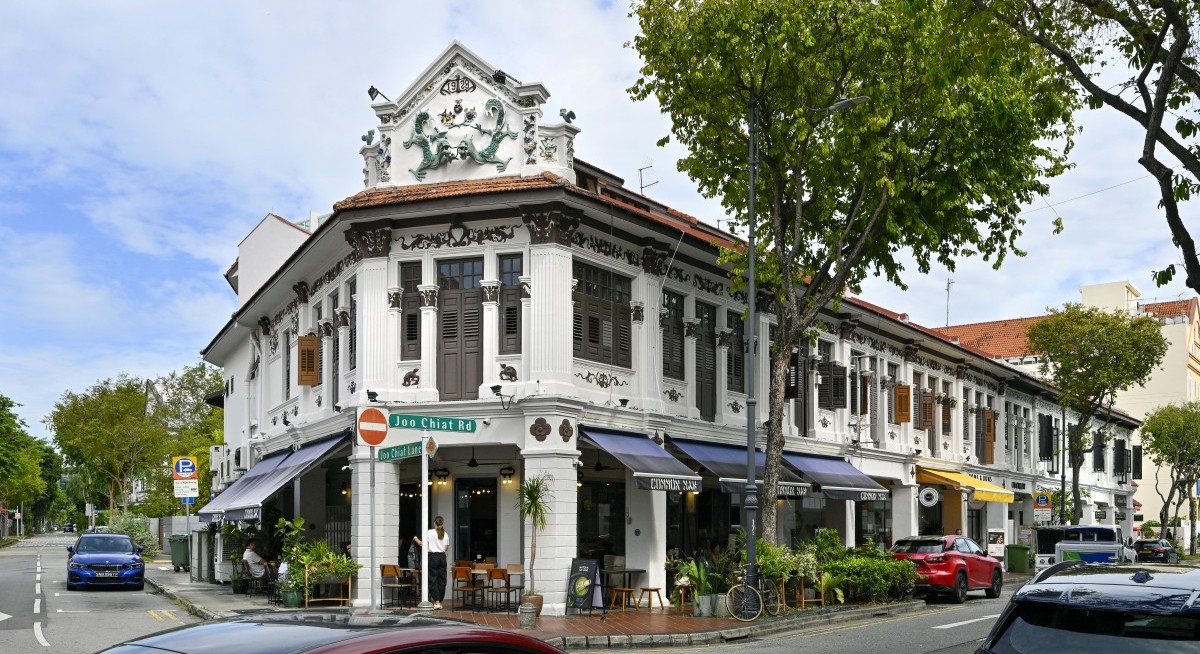
While the Central Business District (CBD) remains the traditional stronghold for foreign investors, demand has begun broadening into city-fringe shophouse districts where entry prices are increasingly becoming more attractive, says Chin to City & Country.

According to Chin, foreign and institutional capital remains active in District 1 (Marina Bay, Raffles Place, Cecil) and 2 (Chinatown, Tanjong Pagar). However, limited supply and elevated prices have prompted investors to explore District 7 (Beach Road, Bugis, Rochor), 8 (Little India, Farrer Park, Serangoon Road) and 15 (East Coast, Marine Parade, Joo Chiat).
In addition, supply within the CBD remains tight, and this has caused prices to rise “sharply”, he adds. “Entry prices for freehold/999-year shophouses in the CBD typically start from around $19 million, with psf values ranging from $3,500 to above $7,000. Buyers here tend also to be institutional investors, family offices and UHNWIs seeking trophy assets and long-term wealth preservation,” adds Chin, naming big-name owners like Clifton Partners, HSBC Asset Management and Arcc Holdings.
Growing foreign interest in District 7
The increase in interest is underpinned by the strong tourist footfall and low vacancy rates in these areas. “Bugis and Kampong Glam see all-week traffic, and that’s why rental is strong and vacancy is low. Foreign buyers are now comfortable outside the CBD, especially in District 7,” says Chin.
Corner shophouses along North Bridge Road command significant premiums due to visibility and scale, notes Chin. “Despite strong demand, supply remains tight, with psf prices ranging between $4,000 and $8,000. The entry quantum typically starts from $18 million [to] $20 million,” says Chin.
Investors seek rental growth in Districts 8 and 15
Separately, Districts 8 (Jalan Besar) and 15 (East Coast) are “both gaining traction among investors, but for different reasons”, adds Chin. “The approximately 4,000 residential units coming up in District 8 will boost future demand and therefore push rental prices up. Investors seeking growth play will be attracted to these districts.”
Meanwhile, District 15 — especially East Coast Road and Katong — is “attracting foreign investors looking for lifestyle-driven retail exposure”, says Chin. “Strong F&B demand and growing residential interest support rental potential, with prices ranging from approximately $2,700 to $5,300 psf and entry quantum starting from about $12 million.”
Capital inflows are complex
Still, transactions may only materialise in 2H2026. While market observers expect Singapore, Japan, Hong Kong and Australia to be the region’s beneficiaries from the Mideast conflict, some warn that relocating capital could face some friction.
Among these four markets, an industry leader thinks regulators in Singapore and Hong Kong may turn away UHNWI whose assets fall under a “grey area” in anti-money laundering (AML) checks.
In the $3 billion AML case uncovered in August 2023, for example, 10 Chinese nationals from Fujian were arrested, convicted and jailed. In 2024, DBS reportedly sold 13 mortgaged shophouses in Chinatown and Geylang that had been previously owned by two individuals connected to the case. The bank had put the companies that held the shophouses into receivership in September 2023.
The average retail investor — even one with global exposure — does not buy commercial real estate, writes PropNex’s Bafna in a LinkedIn post on March 12. “Commercial assets require larger capital commitments, longer holding horizons and a deeper understanding of leasing risk. Many investors who are comfortable buying apartments are not necessarily comfortable buying office floors or entire retail buildings.”
He adds: “So, when we hear confident statements that ‘all this money from the UAE will come and buy Singapore property’, it may be worth pausing for a moment.” — with additional reporting by Jovi Ho
Photos: Albert Chua/The Edge Singapore, Savills Singapore, Adrian Khoo/Haoran Estates, Loyalle Chin/Steward Asia
Data: URA Realis, Loyalle Chin/Steward Asia




