




What was different was that this particular home sat 10m from the waterfront, in air carrying salt from the Strait of Singapore, and that changed what the material could reasonably be expected to do. It was the first time I understood that location, not just specification, was part of the brief.
Singapore is not one climate, even though it is often treated as one. A waterfront bungalow on Sentosa, a sealed apartment on the 19th floor of a CBD tower, a landed home sitting behind the tree canopy in Bukit Timah — these impose meaningfully different stresses on the same specification and I have spent enough years working across all three to know that they need to be treated differently.
After that first Sentosa project, I moved to grade 316 for all coastal metalwork — the marine-grade standard, which was allegedly more resistant to salt air. It lasted 18 months before visible surface corrosion appeared. This was a better outcome than six months, but still not the performance a homeowner expects from what they understand to be a premium specification.
The maintenance conversation that should have happened at the point of selection instead happened when the evidence was already on the gate and the client was already disappointed.
See also: Arcc Spaces appoints The Afternaut Group to design Bank of Singapore Centre co-working space
In a coastal environment, the more honest version of that conversation is not just which grade to specify; it is what the material will need from its owner over time and how often.
The stress that high-rise apartments impose is less visible and harder to pinpoint. Air conditioning lowers indoor humidity to below 60% for most of the day. Singapore’s outdoor air, which routinely sits above 85%, floods back in every time a window opens or the system switches off overnight. Materials that hold their shape in a stable environment struggle when conditions shift daily, with stress building across seasons and years.
Within a year of occupancy, a custom medium-density fiberboard (MDF) mirror frame on one of my projects began to buckle and expand despite being well-made, well-finished and looking exactly as intended upon handover. The board had absorbed and released moisture often enough that it gave way from the inside, and once MDF expands like that, there is no undoing it. You can replace the finish, but the frame itself is gone.
See also: Maximising project value through design
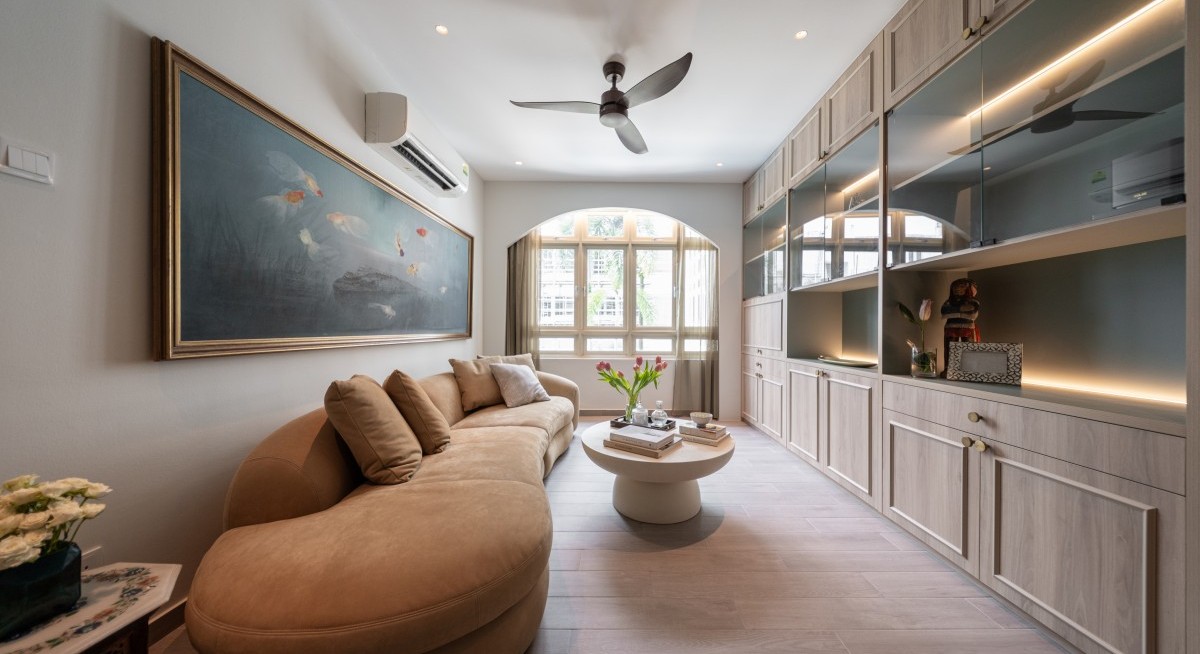
Timber flooring is where that same humidity cycle tends to show its impact. Solid hardwood and engineered timber look the same at handover — same species, same surface texture, the same warmth underfoot — but they respond to Singapore’s humidity cycle in very different ways over time. Solid wood moves with every shift in the moisture around it. In a fully sealed high-rise where air-conditioning creates more extreme humidity swings than a naturally ventilated home in Bukit Timah, that movement accumulates into cupping at the board edges, gapping between planks, and eventually a floor that no amount of maintenance can return to its original condition.
Engineered timber, built with a real hardwood veneer over a layered core, resists that movement by design; the layers are arranged to prevent the floor from expanding in a single direction. But that benefit only holds if the floor was left on site to adjust before installation, laid over a proper moisture barrier, with enough room built in to allow for natural movement. These are the decisions made before any plank is visible; they are entirely invisible at handover, but they are what the floor will perform on for the next five years.
Natural stone carries the same dynamic. Marble and travertine are typically selected in showrooms, under controlled lighting, at the beginning of a project when the focus is on how something looks rather than what it asks of you.
In Singapore’s humidity, both materials need resealing every six to 12 months, more urgently the travertine, because its naturally porous surface lets moisture work into the stone when the protective seal breaks down, forming mineral stains that cloud the surface and are difficult to reverse.
The difference between a stone bathroom that still looks right in year three and one that has already begun to look tired is mostly invisible at the point of selection. It comes down to how the surface beneath was prepared, the adhesive used, how the initial sealing was done, and whether anyone told the owner what to do and how often to keep it protected.
Material selection should be a design decision. But in Singapore, it is also an environmental one, then an installation one and then a maintenance commitment that outlasts all three.
The homes I have seen hold up best over time are not always the ones with the highest-grade materials; they are the ones where all three of those things were considered together, before anything was ordered, before any work began, when there was still time to make them work as a system. The ones that were not tend to announce themselves within three years.
Loren Ng is the founder of interior design-and-build studio and atelier Loren Ng Designs




