


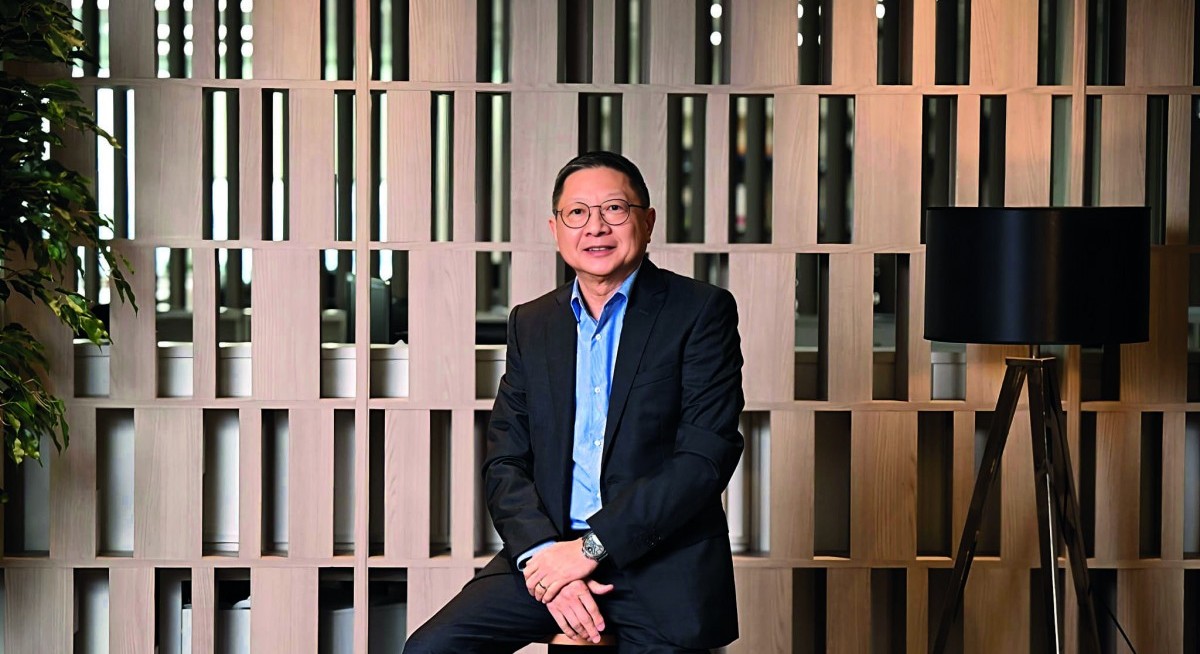


In 1992, he joined the Singapore branch of P&T Group, one of Asia’s oldest architectural practices. Over nearly 20 years, he grew with the firm as it expanded across the Middle East, Southeast Asia and China.
“After 19 to 20 years in P&T, I learnt almost everything about architecture — from design to management to market expansion and business development. I had my full training there.”
In 2011, he moved to Swan & Maclaren, the Singapore firm established in 1892 and responsible for many of the city state’s national heritage buildings, including the Victoria Theatre and Concert Hall and the original Raffles Hotel.
Asked for his reason behind the move, Lim jokes, “Because Singaporean mah.”
See also: Arcc Spaces appoints The Afternaut Group to design Bank of Singapore Centre co-working space
His decision was, in fact, deliberate. “I wanted to do something for Singapore. I also felt on the edge of deciding if I wanted to make a career change and start something for myself. So I joined Swan & Maclaren. It was very small then and had become to a sole proprietorship. We had to rebuild the company.”
Today, he is president and chief designer of the company, which operates in Southeast Asia and China and has expanded into healthcare, master planning and adaptive reuse.
“We need to be globalised. But at the same time, we need to be local,” he says. “When we go down to the local … level, we must be able to adapt to its conditions and compete with the locals.”
See also: Maximising project value through design
Form follows function
If there is a single thread running through Lim’s career, it is his unwavering belief in function as the foundation of architecture.
“In architectural jargon, they ask whether form follows function or function follows form,” he explains. “I truly believe that form follows function, because it serves the user. That is the responsible thing to do.”
For Lim, architecture is ultimately service. “Every design decision that we make must serve its functional requirements. You can’t have a building that you’ve designed that cannot work.
“I am quite rooted in the responsibility to the end user as a key fundamentalism, that everything in it must work. You can’t have something that is very beautiful but doesn’t work. Fundamentally, it’s like a duty to your end user, your client.”
Aesthetics are equally important, he adds, as buildings must endure and weather well.
This philosophy is strongly expressed in Swan & Maclaren’s design for Shanghai Raffles Hospital.
Shanghai Raffles Hospital
“One of the projects that I feel [most] satisfied with is probably the Raffles Hospital Shanghai,” Lim says.
Located in Pudong’s New Bund area, the 400-bed A-class tertiary facility, which is Raffles Medical Group’s first hospital outside Singapore, was developed to Joint Commission International standards.

“Raffles Medical Group’s key requirements centred on clear functional zoning, operational efficiency and a healing environment aligned with international standards,” Lim explains.
To fulfil this, inpatient and outpatient functions were separated into distinct zones and organised around a centralised core to minimise travel distances and improve workflow. A concave building form maximises south-facing exposure to natural light, while skylights and roof gardens draw daylight and greenery into the development.

“At its core, the design was guided by a balance of functionality and flexibility, ensuring the hospital could operate efficiently while adapting to future needs,” he says.
A large podium-level atrium anchors the experience. “It acts almost like a ‘shopping street’, making movement intuitive and helping people find their way easily through the hospital. At the same time, it creates a strong sense of arrival, which is especially important in a healthcare setting that can otherwise feel overwhelming.”
Greenery is layered from ground to roof level, reinforcing the healing environment. The project was shortlisted for the World Architecture Festival Awards — a recognition Lim describes as a defining milestone.
More importantly, he says, it “rethinks traditional healthcare design, replacing clinical sterility with warm, human-centred spaces”.
Upcoming Senibong Cove project
In Johor, Swan & Maclaren is spearheading a luxury high-rise residential project with WM Senibong in Senibong Cove — which is part of a waterfront master plan the firm has been engaged with since 2013.
The project, which will be launched in 2Q2026, sits on elevated ground, forming a backdrop to much of the surrounding township. Its long, linear site defines the planning strategy.

“The location is good, and sits on elevated ground facing Singapore, with a commanding view. It forms the backdrop of almost the entire Senibong site,” Lim says.
Three residential towers are positioned along the stretch to maximise southern views. “All the blocks are placed to have a very good commanding view with minimum overlook. That is very important.”
Arrival is organised along a central boulevard framed by greenery and flanked by landed residences. “There will be a central boulevard that leads you into the hillside. There will also be a clubhouse right in front of the entrance, so that gives you a very welcoming feel.”
The architecture adopts a modern tropical language expressed through clean forms and disciplined facades. Planning precision remains central.
While Johor allows for more generous unit sizes, layouts are calibrated to reduce wastage and prioritise usable living areas. “In Singapore, we must be very engineered in the way we utilise our space. It needs to be very functional, very efficient and very optimal,” says Lim.
Shared amenities will be consolidated at the podium level, where a landscaped deck will integrate facilities including a beach-style pool, recreational courts and clubhouse.
“Being close to the waterfront allowed us to shape it around a relaxed, resort-style way of living. Environmental considerations are embedded through orientation, cross-ventilation and natural daylight. Orientation is very important as we want to minimise [heat from the afternoon] western sun,” says Lim.
The objective, he adds, is straightforward: “Functional, well-considered and relevant.”
This article first appeared in the March 9 issue of The Edge Malaysia




