




Meanwhile, PAB Architecture director and Malaysian Institute of Architects (PAM) honorary treasurer David Teoh says there has been a surge of interest from developers in exploring health and wellness facilities after the pandemic. “We were approached to design typologies that incorporated assisted-living units and independent-living units, ideally with physical linkages to medical centres.”
Teoh notes that the two types of units are currently only accessible to the upper-middle class. Ho says many homeowners still prefer to retrofit their home to be senior-friendly.

See also: Go ahead and resent boomers but for the right reasons
This begs the question: what about elderly people living in older houses that were not designed with senior living in mind?
“In our current environment, where live-in help is relatively affordable, most families prefer to have their aged parents live in the same household or independently with a helper a short drive away. Instead of building isolated, niche senior-living enclaves, the market actually demands universally designed units that are integrated seamlessly within standard, multigenerational developments,” says Teoh.
Designing with dignity in mind
See also: iWow subsidiary bags $1 mil prize funding from DBS Foundation’s inaugural eldercare innovation award
Most of the elderly prefer to spend their golden years in their own home rather than relocating to a retirement facility. Nevertheless, ageing in place requires homes that can meet the evolving needs of the residents as they grow older.
What does it take to retrofit a home to be senior-friendly, or design a new home that can be adapted as its residents’ mobility changes?
According to PAM’s professional practice committee chairman Hue Chiun Hau, who is director of Environmental Design Practice, designing a senior-friendly home requires a human-centred approach which takes into account mobility, vision and balance as well as the provision of cognitive comfort.
“Architecture is about people, and our designs must evolve as people’s needs evolve,” says Hue, adding that senior living should be viewed from a different lens of physical mobility. “Ageing may also involve conditions such as dementia or neurodivergence, where sensitivity to noise and environmental stimuli can vary significantly.”
As such, designing for seniors includes elements such as step-free circulation, wider doorways, clear sightlines and placing bathrooms on the same level wherever possible.
For residents experiencing cognitive decline such as Alzheimer’s or dementia, visual memory cues can support wayfinding. “Personal photographs, familiar objects or display shelves near entrances can help reinforce memory and provide a stronger sense of belonging. When spaces are easy to understand, residents move through them more confidently and safely.”
The bathroom is usually the most challenging space for ageing residents as wet floors, compact layouts and frequent movement transitions create higher risk of slips and falls.
“Good design focuses on reducing these risks through spatial planning and material choices. Walk-in showers, slip-resistant flooring, adequate turning space and reinforced walls for grab bars can significantly improve safety,” Hue explains.
Lighting is also crucial in the bathroom, he adds, as seniors require higher illumination levels with minimal glare to see clearly, while small level differences, such as raised shower platforms or thresholds, should be avoided as they can be a trip hazard.
The kitchen is another part of the house that should be looked into as many seniors value the ability to prepare simple meals independently. “Safer kitchen design may include induction stoves with automatic shut-off features, accessible storage and well-organised work surfaces.”
Similarly, Teoh approaches senior-friendly design from another critical perspective — dignity. He believes that maintaining personal dignity is essential in such homes. “Safety and independence are simply the architectural tools we use to maintain dignity. If we prioritise safety above all else, we end up designing something resembling a hospital ward, which strips the residents of their humanity,” he says.
Teoh elaborates that upholding dignity means designing an environment where seniors can comfortably and proudly host guests, move freely without feeling institutionalised and remain actively connected to their loved ones.
Together, these perspectives highlight that senior-friendly design should not just prioritise physical accessibility, but also preserve the emotional well-being and dignity of the elderly.
While architects emphasise human-centred design, developers must also adhere to formal planning standards.
For developers who wish to undertake a project that caters to senior living, there are already guidelines in place, courtesy of Jabatan Perancangan Bandar dan Desa (PLANMalaysia), a government agency responsible for urban and rural planning.
Published in 2018, Garis Panduan Perancangan Fizikal bagi Warga Emas outlines what needs to be included should developers build aged-care facilities or homes that cater to senior citizens, as well as public spaces such as malls and amenities in strata developments.
The outlined requirements include adequate wheelchair space in living areas, bedrooms and kitchens, as well as in common areas like corridors and outdoor spaces such as parking lots, walkways and ramps, while landed homes should include a ground-floor bedroom with a wheelchair-accessible ensuite and ramp access from the car porch.
The guidelines are also supported by MS1184:2014 Universal Design and Accessibility in the Built Environment and PLANMalaysia’s Garis Panduan Perancangan Reka Bentuk Sejagat (Universal Design).
“Generally, the guidelines call for open spaces for ease of movement and to reduce risk of accidents, along with accessible kitchen cabinets, cupboards, sinks and other facilities for all, including wheelchair users, as well as ample resting areas, well-lit public spaces, wheelchair-friendly pathways and clear specifications for stairs, railings, handrails and lifts,” says Ho.
Future-proofing homes
Hue says senior-friendly design does not necessarily require significantly higher costs when planned from the outset as many improvements are more about better design decisions than expensive equipment.
“Retrofitting older homes can be more challenging due to structural and spatial limitations, but targeted upgrades — particularly in bathrooms, entrances and circulation areas — can significantly improve safety. In many cases, avoidable costs arise not from the accessibility features themselves but from designs that were never planned for adaptability in the first place.”
Strategies could include step-free entrances, wider circulation spaces, reinforced bathroom walls for future fittings, flexible rooms that can accommodate caregivers or evolving family living arrangements, as well as an emergency access for stretcher access or caregiver movement when medical assistance is required.
Meanwhile, Teoh suggests installing smarthome technology such as emergency pull cords and smart fall detection sensors in wet areas, as well as swapping traditional doorknobs for lever-style handles and lowering light switches to a wheelchair-accessible height.
For landed homes, homeowners have more flexibility in executing extensive, structural adaptations, say Teoh and Hue. As such, owners could locate bedrooms on the ground floor, consider structural provisions for future lifts or stair lifts to allow the elderly to continue using upper floors, hacking structural walls to enlarge an existing ground-floor bathroom to accommodate a wheelchair’s 360° turning radius or knocking through non-load-bearing panels to create an adjoining caregiver’s space.
The outdoors as a healing agent
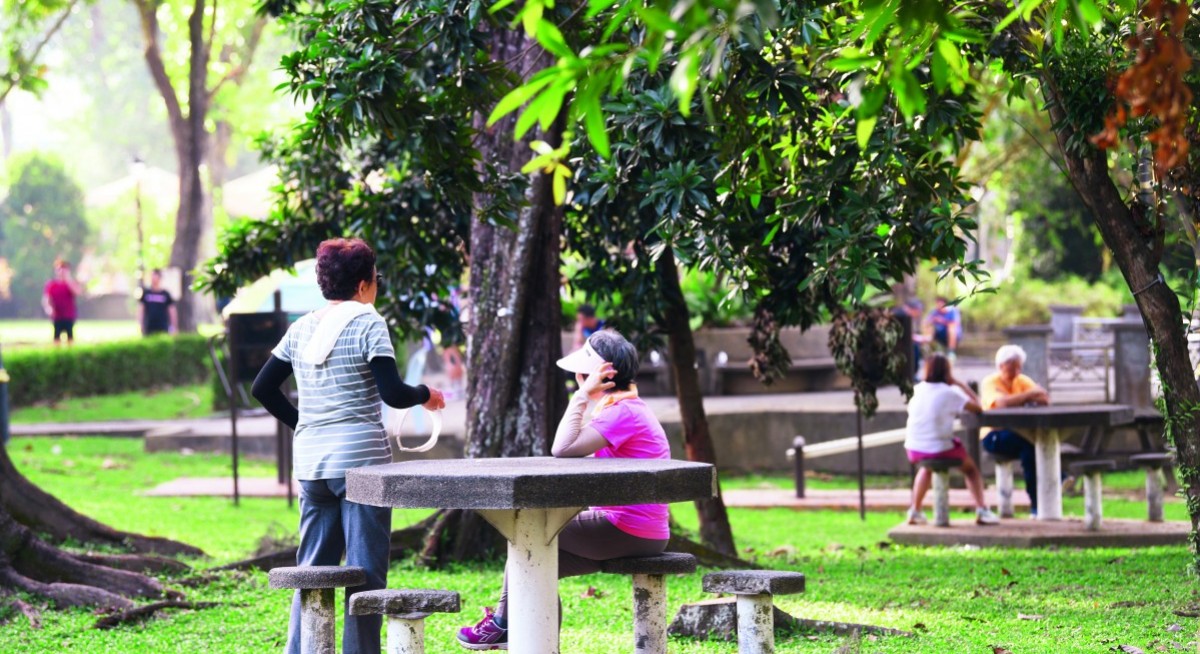
Besides creating a safer indoor environment, equal attention should be given to outdoor spaces. Institute of Landscape Architects Malaysia (ILAM) president Nor Atiah Ismail says landscape architecture, in the context of ageing societies, transcends aesthetics. “It’s no longer simply about planting trees. It is about intentionally designing environments that extend healthy life expectancy, restore dignity and reduce long-term healthcare burdens,” she says, adding that true ageing in place requires landscapes that are actively lived in, not merely observed.

“Physically, it encourages gentle movement and activity. Mentally, it reactivates memory through sensory engagement. Emotionally, it reconnects individuals with identity and meaning.”
How can we design outdoor spaces that allow seniors to explore safely while enhancing their mental and physical well-being? Nor Atiah says designing for seniors requires a shift from caution-based environments (a setting that is designed with an emphasis on safety, risk awareness and harm prevention) to one that nurtures confidence, continuity and companionship.
In many urban areas, fragmented sidewalks, poor connectivity and a lack of shade discourage movement for even the shortest distance. It is important to recognise that safety is not only about preventing physical accidents, but also about eliminating psychological barriers.
“When fear is removed, movement becomes natural and sustained,” she says.
Nor Atiah observes that the integration of wellness elements into senior living has increased and notes that the shift is urgent and inevitable. “We are transitioning from a reactive healthcare model to one that emphasises preventive environmental care.
“In Malaysia, rising cases of non-communicable diseases, declining mobility and increasing social isolation among the elderly highlight challenges that cannot be addressed by medical systems alone. The built environment must now play an active role.”
These wellness elements are not just beautification features but also provide a low-cost, high-impact alternative that can significantly “reduce hospital visits, enhance mental resilience and support ageing in place”.
She cites countries like Japan and Singapore as examples. Japan integrates dementia-friendly gardens into neighbourhoods to promote safe and independent movement, while Singapore’s National Parks Board develops therapeutic gardens designed to stimulate memory and reduce agitation among elderly users.
If other countries can do it, why not Malaysia? Nor Atiah asks. “Malaysia is at a critical threshold of this transformation and decisive action is needed to embed these principles into mainstream development.”
To support ageing in place, the design needs to be approached from the experience, dignity and everyday usability of the end-user. Various factors should be considered when designing an effective landscape design that is friendly for seniors of all abilities.
As such, an effective landscape could have looped walking journeys that allow safe and uninterrupted movement, supported by shaded canopies; edible and cultural gardens that reconnect seniors with memory, tradition and personal history; distance markers for motivation; gentle gradients with clearly defined edges; and resting points designed as social spaces to encourage interaction and engagement. These amenities could help seniors find meaning and belonging within their senior-friendly communities.
“A garden is not simply a green space, but a place of nurturing, where individuals can care for living elements and, in turn, feel cared for. A walking loop is not merely a circulation route. It establishes a daily rhythm that structures time and promotes consistent physical activity,” she says. “Sensory playscapes — enriched with fragrance, textures and sounds — transform design into memory. This illustrates how landscaping functions as more than just a setting and becomes an active agent of healing.”
Thermal comfort must be considered too, especially with Malaysia’s tropical climate. As such, it necessitates the integration of trees, pergolas and water features to mitigate heat stress. Visually, the design should stress the intuitiveness and legibility of a space. “In many Malaysian homes, green spaces remain visually appealing yet functionally disconnected from daily life.”
Smarter homes, safer places for elderly
Retrofitting older terraced and semi-detached houses into senior-friendly places to live in often presents significant hurdles, such as narrow corridors, small bathrooms and level differences. Because of these constraints, architects typically prioritise modifications in high-risk areas such as bathrooms, entrances and main circulation routes.
“In Malaysian homes, small floor level differences such as raised bathroom floors or balcony threshold are common and can become serious trip hazards as people age. Outdoor circulation areas should also be considered. Garden paths and driveways should have safe gradients, non-slip surfaces and adequate lighting,” says Hue. “Where structural changes are limited, technology solutions such as sensors, monitoring systems and alarm devices can complement architectural improvements. Adapting older homes often requires a practical balance between what is ideal and what is realistically achievable.”
For Nor Atiah, the most fundamental mistake designers or developers could make is designing without empathy. “Too often, outdoor spaces prioritise visual appeal over the human experience. This results in parks without adequate shade in tropical climates, benches that lack backrests or arm support, long pathways without sufficient resting intervals and layouts that emphasise symmetry rather than usability.”
Such design decisions reflect a disconnect from the realities of ageing bodies and lived experiences. These are not minor oversights, but critical shortcomings that can discourage use and limit accessibility. Effective design must begin with a deep understanding of users to ensure that spaces are not only beautiful but also comfortable, inclusive and responsive.
Nor Atiah says developers are often perceived as prioritising returns over quality in their project investments, where they emphasise “measuring value in square footage rather in quality of life, long-term residency or healthcare savings”.
Another critical issue is maintenance where a well-designed landscape can quickly lose its therapeutic value if not properly maintained, leading to underutilisation and decline. Meanwhile, land scarcity, a perennial issue in dense urban areas, should be seen as an opportunity to innovate.
As a matter of fact, newer integrated developments have adopted innovative strategies such as sky gardens, rooftop therapeutic spaces, vertical greenery systems with accessible platforms, pocket parks integrated within high-density environments as well as green corridors that connect buildings into cohesive, walkable ecosystems.
However, the adoption remains inconsistent as the challenge lies not in space, but in the commitment to prioritise human well-being within that space, says Nor Atiah.
Rehda’s Ho notes that it is the responsibility of industry players to enhance products such as senior-living homes, with the government taking the lead. “Should the day come when senior-living features in homes become mandatory, the government should take into account the cost developers will incur and offer sufficient incentives to encourage its adoption, not only to developers undertaking such projects, but also for individuals upgrading their homes to include these features,” he says, adding that the incentives could come in the form of rebates and tax breaks.
This article first appeared in the May 18 issue of The Edge Malaysia




