


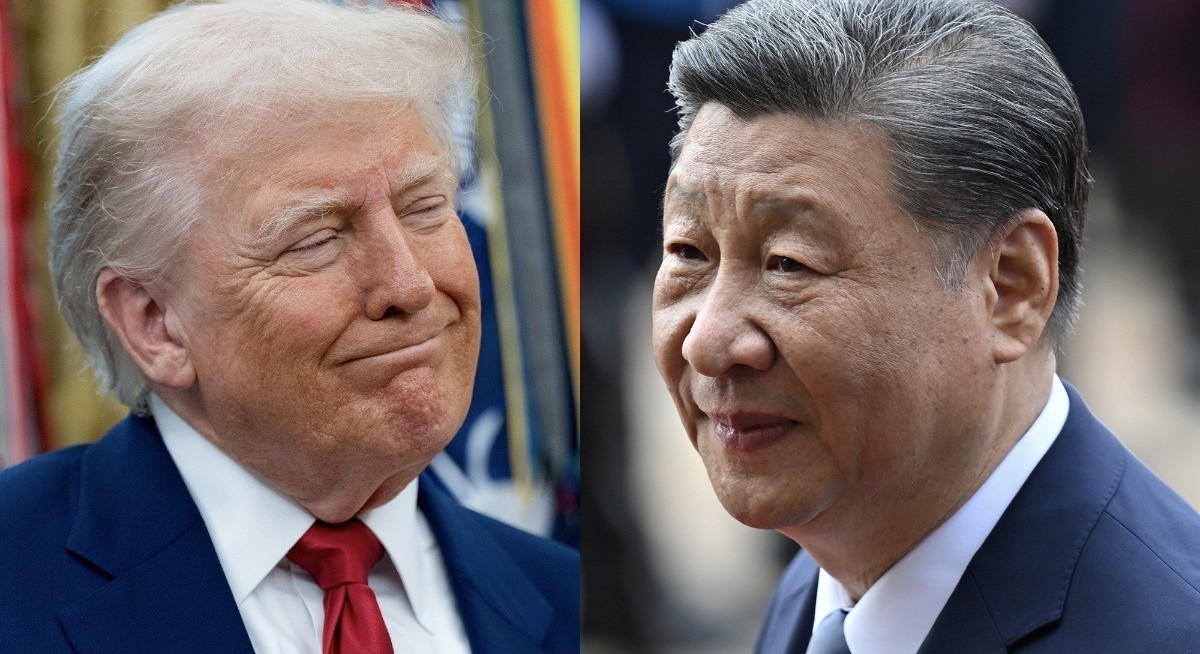


The US represents the world’s most sophisticated form of market capitalism. China represents an increasingly powerful form of state-bounded capitalism.
Both systems use markets.
Both rely heavily on private enterprise.
Both reward innovation, competition and scale.
See also: China’s titans are victims of China’s own success
But they optimise for very different outcomes.
The ancient foundational philosophies that differentiate America and China may still have huge explanatory power today.
Echoing Christianity 2,000 years ago, America’s Declaration of Independence in 1776 states:
See also: China’s next-generation industrial policy
“We hold these truths to be self-evident, that all men are created equal, that they are endowed by their Creator with certain unalienable Rights, that among these are Life, Liberty and the pursuit of Happiness.”
Hence, the primacy of private control over capital; whereas Confucianism in China around 500BC prioritised the social unit — family — and by extension, the nation. Capital and markets are the tools to be marshalled by the state in the primary interest of the nation’s goals and outcomes.
And that difference increasingly explains why:
• American companies dominate global equity markets;
• Chinese companies dominate the industrial ecosystem;
• US firms generate extraordinary shareholder returns; and
• China keeps producing brutally competitive manufacturing capacity at astonishing speed.
For more stories about where money flows, click here for Capital Section
The future of the global economy may ultimately not depend on which system innovates more, but which one compounds power more sustainably.
America builds corporate giants, China builds societal ecosystems
The American model is fundamentally built around the primacy of capital. Private ownership, shareholder returns, intellectual property protection, deep capital markets and scaleable profit incentives form the core of the system.
The American state certainly matters enormously. Silicon Valley itself emerged from decades of defence spending, research grants, university ecosystems and state-backed technological development. America has long deployed industrial policy through aerospace, semiconductor, energy, defence, pharmaceutical and research funding.
But critically, the American system still allows private capital to dominate the commercial outcome. Once companies succeed, they are generally allowed to:
• Expand aggressively;
• Consolidate market power;
• Protect margins;
• Monetise intellectual property; and
• Compound shareholder wealth over long periods.
This is why America repeatedly creates globally dominant corporate giants — not merely in technology today, but across multiple industrial eras. These include Ford Motor Co, General Motors, Boeing, Coca-Cola, IBM, Walmart, ExxonMobil, Pfizer, Microsoft, Amazon, Apple, Google, Meta and Nvidia.
The sectors change. The mechanism remains remarkably consistent.
Deep capital markets reward future profitability aggressively. High valuations reduce the cost of capital. Cheap capital funds more research, acquisitions, talent and long-duration risk-taking.
This creates a powerful self-reinforcing cycle:
• Innovation creates profits;
• Profits create high valuations;
• High valuations create cheap capital;
• Cheap capital funds more innovation.
American capitalism therefore excels at producing frontier innovation and extraordinarily profitable global champions.
The objective is growth and abundance, and in doing so comes dominance.
And once dominance is achieved, the system becomes extraordinarily powerful.
Software scales globally.
Patents are protected through American legal and geopolitical power.
Platforms lock in users.
Network effects strengthen over time.
Markets, therefore, assign very high valuations because investors believe future profit pools can persist for decades. This is why American technology firms often trade at valuation multiples far above the rest of the world.
Importantly, those valuations are not merely symbols of optimism. They are strategic weapons. High valuations allow companies to:
• Raise capital cheaply;
• Absorb losses longer;
• Hire the best talent globally;
• Acquire competitors; and
• Finance moonshot technologies at enormous scale and risk.
America’s greatest strength is therefore not simply innovation itself. It is the ability to financially weaponise successful innovation through capital markets.
China industrialises competition
China evolved differently. It is no longer remotely close to classical socialism. Nor is it a traditional command economy. Its growth over the past four decades has been overwhelmingly driven by private-sector incentives, entrepreneurship, competition and industrial ambition.
China’s most dynamic sectors — electric vehicles (EVs), e-commerce, batteries, logistics, consumer technology and manufacturing — are dominated by intensely competitive private or quasi-private firms.
Tencent, Alibaba, BYD, Meituan, Xiaomi, CATL, DJI, Shein and Huawei did not emerge simply because the state ordered them into existence. They emerged because firms were forced to compete relentlessly on cost, speed, manufacturing, operational execution and, increasingly, technology.
China understands something many ideological debates ignore: Efficiency ultimately requires incentives, competition and private-sector pressure. Purely state-run systems eventually become bureaucratic and inefficient.
But unlike the American model, China does not allow capital to become fully autonomous from national priorities. Markets are permitted. Competition is encouraged. Entrepreneurship is rewarded.
But the state remains above capital.
Strategic sectors are guided. Finance remains heavily influenced by policy. Data and platforms remain politically sensitive. And whenever private capital becomes too dominant or socially destabilising, intervention follows.
The philosophical assumption is fundamentally different.
In the American model, markets are assumed to optimise society.
In the Chinese model, markets are tools to strengthen society, industrial capability and national capacity.
That distinction profoundly changes corporate behaviour.
American firms are generally optimised for maximum profitability per user.
Chinese firms are often optimised for:
• Scale;
• Affordability;
• Industrial depth;
• Market penetration; and
• Ecosystem expansion.
The ride-hailing industry illustrates this clearly. In the US, Uber rides are materially more expensive because the ecosystem ultimately rewards pricing power and margin expansion once dominance is achieved. Various industry and consumer comparisons suggest a typical 5km DiDi ride in China costs around US$2 to US$3.50, while a comparable UberX ride in the US commonly costs US$8 to US$15. This difference is not merely labour costs, but deeper institutional structure.
In China, competition between platforms remained far more intense, pricing stayed lower, and affordability remained socially and politically important.
The result is that Chinese firms often operate within ecosystems where:
• Competition is relentless;
• Margins are compressed;
• Copying spreads rapidly; and
• Permanent monopoly extraction is far less tolerant.
Two capitalisms, two forms of innovation
This creates very different forms of innovation. American innovation still dominates many frontier technologies:
• Advanced software;
• Semiconductor design;
• Aerospace;
• Biotechnology;
• Cloud infrastructure;
• Operating systems;
• Venture capital ecosystems; and
• Global financial architecture.
Chinese innovation increasingly dominates:
• Manufacturing efficiency;
• Cost reduction;
• Supply-chain integration;
• Industrial engineering;
• Hardware scaling; and
• Rapid mass-market adoption.
America remains exceptionally strong at innovation and monetisation.
China is becoming exceptionally strong at industrialisation and execution.
The EV sector illustrates the contrast clearly. China developed an extraordinarily dense and competitive EV ecosystem involving dozens of domestic firms competing simultaneously across:
• Batteries;
• Charging infrastructure;
• Autonomous systems;
• Software integration;
• Manufacturing; and
• Supply chains.
Competition itself became industrial policy.
When dozens of firms compete intensely:
• Costs fall;
• Supply chains deepen;
• Manufacturing improves;
• Technology diffuses faster; and
• Adoption accelerates.
The result is industrial depth.
But this model also produces enormous stress:
• Overcapacity emerges;
• Margins collapse;
• Debt rises;
• Duplicated investments proliferate;
• Capital destruction becomes common.
China’s industrial system is extraordinarily competitive precisely because it is often brutally unforgiving.
Only the strongest firms survive.
Why American stocks win — and why China still matters
This also explains why American equity markets have dramatically outperformed Chinese markets over long periods.
American capitalism is structurally designed to reward shareholders aggressively. When companies succeed, investors benefit through:
• Expanding margins;
• Rising valuations;
• Durable pricing power;
• Market concentration; and
• Long-duration profit extraction.
China’s system is not primarily designed around maximising shareholder returns. It seeks to balance:
• Employment;
• Social stability;
• Industrial capability;
• Affordability;
• Technological independence; and
• National resilience.
Shareholders are important but they are not supreme. And when shareholder interests conflict with broader national priorities, capital is not always protected.
This explains why many Chinese firms achieved enormous scale, revenue and technological sophistication, yet still delivered disappointing long-term equity returns relative to American peers.
The ecosystem intentionally suppresses excessive monopoly economics.
Competition remains intense. Margins are competed away. Policy risk remains ever present.
But China’s model also faces a major long-term contradiction. High valuations are not merely market vanity. They are strategic financing tools.
If companies remain structurally undervalued for prolonged periods:
• Capital becomes more expensive;
• Long-duration research becomes harder;
• Talent attraction weakens; and
• Innovation financing eventually slows.
America risks excessive capital dominance. China risks not rewarding capital sufficiently. That may become the defining economic tension of the coming decades.
The next phase: China exports industrial power
And it may already be shaping China’s next phase of corporate expansion. If domestic competition permanently constraints profitability, Chinese firms will increasingly seek higher-margin international markets.
This is already visible across:
• EVs;
• Batteries;
• Drones;
• Consumer electronics;
• Solar;
• Industrial equipment; and increasingly
• Digital platforms and technologies.
China’s domestic market has effectively become the world’s largest training ground. Only the strongest firms survive its brutal internal competition. And once those firms expand globally, they may encounter something China itself often does not provide:
• Higher margins;
• Wealthier consumers;
• Less intense competition; and
• Stronger pricing power.
If Chinese firms eventually combine Chinese-scale efficiency with global pricing power, the implications for American, European and Asian companies could become profound.
America remains extraordinarily good at monetising innovation. But China is becoming extraordinarily good at industrialising competition itself.
The deeper geopolitical reality
The real competition is no longer merely economics. It is increasingly about different forms of power. America’s system compounds financial and technological dominance:
• Reserve currency strength;
• Deep capital markets;
• Software ecosystems;
• Intellectual property;
• Financial infrastructure; and
• Global investor alignment.
China’s system compounds industrial dominance:
• Manufacturing ecosystem;
• Supply-chain control;
• Battery production;
• Critical minerals refining;
• Industrial hardware; and
• Physical production capacity.
One builds financial empires. The other builds industrial gravity. And both models increasingly compete to shape geopolitics.
Conclusion
The defining battle of this century may therefore not be capitalism versus socialism, nor democracy versus authoritarianism. Both America and China are deeply capitalist in their own ways. The real difference is whether capital ultimately serves the state — or whether the state ultimately serves capital.
America builds dominant profit machines. China builds relentless industrial ecosystems.
One concentrates capital. The other compounds capacity.
One produces extraordinary stock market winners. The other produces extraordinarily competitive industries.
And the world may still be underestimating how powerful China’s model could become if it eventually learns not merely how to industrialise competition, but how to monetise it globally.
Next week, we present the second half of this article on how China strategically uses its savings from net exports to strengthen its industrial competitiveness and contrast it with Japan.
Portfolio commentary
The Malaysian Portfolio gained 0.4% for the week ended May 26, outperforming the benchmark FBM KLCI, which fell 1.1%. The winners were Hong Leong Industries (+3.1%), LPI Capital (+2%) and recent addition, Public Bank (+0.4%). Our acquisition of 12,500 shares in Public Bank increased total invested capital to 64.6%. Meanwhile, the biggest losers for the week were Kim Loong Resources (-1.6%), Maybank (-1.1%) and United Plantations (-0.1%). Total portfolio returns now stand at 216.7% since inception. This portfolio is outperforming the benchmark FBM KLCI, which is down 7.1% over the same period, by a long, long way.
We made several changes to the Absolute Returns and AI Portfolios. What we have articulated above has profound implications for us as investors. It strongly suggests that the US equity market will outperform Chinese stocks, given their higher and more durable profitability and primary objective of maximising shareholder returns. This being the case, we have pared our exposure to Chinese-based stocks in both portfolios. We also disposed of our gold investment.
The Absolute Returns Portfolio fell 1% last week, reducing total portfolio returns to 32.2% since inception. The sole gainer was Schneider Electric (+1.6%) whereas the losers were Alibaba (-5.8%), Sun Hung Kai Properties (-3.7%) and Berkshire Hathaway (-0.2%). Cash holdings increased to 73.1%. We intend to reinvest part of our cash in the US soon.
The AI Portfolio, once again, outperformed by gaining 6.9% for the week. Total portfolio returns since inception now stand at 27.4%. The biggest gainers were Unusual Machines (+31%), Hewlett Packard Enterprise (+10.1%) and Cadence Design Systems, Inc (+6.6%) while the sole loser was Alibaba (-5.8%). As mentioned above, we will reinvest the sales proceeds in the coming days.

Disclaimer: This is a personal portfolio for information purposes only and does not constitute a recommendation or solicitation or expression of views to influence readers to buy/sell stocks, including the particular stocks mentioned herein. It does not take into account an individual investor’s particular financial situation, investment objectives, investment horizon, risk profile and/or risk preference. Our shareholders, directors and employees may have positions in or may be materially interested in any of the stocks. We may also have or have had dealings with or may provide or have provided content services to the companies mentioned in the reports.




