




The EQDP has been closely watched since its launch as a $5 billion initiative to channel capital into the local market via private fund managers. At Budget 2026, Prime Minister Lawrence Wong announced a $1.5 billion top-up, bringing total funding to $6.5 billion.
Other measures proposed by the group include a dual listing arrangement with the Nasdaq as well as a $30 million “Value Unlock” programme to help listed companies bolster their investor relations and value creation capabilities.
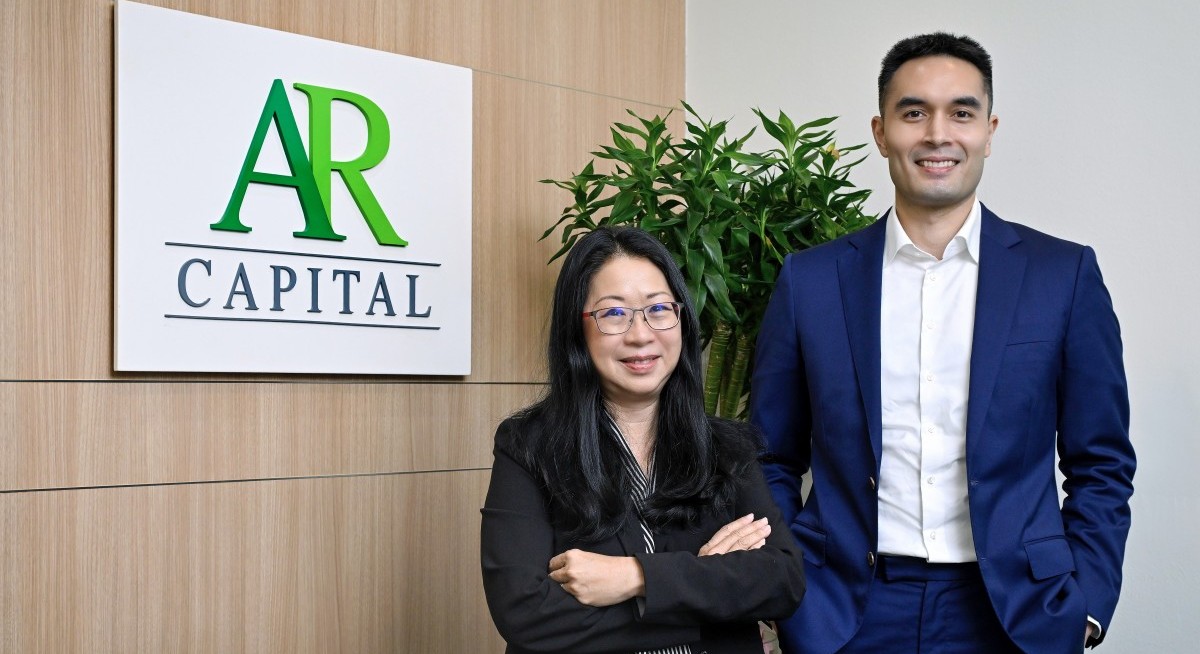
AR Capital was one of nine fund managers picked by MAS to receive funding under the EQDP. The locally-based asset manager says it will be launching its new AR Majulah SG Fund in the second quarter of 2026. The fund is targeted at accredited investors.
“This fund would be long-only. It’s going to be actively managed, focused on Singapore and Singapore nexus equities,” the fund’s lead analyst Lam Min Hwui told The Edge Singapore.
See also: We are not at the peak of the AI cycle: Eastspring
Singapore nexus equities are companies that may not be listed in the city-state but run substantive operations in the city-state. For instance, their management activities or intellectual property might be situated in the country. The term also refers to companies that are pre-IPO and planning to list domestically.
Despite the inclusion of Singapore nexus equities into the fund’s coverage, AR Capital’s executive director and portfolio manager, Millicent Lai, says they expect a large portion of the fund’s holdings to be listed locally.
Interestingly, the fund’s name came out of an internal competition within the firm. Lam says the team decided to incorporate the Malay word majulah because it means “onward”, as it is in line with the spirit of the EQDP.
See also: World Cup: Not just a major sporting spectacle, but also a growing investing theme
“We think that majulah felt like the right name,” says Lam. “It speaks [to themes] like progress [and] long-term development. It’s really aligned with what the programme is trying to achieve.”
AR Capital was part of the second batch of fund managers to be announced in November, alongside Amova Asset Management (formerly Nikko Asset Management), BlackRock, Eastspring Investments, Lion Global Investors and Manulife Investment Management.
The first batch of fund managers was appointed by the MAS in July 2025 and comprised Avanda Investment Management, Fullerton Fund Management and JP Morgan Asset Management. So far, a total of $3.95 billion has been allocated from the EQDP fund.
Not its first venture
The AR Majulah SG Fund would not be the asset manager’s first foray into the domestic market on behalf of clients. AR Capital currently manages the AR Dividend Plus Fund, a Singapore dollar-denominated dividend fund that invests in global equities. Singapore makes up a significant portion of its holdings, and AR Capital has also served as a cornerstone investor in several local IPOs in recent years.
Lai said they had considered channelling the capital they receive from the EQDP into the dividend fund, but ultimately decided against it. This was what Lion Global Investors did when it allocated its EQDP funds into the existing LionGlobal Singapore Trust Fund.
“The fund has already been structured,” adds Lai of their existing dividend fund. “To meet the requirements for funding would mean having to restructure how we set up the mandate, and that wouldn’t be fair to investors who have already invested in the fund.”
For more stories about where money flows, click here for Capital Section
The AR Majulah SG Fund will enjoy the same level of expertise AR Capital has been bringing to the table. Lai says the fund will be managed by a team of nine portfolio managers and analysts, including AR Capital’s founder and CEO, Leong Wah Kheong.
It’s about growth
Leong set up AR Capital after leaving the British asset management firm Schroders in 2005. He was then Schroder’s CIO for Asia ex-Japan equities. Lai was also from Schroders, where she served as director and senior portfolio manager with their Asia Pacific ex-Japan equities team. She left Schroders to join Leong at AR Capital in 2008.
“Our team has an average investment experience of 23 years, which is pretty deep for a kind of smallish firm like us,” says Lai. However, being a small team does have its benefits. “Unlike global firms that have multiple teams across different locations, we operate as one single, integrated team in one location.”
“This means we can not only compare a local company against its local peers, which everyone else does, but we can compare that local company and benchmark the company to its global peers,” adds Lai. “That’s a valuable perspective we bring to the ecosystem.”
In terms of their equity selection process, Lam says AR Capital is honing in on three key themes for their new fund. Firstly, the team is on the hunt for stocks that demonstrate secular growth. These are businesses that are exposed to long-term trends and can grow through and above the market cycle. “This could be in places like digitalisation, AI infrastructure, healthcare and advanced manufacturing,” adds Lam.
Secondly, they are looking out for companies that are engaging in value unlock activities, whether it be through portfolio rationalisation, capital return programmes or delivering improvements in their approach toward corporate governance and shareholder engagement.
“This group is interesting because it is normally quite underappreciated at the beginning as people don’t believe or don’t have the visibility as to how much improvement can be made,” says Lam.
“So when this happens, this group of stocks will see earnings upside. But not only earnings upside, but their valuations can re-rate when people start seeing these initiatives come true.”
Companies can unlock value as well by embracing new technologies like AI, adds Lam. This is particularly useful for businesses operating locally, where the labour market is generally quite tight, and labour is scarce.
Thirdly, AR Capital is searching for dividend growers. These are companies that are willing and able to grow their dividends over time. “We don’t really care as much about the headline yield currently. For us, we want that dividend to be able to grow,” says Lam.
Ultimately, it is the sustainability of a dividend and not how large it is that matters. “We want to look at the sustainability of the dividend and preferably some growth,” Lai adds. “It doesn’t have to be high growth, just some element of compounding growth.”
“Normally, a company that exhibits steady dividends with some growth will have a higher valuation (and thus a) lower dividend yield over time. If the dividend yield is very high, it means the market is concerned about the long-term sustainability of that dividend.”
AR Capital is not assessing companies based on the size of their market capitalisations. Instead, the focus is on finding companies that reflect the three themes they have identified.
“We are not looking for a particular market capitalisation. If we see opportunities for earnings growth, reforms, better governance and so on, that is actually interesting for us,” Lai says, noting that small- and mid-cap companies can grow and mature into mid- and large-cap companies over time.
One aspect which Lam and Lai repeatedly emphasised during the interview was their preference for companies that can demonstrate long-term earnings growth, rather than those whose valuations are sentiment-driven and dependent on liquidity rushing into the local market.
“It’s not to say we don’t care about valuation. We do,” notes Lai. “But valuation alone is not enough.” Lam adds: “Valuation re-rating can only bring you so far. Once you re-rate up to a certain level, you become expensive, and if you do not have the earnings growth to propel you forward, then you stall.”
‘Still room to go’
While some of the EQDP fund managers have already started deploying their capital, AR Capital believes that the valuations for Singapore equities remain attractive. “We are still early in the programme,” says Lam, noting that the next batch of EQDP fund managers is expected to be announced in mid-2026.
This means that even though some stocks might have gone up, there is still an opportunity out there, adds Lam.
“Actually, valuations in Singapore, while it has re-rated, it was coming off a very low base. So valuation-wise, there is still room to go.”
More importantly, the EQDP should not be regarded as a cure-all for Singapore’s market challenges. “That’s why the EQDP is a catalyst. It’s not a complete solution. If you look at the broader range of policy objectives, it does include getting more attractive companies to IPO and to help existing companies unlock value,” says Lai.
“If you look at it in totality, it is really not a short-term boost, like we say $6.5 billion or three rounds, four rounds,” she adds. “It’s not how much we put in but what it takes to get us there.”
AR Capital’s value proposition
AR Capital says its new fund has drawn interest from investors in Southeast Asia. Lam says this is mainly due to the strength and attractiveness of the Singapore dollar, the trust in the local legal and political system, the abundance of liquidity, as well as the push by the MAS to bolster the domestic stock market.
He adds that this comes on top of a broader shift from fixed income to equities amid a low-interest-rate environment. In the past, investors moving out of fixed income would have turned to real estate instead.
However, that option has become less attractive due to government cooling measures, such as additional buyer’s stamp duty, aimed at curbing property speculation.
When it comes to differentiating itself from the competition, Lai says AR Capital stands out in three ways. First, the team’s wholly integrated structure means it can move faster when it comes to exchanging ideas and acting on decisions. Second, the team brings a global lens to its analysis, which lends it greater depth.
Finally, AR Capital’s employees invest their own personal capital alongside their clients and have skin in the game.
“We are focused on the same goal, and that goal is to really protect and compound their capital over the long-term.”




