


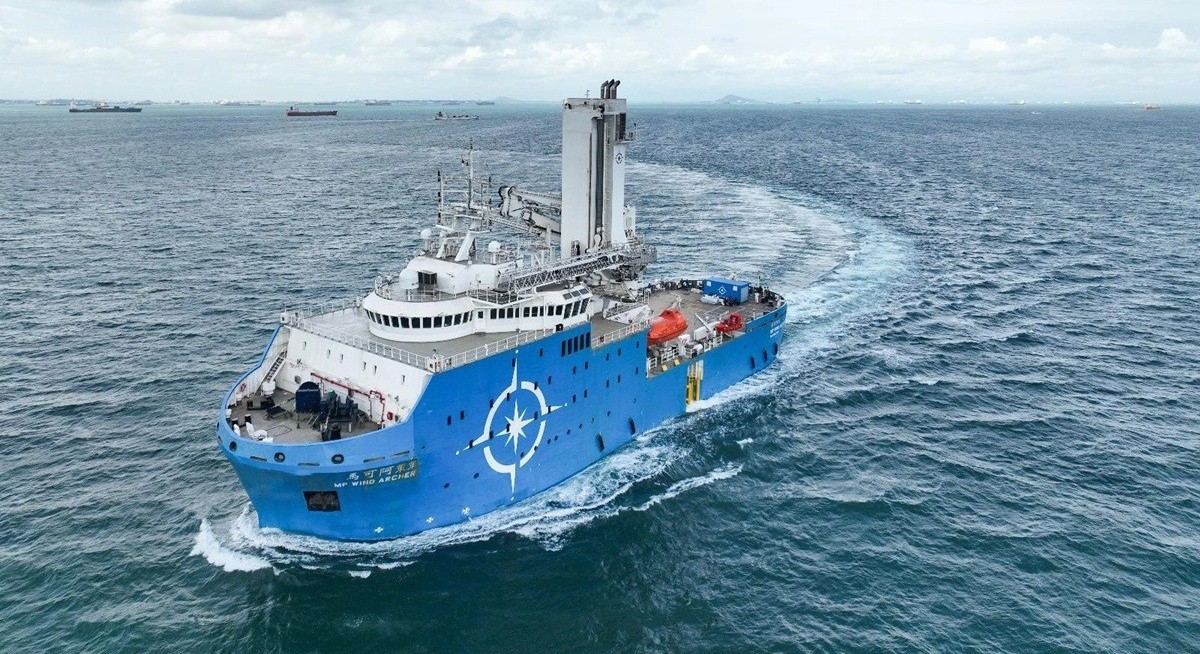


For context, FOPM is founded and controlled by the Teo family, who are also substantial shareholders in MPM via Apricot Capital. It is also noteworthy that Lim Ah Cheng (or AC Lim, as he is known in the offshore and marine circles), the former executive chairman of Dyna-Mac Holdings, announced plans in May 2025 to acquire a 16.7% stake in FPOM by buying new shares at 45 cents each.
The involvement of Lim, who is credited with turning around the fortunes of Dyna-Mac, suggests business expansion for MPM into engineering, procurement, construction and commissioning of topside modules for offshore assets.
Winning deal that unlocks value
“AC Lim is also part of Fuji Offset, so there’s a lot of talk to see how to bring this company to the next level,” says MPM CEO Sean Lee at MPM’s 1HFY2026 results briefing on May 18. “His involvement will be more on fabrication; he has the leads, the contacts.”
See also: Singtel maintains prospects of higher dividends; ramps up bid to capture AI growth
Since the announcement of the transaction, multiple analysts have said the deal is a win for MPM shareholders, as it unlocks value.
The transaction will see MPM divesting its shipyard business to FOPM at 70.1 cents per FOPM share on May 15. The total value of the transaction ranges from $120 to $139 million, depending on whether Marco Polo Shipyard and MP Marine achieve specific adjusted NPAT thresholds to trigger a $19 million earn-out.
Upon completion of the deal, MPM is expected to hold a controlling interest of approximately 74.1% to 76.8% in FOPM. FOPM will also seek to change its name to MPSE.
See also: Revenue-sharing to ‘structurally accelerate’ DPU growth for Parkway Life REIT: DBS
In his May 15 report, Jarrick Seet of Maybank Securities is optimistic that the transaction will help propel growth in the shipyard business by providing a separately listed platform for funding. He believes that the valuation represents a substantial premium to the shipyard business’s book value within MPM.
Similarly, despite initial earnings dilution from the transaction, CGS International’s Meghana Kande and Lim Siew Khee see strategic upside from capital-market optionality, which could translate into stronger earnings growth for FY2027 to FY2028.
“Over time, this [deal] could position the group to scale its shipyard operations beyond balance sheet constraints, which we view as the primary strategic rationale of the deal,” note Kande and Lim in their May 16 report.”Given the tight bank financing environment for offshore players since the last industry downcycle, we think this deal crystallises the value behind MPM’s assets.”
Another positive view of the transaction comes from the May 18 report by Heido Mo and John Cheong from UOB Kay Hian (UOBKH). To them, the deal is a “transformational value-unlock” as separating the shipyard from the parent eliminates intra-group revenue eliminations, enabling the market to price the shipyard business on its standalone earnings.
“The shipyard currently generates ebit margins of around 18% with a multi-year ORV [offshore research vessel] anchor,” note Mo and Cheong. “This [deal] also unlocks value that has been obscured within MPM’s conglomerate structure.”
Regarding the potential impact of the ORV, Lee notes that the company is gaining significant traction with the Taiwanese government, which could lead to more orders.
Strong margins back-stop business
For more stories about where money flows, click here for Capital Section
For 1HFY2026 ended March 31, MPM reported a 40% y-o-y increase in revenue to $74 million with a gross profit margin of 42%, representing a one percentage point improvement y-o-y. Excluding foreign exchange gains/losses and disposal of property, plant and equipment, adjusted NPAT is $13.8 million or 44% higher than the previous corresponding period.
Lee is optimistic about his company’s prospects, with the offshore oil and gas industry continuing to project a favourable outlook, with prolonged underinvestment during previous market downturns leading to under-replacement of global ageing fleets.
Offshore wind is another sector which will propel the company’s growth, says Lee. “Offshore wind is only 35% of revenue currently,” he remarks. “It’s going to be more moving forward and increase to around 50% in terms of revenue contribution for growth.”
Earnings per share are expected to increase between FY2027 and FY2030, supported by fleet expansion, projects Maybank’s Seet. Setting a higher target price of 24 cents per share for the counter, up from 20 cents, Seet values the company at 24 times the forecast FY2026 P/E, maintaining his “buy” rating.
Maintaining their “add” call, Kande and Lim raise their FY2027–FY2028 forecasted net profit on more back-ended newbuild recognition and stronger repairs. Correspondingly, they increase their target price to 21 cents from 20 cents on a higher 19 times FY2027 forecast P/E, which represents a 50% premium to 12 times that of peers.
Mo and Cheong note MPM’s stronger balance sheet with net cash quintupling h-o-h to $46.9 million, which enabled MPM to start construction of an advanced commissioning service operation vessel (CSOV+). Increasing their target price from 19 cents to 23 cents, they maintain their “buy” rating with a valuation of 25 times FY2026 P/E, which is one standard deviation above the mean.They add that the potential listing of Taiwanese subsidiary PKRO and the completion of the RTO may bring about “higher intrinsic value”.
Shares in Marco Polo Marine closed at 18 cents on May 26, down 0.1 cent of 0.6%.




