


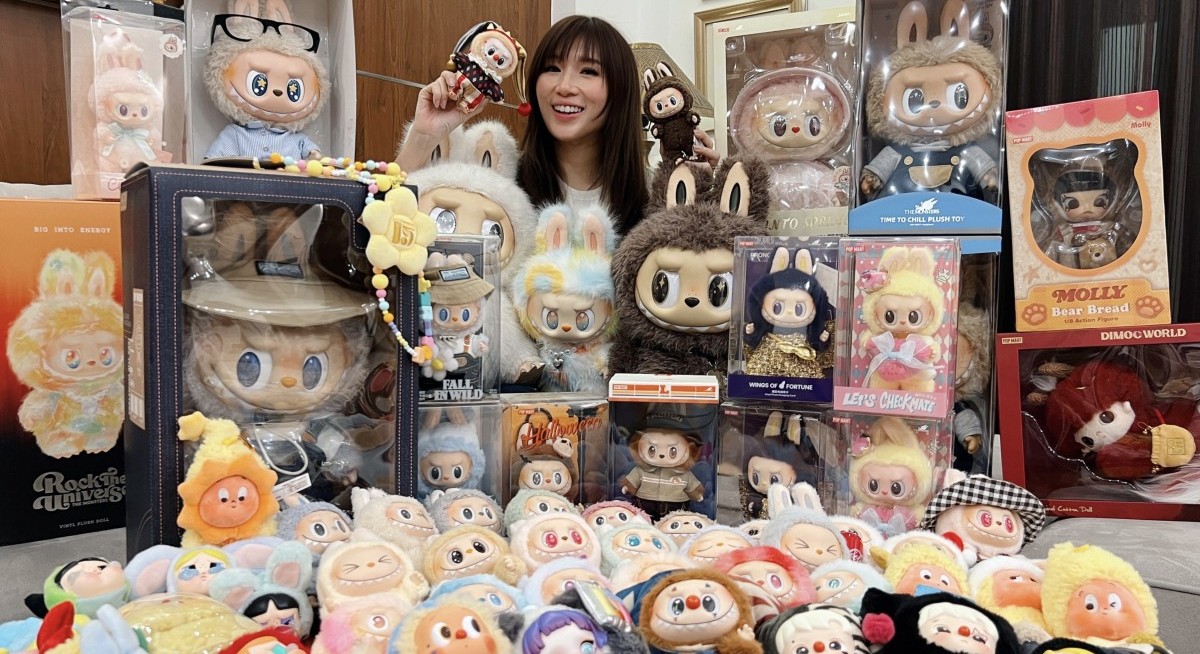


Sim has spent thousands of dollars on her figures, and her full collection numbers in the hundreds.
“Sometimes I feel I’m done, but new blind box releases somehow reignite the thrill and make me slide further down the rabbit hole. I think I’m too far down to get back up,” she says.
Hardcore fans of Labubu and its blind box brethren have sent Pop Mart’s stock surging this year. Pop Mart shares reached an all-time high of HK$339.80 on Aug 26, but have since fallen by more than 40%. Pop Mart’s stock is up by over 112% year to date, outperforming the Hang Seng Index, which is up by over 27% year to date.
Representatives for Pop Mart did not respond to The Edge Singapore’s request for comment on this story.
See also: GFL Environmental weighs take-private amid interest from buyout firms — Bloomberg
The rise and rise of Pop Mart

Pop Mart was founded by advertising graduate Wang Ning and his college friends in 2010. Wang opened Pop Mart’s first store in a shopping mall in Beijing’s Zhongguancun, also known as China’s version of Silicon Valley. Pop Mart initially sold a wide range of trendy and lifestyle items, but struggled to break even. That was until Wang made the pivotal decision in 2014 to focus exclusively on toys, its best-selling category.
See also: Czech billionaire Strnad mulls buying 14% stake in Pirelli — Bloomberg
Wang began working with artists to design new toy lines for Pop Mart. One such collaboration was with Hong Kong designer Kenny Wong, who had created the iconic Molly doll, a little girl with wide eyes and pouty lips, back in 2006. Wang secured the rights to Molly in 2016 and it became a major hit for Pop Mart.
Pop Mart went public on the Hong Kong Stock Exchange in 2020 and has since expanded its retail presence to more than 500 stores across 30 countries, including the US, the UK, South Korea and Singapore.
Enter Labubu

In 2019, Pop Mart signed an exclusive licensing deal with Hong Kong illustrator Kasing Lung to produce toys based on characters in his children’s series, The Monsters. Lung created The Monsters in 2015, whose members include the rabbit-like Zimomo and Labubu, Labubu’s boyfriend Tycoco, a creepy-looking snowman named Spooky, and a mouse-like creature called Pato.
The explosive success of Labubu was critical to turning Pop Mart into a household name, though it arguably received a significant boost from celebrity endorsements from global stars like Lisa, a member of the K-pop group Blackpink. Most Labubu fans first encountered the doll when Lisa began posting photos of her collection on Instagram in April 2024. That’s when the frenzy for Labubu dolls really began to heat up.

For more stories about where money flows, click here for Capital Section
Cindy Teo, a homemaker and avid collector of Labubu dolls, began collecting them before Lung’s deal with Pop Mart, when they were still produced by another toy company, How2Work. “So, before the Labubu craze, actually, the Labubu plushies are available online and in-store. You can go there and if you want to buy it, you can buy it off the shelf,” Teo says.
“Back then, nobody wanted to buy it. But after Lisa had it, then suddenly, boom, there’s a Labubu craze, and everyone is looking for it,” she adds.
The hunt for Labubu dolls saw countless fans around the world sacrifice sleep and time just to get their hands on the highly coveted dolls whenever a new shipment drops. On June 28, over 100 fans queued at a Pop Mart store at Ion Orchard from 5.30 am for the launch of a snack-themed series of Labubu dolls. Similar queues can be found in Pop Mart stores worldwide, including in cities such as Shanghai and London. In May, the BBC reported that customers were engaging in physical confrontations with Pop Mart staff over Labubu dolls.
Labubu fever also helped fuel a vibrant resale market for the dolls. Each doll typically sells for $15 to $40, but some dolls can be resold at 10 to 20 times their retail price at their peak. Pyron Tan, a graphic designer and toy collector, says it is difficult to eke out a profit reselling Labubu dolls unless you happen to own the secret, rare variants. Otherwise, one would typically lose money when selling the more common ones.
“Out of the entire series, you can maybe make a profit out of one or two characters. For the rest, you sometimes cannot sell them at the retail price. So you will profit from one or two, but for the rest, most of the time you are losing money,” Tan says.
Will Pop Mart pop?
The meteoric rise of Pop Mart’s Labubu has raised questions over whether the elvish creature will enjoy the same longevity as Sanrio’s Hello Kitty or if it will join the ranks of yesteryear fads like the Beanie Babies from the 1990s.
Bernstein analyst Melinda Hu told Bloomberg in a Nov 16 interview that Labubu’s popularity was being propelled by “scarcity, the hunt, the dopamine hit and the secondary market,” the same factors that had driven the hype over the Beanie Babies. Hu says long-term investors should avoid adding Pop Mart shares unless the company makes fundamental changes to its strategy.
“The bull-bear debate boils down to one question: can the company break free from Labubu dependency and spark growth through other intellectual properties [IP]?” Hu says, using the acronym for intellectual properties.
Most analysts, on the other hand, take a more bullish view on Pop Mart. DBS Group Research analysts Mavis Hui and Clement Xu reiterated their “buy” call and raised their target price to HK$415 from HK$368 in their Oct 22 report.
Pop Mart’s profitability will be supported by its “skyrocketing growth in the US,” enabling it to achieve a core net margin of around 35% in 2025, Hui and Xu write. The Trump administration’s tariffs are unlikely to upset this, given that the company has already increased its average selling prices for the US market. “Even if tariffs rise to 100% under a potential future administration, the impact is expected to be limited due to prior price adjustments and sufficient inventory prepositioning,” they add.
Morningstar’s Jeff Zhang raised his fair value estimate for Pop Mart to HK$280 from HK$240 in his Oct 22 report. Zhang attributes the recent decline in the resale prices for Pop Mart collectibles to “ongoing restocking and waning demand.”
“That said, Pop Mart’s new launches continue to sell out instantly, and we foresee overseas markets contributing more to future sales,” Zhang adds.
JPMorgan’s Kevin Yin and Yibo Wu raised their target price to HK$350 from HK$320 in an Oct 22 report. Yin and Wu cite the company’s impressive 3Q2025 sales performance, up 245%-250% y-o-y and ahead of their expected 140% growth. The pair sees the upcoming holiday season, the release of the Labubu and Friends animated series, as well as the next version of Labubu as potential catalysts for Pop Mart.
CGS International analysts Charlotte Zhou, Lei Yang and Aaron He say in their Oct 27 note that Pop Mart is a “mature IP platform” that is not solely reliant on Labubu. Labubu, as well as other characters from The Monsters, contributed to 35% of Pop Mart’s revenue in 1H2025, while newer IPs like Twinkle Twinkle are starting to gain traction.
That is not to say that Labubu’s value to Pop Mart is diminishing. Franchises such as Hello Kitty and Pokémon suggest that “peak popularity does not equate peak commercial value” and Labubu still has “substantial commercialisation upside,” write Zhou, Yang and He.
In November, entertainment outlet The Hollywood Reporter reported that Sony Pictures has secured the screen rights to Labubu and is developing a film based on it. Movies based on toys, however, have been a hit or miss at the box office. While movies such as Transformers: Dark of the Moon (2011) and Barbie (2023) have grossed over a billion dollars, misfires like the board-game-based Battleship (2012) grossed over $300 million despite an estimated budget of over $200 million.
Mark Greeven, dean of Asia at IMD Business School, says Labubu has yet to reach its commercial peak, given that Pop Mart will likely release another version in the months ahead. That’s on top of Pop Mart’s ability to keep inventing and developing new IPs as part of a comprehensive character ecosystem.
“Basically, the engine behind it is fast iteration, creative collaboration, discipline and controlled scarcity. It’s actually engineered luck if you think about it. So they have been quite good at engineering this,” Greeven says of Pop Mart.
Collectors like Teo and Tan, however, are less optimistic about Pop Mart’s trajectory. While Teo remains eager to see what Pop Mart has to offer, she fears the toymaker may have sacrificed quality for profit in meeting the surge in demand for Labubu.
“I hope Pop Mart will retain its quality. Once they go and overproduce the item, like the Labubu plush, you can see the quality went down a lot,” Teo says.
According to Teo, the first batches of Labubu plushies and blind boxes were significantly better than those available in stores today. “The new batches look very different. The fur colour, the sewing. Some are very fat, some are very thin. I think Pop Mart went to find a lot of different factories to help them rush all these goods out,” she says.

Tan, on the other hand, says he has been scaling down his Labubu collection. While he used to collect the smaller Labubu figures, he has since sold most of them and now focuses on Labubu plushies.
“I actually like the small ones, but after going through a few series, there’s no way I can just buy everything and display them,” Tan says, adding that Labubu plushies are more suitable for collectors living in Singapore, where space is limited.
Tan finds it difficult for Labubu to achieve the same level of fame and recognition as Hello Kitty, partly because Pop Mart’s business model involves developing a broad range of characters and IPs. So far, those characters haven’t been able to draw the same amount of hype as Labubu does.
“That’s because Lisa was not caring about them. One day, if we see somebody, like some stars carrying another character, then maybe,” Tan says.




