


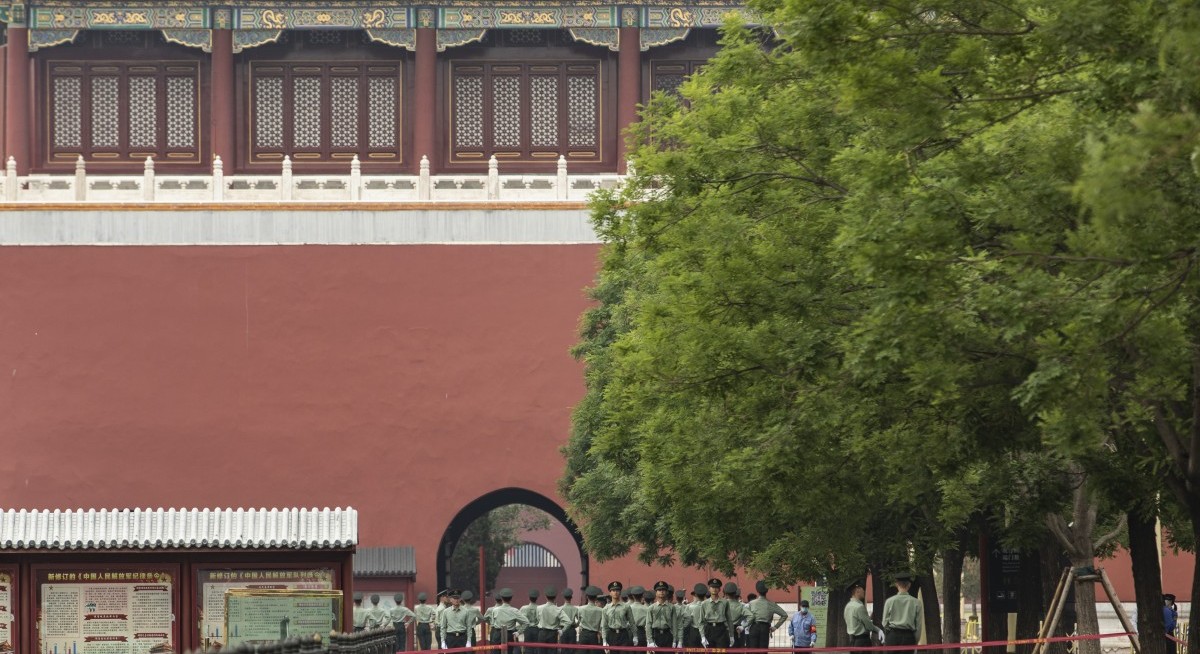


Reading his social media post, I was reminded of the time when I was supporting a delegation. The leader had some free time due to a cancelled meeting and he wanted to walk in the Forbidden City.
The official advice was that none of this was possible due to the wait caused by the long holiday lines.
There is always a side-door solution to any problem in China. In this case, it was literal, rather than metaphorical.
I directed the taxi driver to drop us off at the East Gate portal and we walked along the side of the Forbidden City wall, with the bitter cold wind blowing across the moat. We stood in line for two minutes, collected tickets and were inside the Forbidden City within eight minutes.
See also: China pursues austerity with first fiscal gap cutback since 2023
Local knowledge provides legitimate shortcuts so you can go where the Chinese go.
The tourists attack the Forbidden City at the front door. Foreign businesses often attack Chinese businesses by seeking entry through the front door. You can attempt to storm the doors, but in return, you can expect to be repelled and exploited. The full-frontal approach sets you up as an enemy or a willing victim.
It’s most clearly seen in companies that go to China to take advantage of cheap labour and cheap production costs. The factory girls in Shenzhen, Guangzhou, Shanghai and many other cities are not stupid. They look at the shoes and bags they are producing. They look at the result of their labours in Shanghai’s high-end shops and note the prices. They compare the asking price to the levels of wages they are paid. This exploitation gap puts out the welcome mat for counterfeiters.
See also: Tencent testing AI assistant for WeChat in China
Exploitation in the age of the internet is even less viable. In the 21st century, the internet provides rapid confirmation of exploitation. Therefore, some people reason, producing a cheaper knock-off, perhaps using the same production process and production line, reflects a true capitalist competitive pressure.
My business in China is built entirely around intellectual property. I cannot protect it successfully in China on my own, but my Chinese partners can. They choose to do so because my business success is part of their business success. Part of their profitable outcome depends on protecting my intellectual property. Our objectives are the same, but the methods used are different.
There is always a side door alternative to the full-frontal assault. The Manchu found the side door at Shanhai Pass in 1644. They broke through and founded the Qing Dynasty. Your business may not be of the same size as the Manchu invasion force, but the methods underpinning success are the same.

Technical outlook of the Shanghai market
The Shanghai Index has developed a strong rebound above the resistance level near 3,900. The rebound is defined with trend line B. The persistence of the rebound is confirmed if there is a pullback and rebound from the projected value of trend line B.
There are three horizontal lines on the Shanghai Index chart that provide the analysis framework. The first line is the support level near 3,900. The breakout above this level is bullish and reflects the broader global sigh of relief at the cooling of conflict with Iran.
For more stories about where money flows, click here for Capital Section
Any breakout from this level has strong resistance near 4,100. This was a major support-and-resistance feature that essentially capped the Index’s long-term uptrend. The index hovered or oscillated around this level for weeks before finally breaking the uptrend line and falling below 3,900.
The move towards 4,100 is also hampered by resistance around 4,000. This is determined by the long-term group of averages in the Guppy Multiple Moving Average indicator.
This group of averages is separating, but the current degree of separation is small. This suggests that investors could quickly change their minds and join the emerging uptrend. Wide separation in this group suggests entrenched selling.
The index plunged to 800 before the current rebound developed. The problem is that sustainable rebounds rarely develop in areas with no prior history as a support feature. This signals caution around the current rebound. This caution disappears if the index can again use 3,900 as a string support level.
Another market that falls below 3,900 has a historical support level near 3,700. This now appears to be a low-probability outcome.
Currently, investors, shown by the red group of moving averages, are confirming that the downtrend pressure is weakening. The move above 3,900 makes this a weak bullish environment.
Daryl Guppy is an international financial technical analysis expert. He has provided weekly Shanghai Index analysis for mainland Chinese media for two decades. Guppy appears regularly on CNBC Asia. He is a former national board member of the Australia China Business Council.




