


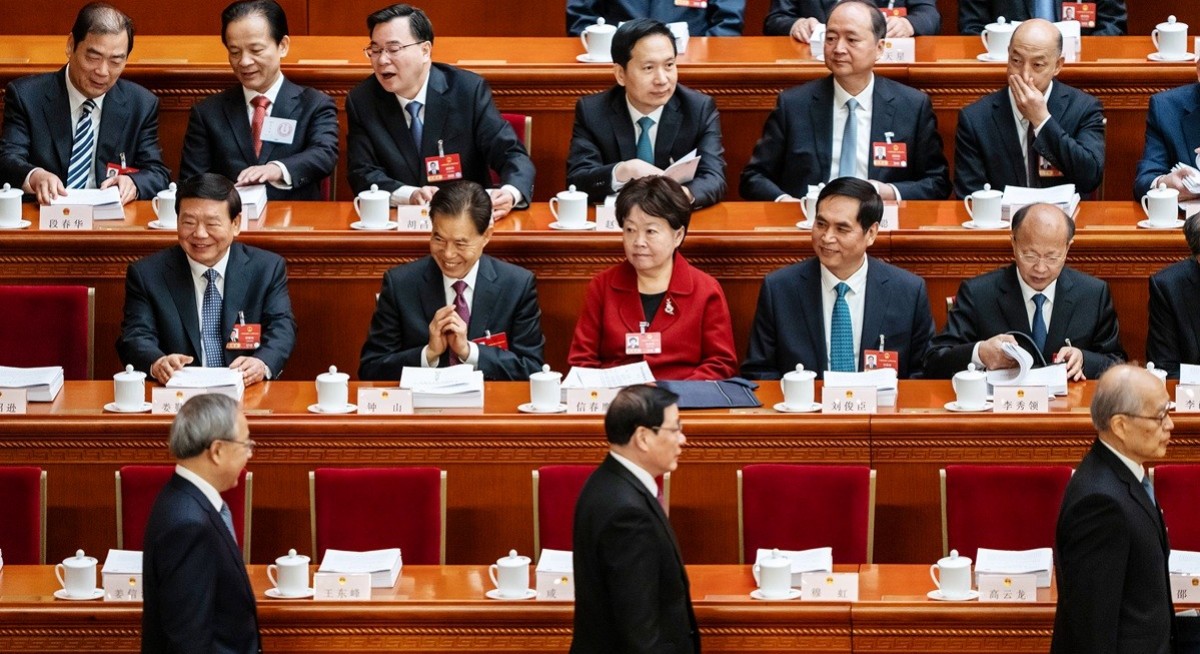


The 15th Five-Year Plan targets 70% AI penetration across the Chinese economy by 2027 and 90% by 2030. It designates humanoid robotics as a core-pillar industry with output doubling over five years. It commits to space-earth quantum communication networks, nuclear fusion timelines, and brain-computer interfaces. It sets AI-related industries at a target value exceeding approximately US$1.38 trillion ($1.75 trillion).
The policy focus is on continuation of the research and application momentum in these “new productive forces”. In this sense, it is a “steady as she goes” Two Sessions as movement towards these objectives is well in place.
The Two Sessions work reports and policy statements also show a drive toward targeted consumer spending, AI focus and confidence building through increasing the social security net.
Initiatives to increase domestic demand ranged from short-term, targeted subsidies to raising incomes and promoting service consumption. These all contribute to an expanding service industry. The key feature are the measures to lift incomes because this is what drives consumption. Previously, the central government boosted incomes by mandating a lift in the minimum wage.
See also: Taiwan suspends stock trading, shuts schools as Typhoon Bavi closes in
The core of this process lies in income growth, which requires a coordinated package of systemic policies. This is more than just boosting the income of low-income groups. The middle class is where modern consumer spending takes place, and in recent years, this group has constrained their spending. Improving childcare subsidies, strengthening educational support, and enhancing healthcare security are all measures which put money into consumers’ pockets by reducing the anxiety over longer-term care obligations for elderly parents.
The urban and rural resident income growth plan plays a pivotal role in stabilising the economy, expectations, and promoting consumption. The aim is to establish a virtuous cycle where income growth lifts consumption, which in turn drives economic growth.
A lift in consumption drives demand in many areas beyond consumer goods. Chinese businesses will step into this area so it becomes more competitive for foreign businesses working in the same areas.
See also: China’s reflation shows signs of peaking as Iran war shock fades
The high level of savings — and the concurrent reluctance to spend — is to be countered by changes to social security and household protections to increase financial security. This will help boost spending confidence by reducing the financial burden of looking after ageing parents.
Raising subsidies to lift income changes the nature of competition. The exact form and full substance of these initiatives are as yet undefined but this focus does signal increasing opportunities for servicing the silver economy.
Technical outlook for the Shanghai market

The Shanghai Index continues to oscillate around the 4,100 level. Trend support remains strong as indicated by the good separation in the long-term group of averages in the Guppy Multiple Moving Average (GMMA) indicator. The rebound is not strong, but it is steady. This is consistent with market caution in all global markets.
There is currently no indication that a substantial trend reversal is developing. Unlike many global markets, the retreats in the Shanghai Index have been very modest.
In previous retreats, the long-term GMMA has not compressed, which was evidence that investors were optimistic and actively buying in the market at a point of price weakness.
For more stories about where money flows, click here for Capital Section
The GMMA shows the same relationship in the current environment. However, the GMMA is edging towards a sideways movement. This shows investor support, but no enthusiasm for a continuation of the uptrend.
A sustained fall below 4,000 has a stronger support level near 3,900. A fall to this level would indicate a significant change in trend behaviour and potentially signal the beginning of a new downtrend. This does not appear to be a probable outcome on the current chart.
It is unlikely in the short term that the index will resume a longer-term uptrend. An index move above the value of the trend line A and above 4,200 would be an exceptionally bullish development.
The most benign outcome is for the index to continue to oscillate around the 4,100 level. However, this remains a critical trigger line for the development of new trend behaviour.
The market is cautious, but not yet nervous. A nervous market would be accompanied by a compression in the long-term GMMA as buying activity moves to a halt.
Daryl Guppy is an international financial technical analysis expert. He has provided weekly Shanghai Index analysis for mainland Chinese media for two decades. Guppy appears regularly on CNBC Asia and is known as “The Chart Man”. He is a former national board member of the Australia-China Business Council. He owns Chinese stock and index ETFs




