


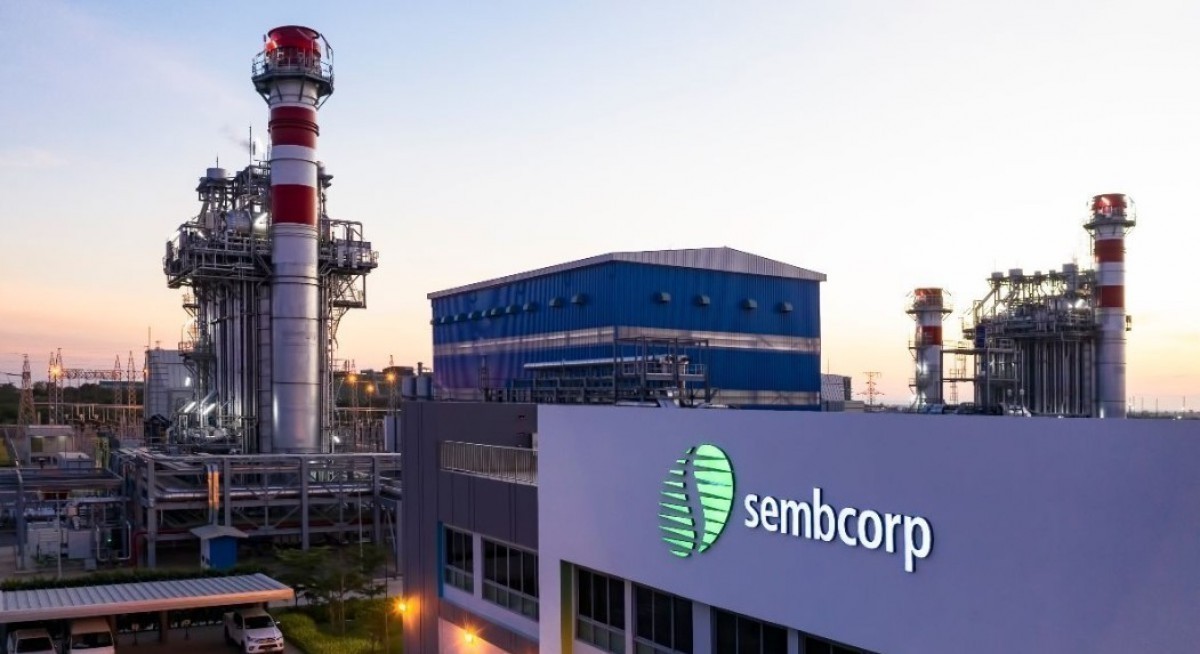


However, on the back of slower earnings trajectory and the company’s high leverage upon completion of the Alinta deal, Samant expects any gains in Sembcorp’s share price to be constrained.
During the results briefing which was also attended by The Edge Singapore, Sembcorp warned of margin pressures impacting the gas and related services (GRS) segment for Singapore. Group CEO Wong Kim Yin highlighted that around 5% the company’s Singapore portfolio is due for recontracting this year, while over at Senoko Energy, in which Sembcorp holds a 50% stake, has some 47% due as well. With energy supply expected to increase this year, Samant expects Sembcorp to enjoy lower margins for the new contracts.
Samant also suggests three other factors that could have a “drag” on Sembcorp’s earnings. These include the loss of key customers for UK assets; further decline in China renewable energy contributions attributed to continued curtailments and tariff pressure; and declining deferred payment note income due to forex changes.
He also believes that while the Alinta assets could mitigate earnings losses for existing business, overall earnings are still likely to be “lukewarm” for FY2026. Samant however, did sound the possibility of a rebound beyond that.
One driver is the expected completion of Sembcorp’s new 600 MW hydrogen-ready power plant in 4Q2026, with higher volumes and efficiency gains could offsetting any decrease in spark spreads. Combined with full annual contribution — estimated to be 12-15% accretive to earnings per share — from Alinta and acceleration of India renewable energy capacity startup, he expects Sembcorp to resume earnings growth from FY2027.
Samant also took note of the following which presumably he will keep an eye on: Sembcorp supplying around 690 MW to high-tech manufacturing including a recent 150 MW contract with semiconductor giant Micron; around $350 million in renewable energy subsidies from China; the recontracts for Senoko Energy; an exceptional item of A$208 ($187) million arising from the Alinta deal; and potential IPO for the India renewable energy business.
Cutting FY2026 and FY2027 core earnings by 10% and 12% respectively from earlier estimates, Samant projects 1% y-o-y core earnings growth for FY2026 and 16% y-o-y growth for FY2027 to account for lower GRS segment margins and renewable energy earnings. As such, Samant values Sembcorp at $5.80 and recommends investors to wait for a “better entry point to play such earnings uptrend”.
Foo Zhiwei of Macquarie is less upbeat about Sembcorp following the results briefing. In his first note, presumably after reviewing the results announcement before market opening, he calculates clean patmi for 2HFY2025 — excluding $59 million in deferred payment note FX losses and net loss of $5 million in one-offs — to be $512 million, better than estimates.
Foo notes that the renewables segment is facing sustained headwinds as the China market, with a 17% y-o-y decline in net profit to $74 million due to higher curtailment and depressed tariffs, continues to be a drag on performance. He also saw the impairment of the rooftop solar assets as Sembcorp exited the consumer and industrial rooftop solar business in Southeast Asia.
Overall, despite also noting the weaker GRS outlook, Foo was still optimistic, rating Sembcorp at “outperform” with TP of $6.59 as well as thinking that Sembcorp’s shares will react “positively” to the better-than-expected results.
Following Sembcorp’s briefing, Foo issued a research report on Feb 26, downgrading Sembcorp to “neutral” with a TP of $6.43. In his report, Foo notes clean patmi to be closer to $485 million, albeit still better than initial estimates.
That said, Foo notes that while GRS’s Singapore net profit remains stable, it belies a steeper decline in the core business. He adds that besides facing re-contracting downside risk for the Singapore power business, the GRS segment is also seeing lower profitability as volatility abates, with FY2025 earnings declining by $25-30 million from FY2024 levels, with Sembcorp sharing that earnings have stabilised.
With regards to the renewables segment, Foo expects no near-term improvement with Sembcorp highlighting the $30 million impact from curtailment in China, with about one-third attributed to higher hydro generation that is unlikely to be repeated. He also points out another $12 million downside in FY2026 due to China's cancellation of the VAT-added tax refund. He writes that growth for renewables now lies with India and Australia.
For integrated urban solutions, Foo expects start-up costs to impact the segment’s FY2026 earnings as Sembcorp scales up its portfolio of leaseable industrial land.
Based on the above, he has a “muted” view of Sembcorp’s valuation, writing that 2026 is likely a transition year for the company to realign its portfolio for growth. He believes that Alinta’s performance in the second-half of 2026 will be key to share price re-rating.
Foo lowers estimated patmi for FY2026 and FY2027 by 2% and 5% respectively, trimming his sum-of-the-parts valuation to $6.43 TP.




