


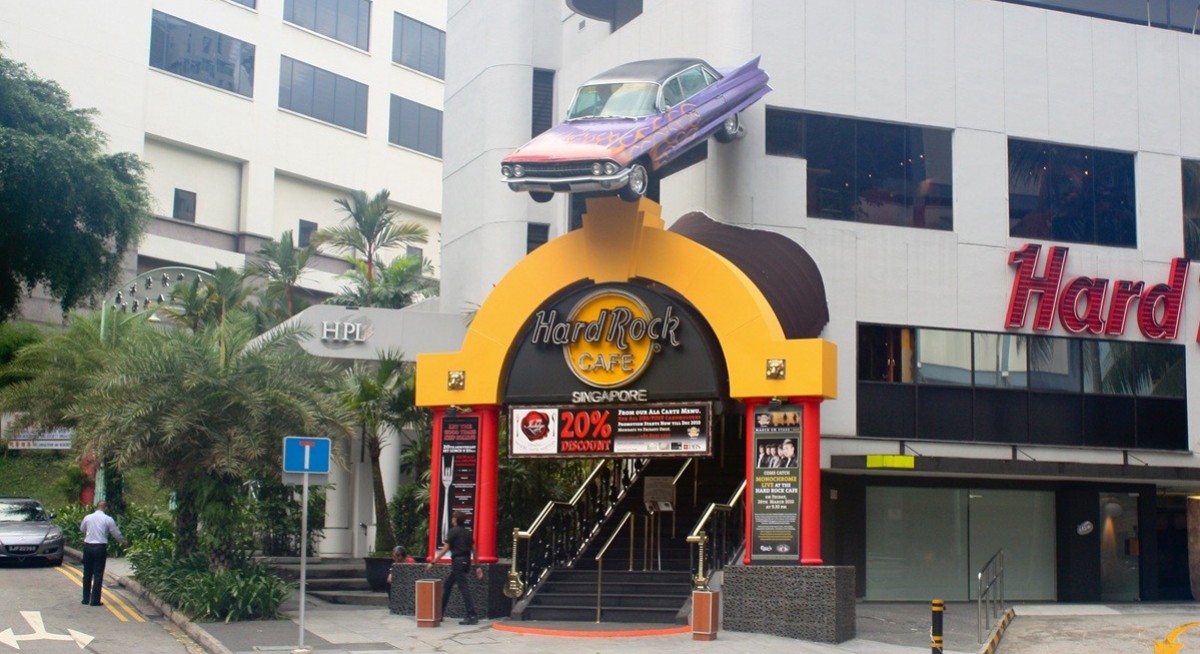


The line to that restaurant off Orchard Road was a mile long. People were jostling for entry. Some people had travelled from Jakarta and Kuala Lumpur to check it out.
Hard Rock Cafe is an American-themed restaurant. It features rock n’ roll memorabilia such as Eric Clapton’s guitar. The menu consists of burgers and ribs, which are served in lavish American portions. Beer is served in tall and icy mugs.
It was the first Hard Rock Cafe venue to open in Asia. It was also one of the earliest international F&B brands that launched in Singapore. Singaporeans in the 1990s were not yet accustomed to US dining brands landing on their doorstep.
The Singapore outpost became an institution among late-night revellers in the Orchard area. They were seeking American food and live music. It was founded by Ong Beng Seng, a businessman who is unlikely to frequent it these days.
See also: Clear cut case of no rate cut, no shortcut to lower US debt: Yellen
Singaporeans are about to get another taste of America. This would feature live markets and not a live band.
The Singapore Exchange (SGX) has launched a tie-up with Nasdaq. Under the Global Listings Board (GLB) programme, companies would be able to list on both exchanges. There would be a single set of offering documents and a simplified review process. The proposed amendments aim to minimise friction.
Nasdaq was founded in 1971 as the world’s first fully electronic stock exchange. It was built to disrupt. Most exchanges then relied on trading floors and telephone orders. Nasdaq ran on computers. It was faster, cheaper, and more transparent.
See also: May is another active month for SGX with volumes reaching new highs
Its defining move was attracting technology companies. Intel, Apple, and Microsoft all chose Nasdaq for their IPOs in the 1980s. Tech companies attracted tech investors, who attracted even more tech listings.
The dotcom crash of 2000–2002 was brutal. The Nasdaq index fell 80%. It was like a natural disaster.
The Nasdaq took 15 years to reclaim its March 2000 high. It was not until April 23, 2015, that it recovered its losses.
The survivors rebuilt Nasdaq into something unassailable. Today, the world’s five largest companies by market capitalisation (Apple, Microsoft, Nvidia, Amazon and Alphabet) are all Nasdaq-listed.
Its technology powers over 90 exchanges, including SGX itself. The result is a virtuous cycle. Its deep liquidity attracts institutional investors, who attract quality listings. This deepens liquidity further. No rival has cracked it. It is no surprise that Singapore chose Nasdaq.
Though Singapore is a tech hub, listings have been rare. The GLB programme could address this problem.
Eight Southeast Asian tech firms currently meet the $2 billion threshold for the scheme. Investors would be well-served to watch out for the names.
Sink your teeth into in-depth insights from our contributors, and dive into financial and economic trends
Carro is Singapore’s used-car platform and Southeast Asia’s first automotive unicorn. It is backed by Temasek and SoftBank, with total funding of over US$1 billion ($1.27 billion), and previously targeted an IPO for 2025–2026. Carro has welcomed the SGX-Nasdaq tie-up and is among the likely early movers in the GLB.
Nium is Singapore’s B2B payment infrastructure platform. It is valued at US$1.4 billion. It enables real-time cross-border payment capabilities. It is licensed in 11 jurisdictions and issues cards directly in 24 countries across 40 currencies. The cross-border payments story plays well to both US and Asian investors. This is exactly the aim of dual listings.
Ninja Van is Singapore’s logistics unicorn valued at approximately US$2 billion. It tackles last-mile delivery across Southeast Asia through technology-based solutions. The platform operates at a regional scale and has a straightforward B2B revenue model. It fits the GLB’s target profile.
Traveloka is an Indonesian travel super-app. It has long circled a public listing like a pack of hyenas. There were plans to list even during Covid, when travel had collapsed. Southeast Asian tourism is recovering and it has the brand recognition to attract Nasdaq tech investors.
Airwallex is a fintech that could be a trophy listing. It is valued at US$6.2 billion. Airwallex highlights the rising importance of cross-border payments. The company has deep ties to Singapore despite its Australian origins.
Investors may want to line up for these listings, as diners did at Hard Rock Café.
Nirgunan Tiruchelvam is head of consumer and internet at Aletheia Capital and author of Investing in the Covid Era




