


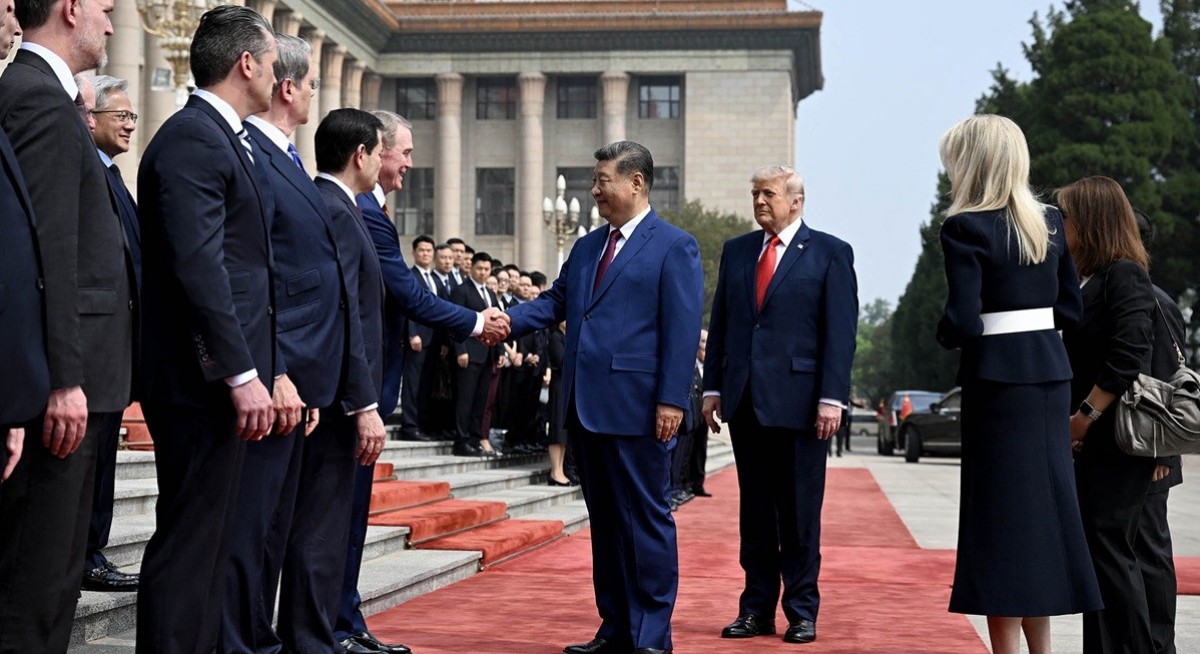


Some good things did come out of the meeting, such as boards of trade and investment to manage economic ties between the two countries. Trump will also host Xi for a summit meeting in the US in September, so the momentum of dialogue will continue. But there was limited progress on bridging disagreements over trade imbalances, technology controls, each side’s military presence in the Western Pacific and Taiwan.
With these differences unresolved, progress could reverse at any time. Over the coming years, Asian nations will have to adapt to a shifting US-China balance of power.
A new US-China framework could emerge
In essence, the summit reflected how the US-China relationship is settling into a more stable equilibrium, but one that is still amorphous and prone to regression back to tensions and misunderstandings.
An encouraging sign was that each side went out of its way to generate goodwill. Xi invited Trump to visit his Zhongnanhai compound, a hallowed ground which few foreign leaders get to see. He took Trump for a walk around the compound and offered to send Trump seeds for roses that Trump liked. For his part, Trump was on his best behaviour. He showered Xi with effusive praise and was well-disciplined in avoiding ad-hoc remarks that could have unsettled his host.
See also: Turkey’s US$37 bil defence firm says foreign orders doubled
But gestures can only go so far. What really matters is how the relationship is institutionalised. The Chinese side elaborated on their proposal for a new “constructive China-US relationship of strategic stability” and believes that Trump accepted it.
The read-outs issued by Chinese officials suggest that Xi wants a relationship in which the reality that both sides will compete against each other is accepted, but where such competition will be “measured”, and so leave room for cooperation. Xi indicated that, with such a framework in place, both countries should expand cooperation in trade, agriculture, healthcare, tourism and law enforcement.
American commentators saw the Chinese proposal as trying to confine the US within a framework that favoured China. Perhaps for this reason, the US response was not effusive: the US is not ready to commit to the Chinese version of this “constructive China-US relationship of strategic stability”.
See also: Qatari LNG ship struck in Hormuz, testing US-Iran deal
The US appears to prefer its looser idea of a board of trade and a board of investment that would manage contentious issues in specific areas of greatest concern to the US. In other words, both sides have a lot of work ahead to narrow the gap on a framework that would manage their relationship effectively.
Only a few concrete achievements
When it came to hard deliverables, the lack of specific details was telling. Clearly, the summit did not produce substantive achievements other than the improved sentiment above.
In the trade sector, hopes for a clear commitment to extend the ceasefire in imposing tariffs beyond October did not materialise. Trump claimed that China would buy 200 Boeing aircraft in the coming years, a number which he said could rise to 750 over time.
The US Trade Representative said that China would also purchase “double-digit billions” of dollars of soybeans and agricultural products. Beyond those deals, there were a few other substantive agreements. Trump claimed that “Xi likes the idea of buying US oil”, but there was no specific Chinese comment on this.
But what is of greatest concern is that the overarching issues lying at the heart of trade disputes were not tackled. American unhappiness over China’s alleged “excess capacity” remains unaddressed — this is an issue that many other countries are also getting agitated about. This issue will rear its ugly head unless China agrees to policy changes at home. For example, it needs to boost domestic consumer demand and remove barriers to imports. Before arriving in Beijing, Trump had proclaimed his intention to get Xi to open up China — it does not look as if he made any progress in this regard.
This was disappointing given that US Treasury Secretary Scott Bessent had met with Chinese Vice-Premier He Lifeng a day before the Xi-Trump summit. Xi had raised hopes when he said that the two countries’ economic and trade teams had “reached a generally balanced and positive outcome, which was good news for the people of both countries and for the world”. One would have thought that these senior officials would have prepared the ground for more meaningful agreements on trade at least.
The balance of power is shifting towards China
The dynamics of the summit highlighted how the US-China power balance has shifted in China’s favour. Xi and his delegation appeared well-prepared for the summit and made few concessions. In some aspects, such as the concept of a new strategic relationship, it seemed like it was China that was taking the initiative and the US was reacting rather than being in the driver’s seat in the relationship.
Sink your teeth into in-depth insights from our contributors, and dive into financial and economic trends
In contrast, it was Trump who was making concessions. It is not clear if Trump got anything in return for these concessions. He said he was considering lifting sanctions on Chinese purchasers of Iranian oil. It was also reported that the US administration had cleared sales of Nvidia’s H200 AI chips to several major Chinese technology firms.
But the biggest win for China was over Taiwan. It does look like Xi may have swayed Trump somewhat on the Taiwan issue. Trump said that Xi spoke about Taiwan a lot over their dinner on May 14. As a result: “I know more about Taiwan right now than I know about almost any country.” His reference to Taiwanese President Lai Ching-te would have made Xi quite happy: “They have somebody there now who wants to go independent.”
China would also have celebrated how Trump broke the longstanding American stance that US presidents would not discuss US arms sales to Taiwan with China directly. In 1982, President Ronald Reagan provided Taiwan with “Six Assurances”. The key assurance was on arms sales, including a promise not to engage in any prior consultation with Beijing on arms sales to Taiwan.
Following his trip, Trump said he had not decided on whether to approve the US$14 billion ($17.9 billion) US arms sale to Taipei that is currently pending approval, noting that “I’m holding that in abeyance and it depends on China.” Trump went on to say that the arms sale was “a very good negotiating chip for us, frankly.” If providing Taiwan with the wherewithal to defend itself against China is a bargaining tool for Trump, that leaves Taiwan in a bad position.
In addition, if Trump had hoped for Chinese assistance in dealing with Iran, he was certainly disappointed. All he got out of Xi was an assurance that Xi would “like to be of help” in ending the war.
Trump’s claim that Xi had assured him that China was not assisting Tehran militarily was not meaningful since China’s position has always been that it does not aid Iran. It is reported, though, that private Chinese companies provided Iran with critical satellite imagery and that China sells dual-use technology to Iran.
The big takeaway is that Trump had to deal with Xi and a China that was far more confident in standing up to the US and far more adept than in 2017 at fending off American pressure. Xi had had the foresight since 2017 to pursue a strategy of controlling chokepoints such as rare earths that could put the US on the defensive.
He also poured money and resources into research and development, with the result that China has made startling technological progress. All this has provided China with strong underpinnings to its ability to drive the relationship in its chosen way rather than simply respond to US pressures as it had to do in the past. Last week’s summit brought out clearly how much the power balance has shifted to China and away from the US.
What should the rest of Asia expect?
First, if a guiding framework for a stable US-China relationship is eventually agreed upon, the rest of Asia would benefit from a more stable US-China relationship, which would provide more certainty to businesses around the region.
Second, if negotiations eventually produce a trade agreement between the two countries as we expect, a less troubled trade environment would be a welcome development for the rest of Asia. In all likelihood, the average US tariff on Chinese goods will still be higher than that on America’s other trading partners in this region, so preserving the latter’s trade advantage over China and encouraging production relocation from China to places such as Southeast Asia.
Third, seeing how the shift in the power balance towards China has become more tangible, Asian leaders will now adapt their security and diplomatic strategies accordingly. It was already becoming evident before this summit meeting that the US is less reliable as a security guarantor, given the weakening of the pillars of American strength under the current administration and China’s growing power. This summit would have crystallised this view even more clearly.
What Asian leaders saw was a confident and competent Chinese side that was well-prepared and that was increasingly taking the initiative. The contrast against a US president who seemed to be less well-briefed, as his admission about learning about Taiwan from Xi showed, was stark. They will expect a less effective counterbalance against China from the US.
The rest of Asia will therefore lean more towards accommodating China as the rising power in the Asia-Pacific. They would look to benefit from more Chinese initiatives in the region. For example, if China were to expand its Belt and Road Initiative to help the region boost renewable energy and improve infrastructure, the response would be even more welcoming than in the past. Previously unthinkable projects, such as a land bridge across the Kra Isthmus to help China bypass the Strait of Malacca, could become feasible with Chinese backing.
Fourth, however, it is not only Taiwan that would be worried about the lack of an effective counterbalance against China’s rising power and assertiveness in the region. For Taiwan, the fear is that China may feel encouraged to step up grey zone pressures on it, given Trump’s half-hearted support for Taiwan. There could be more air and naval intrusions, more diplomatic pressures and more hostile trade actions.
But China has also been raising its military profile in disputed waters across East Asia. The construction of a large military base in Antelope Reef in the Paracel Islands is one example. Its fishing fleets and maritime militia are frequently embarking on large-scale activities in waters that are claimed by Japan, South Korea and others. If the perception of a weaker US commitment to its Asian allies encourages China to expand these activities, other Asian countries would feel more pressure.
Thus, we are likely to see more efforts by Asian nations to expand security alliances. In Southeast Asia, we are already seeing enhanced defence ties among countries such as the Philippines and Vietnam with external parties such as Japan, South Korea, Australia and India. This trend is likely to be reinforced.
In other words, this summit helped to crystallise an understanding of the power shifts in the region and will therefore speed up Asian nations’ responses to those shifts.
Manu Bhaskaran, CEO, Centennial Asia Advisors




