


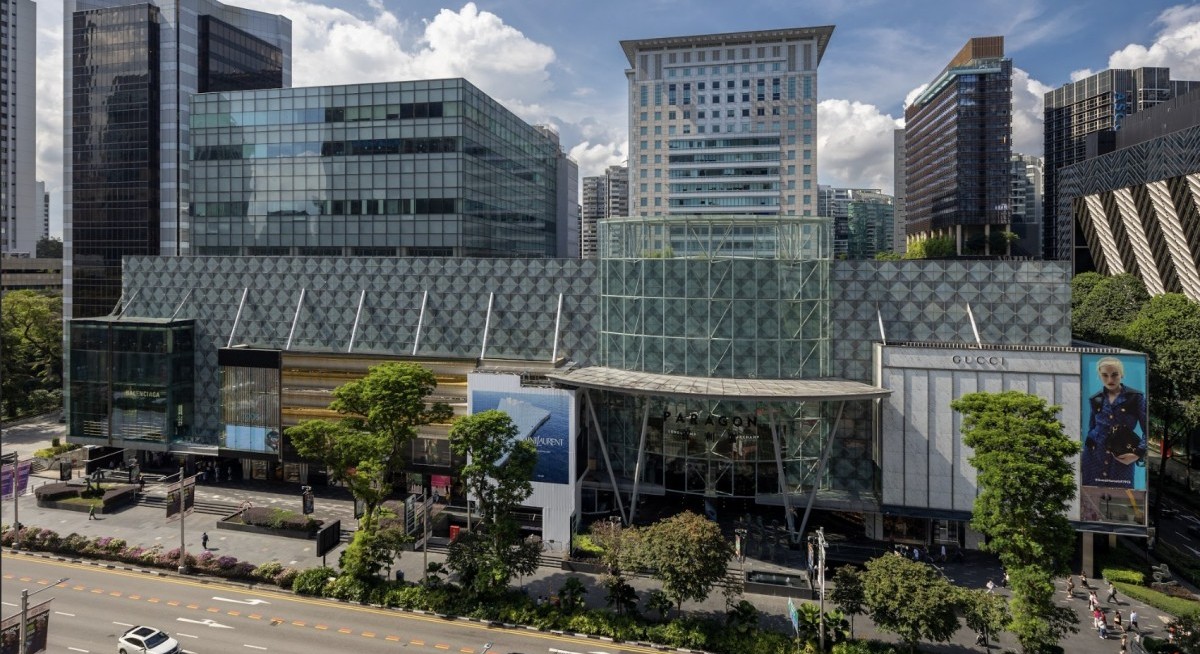


Consider this: CICT’s April 20 announcement states the total acquisition outlay for Paragon is $3.919 billion, comprising the estimated purchase price of approximately $3.848 billion, an acquisition fee payable in units of $39 million, and the fees and expenses incurred in connection with the private placement of $32 million.
How does the estimated purchase price of $3.848 billion compare with JLL’s valuation of Paragon as at the end of 2024 of $2.9 billion? Quite reasonably, it turns out that way because Paragon wasn’t privatised at $2.9 billion.
Recall that the privatisation scheme document for Paragon REIT offered unitholders a 10% premium over Paragon REIT’s net asset value (NAV). This would have priced Paragon at $3.19 billion. The premium paid to unitholders was 1.07 times P/NAV and unitholders received 2.33 cents per unit in distributions. Additionally, the decision to privatise was made wholly by independent unitholders.
The next point is the premium of a freehold asset versus a leasehold. At the time of privatisation, Paragon still had a land lease of some 83-84 years. Analysts have articulated that the freehold premium for Paragon should be around 15-20%. (Bala’s table would have placed the discount of leasehold tenure of 83 years nearer 92% of freehold value, giving an 8% premium.) Depending on the premium ascribed to freehold land at the end of 2024, a freehold Paragon would have been valued at between $3.44 billion (8% premium), $3.66 billion (15% premium) and $3.83 billion (20% premium). Depending on the value used, CICT unitholders are paying as little as a 1% premium to as much as an 11% premium on the end-2024 leasehold value of Paragon.
See also: Should CSE Global’s lead independent director have stayed?
Why the premium? CICT’s own Singapore portfolio experienced an average valuation increase of 1.1%. While capitalisation rates did not move much, CICT’s net property income in FY2025 rose 3.1% y-o-y to $1.1189 billion. NPI is an important consideration in valuation.
CICT’s regulatory announcement states that Cuscaden Peak indicated a major AEI on Paragon could cost $300 million or more, depending on the eventual scope, design, and timing. CICT will undertake its own evaluation, including detailed feasibility studies and cost analysis, and any capital expenditures going forward will be subject to internal processes and approvals, and may differ from Cuscaden Peak’s preliminary analysis.
The real challenges Paragon REIT faced were likely due to its mishmash of Australian assets. Paragon REIT’s 50% stake in Marion Westfield Shopping Centre in Adelaide was neither here nor there. With forex risks, no boots on the ground, no fees and no management control, this property, along with Figtree (which was divested), proved to be a leakage.
See also: Does NTA mean anything?
cicOn the other hand, the CEO of CICT’s manager, Tan Choon Siang, a triathlete who has completed the Ironman, has articulated that his focus is on Singapore. In a recent interview, Tan shared that it was CICT’s manager who approached Cuscaden Peak.
Paragon will comprise a much smaller portion of CICT’s asset base compared with Paragon REIT, where it was the dominant mall. “With this acquisition, we are close to $29 billion (in assets). Ours is a different proposition from Paragon REIT. If we were to embark on an AEI — and we haven’t made a decision — we will do it such that it will not dent our cash flow as significantly and we will still maintain a stable DPU,” Tan says.




