


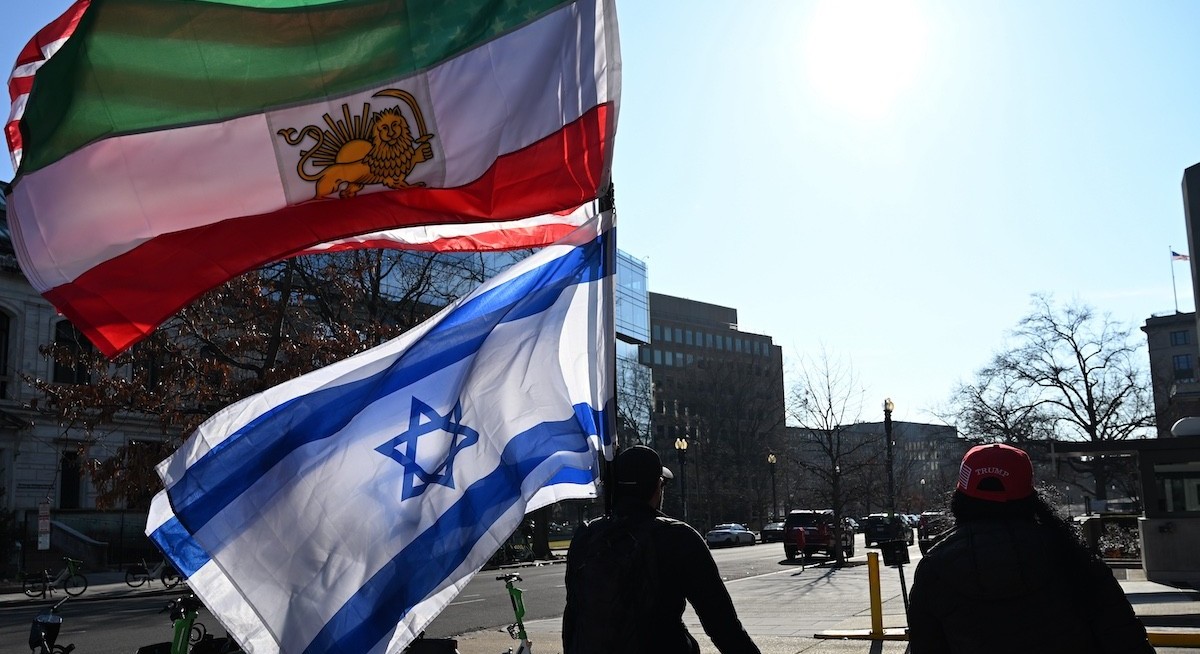


An optimistic Trump, however, regards energy price rises and financial market volatility as temporary, just as he seemed rather circumspect about “some people may die,” so long as the US keeps winning, even as Iranians stood their ground and did not roll over.
So far, some US defence contractors may be benefiting from Trump’s typical hyperbole, which promises to “quadruple” the replenishment of multi-million-dollar missiles. These missiles are used asymmetrically to target US$20,000 ($25,496) Shahad drones, which have become a persistent nuisance across the Gulf states. The presence of numerous US military bases in the region has also unsettled residents of the Burj and Fairmont Dubai, who had been enjoying their city’s reputation as a freewheeling financial and crypto hub.
Whatever the eventual outcome, as expats scrambled across the desert to evacuate, the concept of a global air hub in the Middle East appears to have gone up in smoke first.
Distraction at home
See also: The time has come to shutter the World Economic Forum
In a masterstroke of his famed ‘art of the deal’, marked by strategic ambiguity and a penchant for four-dimensional chess, the US administration’s narrative and rationale have shifted daily, as volatile as oil and gas prices across global markets.
It started with attacks meant to prevent a response from Iran. These followed a planned Israeli operation targeting parts of Tehran and other areas. The operation was not intended to overthrow the Iranian government. Yet, with the Israelis accidentally taking out not just the Ayatollah, but also numbers two, three, and so on, everyone else is left wondering what Plan A was in the first place — if it even existed — and whether it matters, so long as there is a narrative to declare a win for Trump, or, more cynically, to reduce the need for domestic distraction.
A quote attributed to Napoleon does say that “When a king feels that his people are about to rebel, he declares war on another country”. Maybe Iran will get messy, and it will be up to those in the region to clean up the mess after victory is declared again and again. Maybe Cuba will be next as threatened. Or maybe domestic terrorism, which results from Epic Fury halfway across the world, will give reason to call off the midterms after all.
See also: Why audit and accounting failures are often cultural and what we can do about it
Genies out of the bottle
The cynics will point to the fact that with the Strait of Hormuz threatened, and Iranians not lying down and destabilising the entire region with Operation True Promise IV hitting back across its neighbours, one immediate beneficiary has been Russia, whose oil is now able to flow at least to India.
If gas prices, which have already spiked in the UK and Europe, rise further, perhaps their principles of supporting Ukraine may be eroded by real economic needs and the need to drink from Russian taps.
But at least for some of Trump’s supporters fed on their own propaganda that features movie and gaming footage, this is a semi-holy war with believers imagining that only if Armageddon happens will Jesus Christ come back to Earth for the rapture.
That the Iranian regime has long aimed to eliminate the “two Satans” — Israel and the US — is true, as some apologists for the chaos of the past two weeks like to point out, citing a “war” that has raged, in their view, for 47 years since the American hostages were taken in Tehran. Likewise, their involvement in terrorism over the years cannot be ignored.
However, for some historians, the question of original sin perhaps lies in the 1953 coup by Western powers to seize back control of Iranian oil after BP’s assets were nationalised. A more recent story, of course, is Venezuela’s nationalisation of Exxon’s assets, which critics say became the ultimate rationale for kidnapping President Nicolas Maduro in January, after the war on drugs story had too many holes.
Ironically, for countries further along the green energy transition — or those with nuclear backstops — the chokepoint of 20 % of fossil fuels stuck at the Strait of Hormuz matters less. Unfortunately, it’s still a sizeable chunk, with China, too, ironically, among the most advanced in this regard.
Sink your teeth into in-depth insights from our contributors, and dive into financial and economic trends
Trump-aligned conspiracy theorists will argue that rolling back the green transition may have ulterior motives, given the recent spate of events. The current geoeconomic messiness perhaps supports our own review of alternative options, including nuclear energy.
Safe harbours
As it is appropriate given times of uncertainty, our government has issued cautious statements about GDP projections since there will be at least a temporary oil shock, especially for North Asian countries like Korea and Japan. The Kospi had a 10% limit-down day last week, and Japan has been buffering by releasing some strategic reserves, which need to be replenished.
It will be inflationary at least temporarily for manufacturing, business and consumers with those countries dependent on 20% of the world’s oil that is choked in the Middle East, and potentially more at risk if oil fields and infrastructure are now legitimate targets not just in Iran, but also the Gulf Cooperation Council (GCC) and Iraq as well.
Bloomberg was quick to report how Singaporeans feel the effects of the war with rising air ticket prices, with some Asia to Europe flights ratcheting up 900% (a first-world problem), and issues regarding our reliance on imported gas, whose prices have shot up.
More broadly, there is a postulation that the “Sell America, Buy Asia” trade has reached an inflexion point, in part because Asian markets took the initial hits while the US financial market response was muted, with flight to safety helping the USD get a small uplift in the first week.
Unfortunately, there is no place to hide completely apart from US defence contractors. And US markets have started to play some belated catch-up, gradually marking down as energy prices spiked.
Gold, which rallied initially not above its parabolic highs in January, pulled back a tad as physical gold prices in Dubai were trading lower than global markets, as exporting physical gold suffered the same choke point challenges. It, however, remains well supported for good reason.
The inflexion point for the “sell US, buy Asia” trade may be but a pause and a bout of near-term Asian profit taking.
It is quite standard for some risk-off in the face of uncertainty, and the Straits Times Index too has pulled back a tad from record recent highs. Some investors, too, with the market having enjoyed a strong run in small and mid caps, took profits off the table to wait and see.
Initial investor euphoria with steady US markets in the initial days, with the expectation that Taco Trump (Trump Always Chickens Out) will quickly declare victory and move on, has now sobered to the fact that this may take some time to run its course. Inevitably, reduced risk appetite and speculative liquidity will follow for now.
There are also those patiently waiting for bargains similar to last April’s tariff rumbles or even the 1991 Gulf War sell-off. A school of thought says if this is the start of World War III and Armageddon, there is no place to hide anyway, and it doesn’t matter to stay invested. If it is not, there are going to be winners and losers.
Singapore’s true promise
In our classic Singaporean cautiousness, not trying to draw attention to ourselves, it is worth noting that some clients, bankers and money from the Middle East are flowing back here. Hopefully not just hot crypto money, but it could be hospitality, real estate and consumption positive for Singapore as some relocation near term and strategic reconsiderations of mid-east competition are rebalanced in Singapore’s favour.
If the GCC has to reassess where their petrodollars are invested, given that they are collateral damage currently for hosting US military bases, maybe some will trickle from the US to Asia too, apart from Asians having to think of their home markets first.
Similarly, if the Middle East aviation hub becomes less reliable long-term, and airlines have ready solutions to pass off rising energy prices with fuel surcharges and raise Asia-Europe fares sustainability, perhaps the sell-offs in Singapore Airlines and Sats may present good re-entry points for those who have sold.
Businesses that are very domestic-focused in Singapore may be worth more of a look versus those more dependent on regional economies, which may take a hit. That includes construction companies with large domestic order books, and companies with more local property exposure — especially those still trading below NAVs — may see more interest from capital allocated here.
Hospitality businesses that are more Asia- and Australia-focused may benefit from more intra-Asian activity as Europeans bypass the Middle East. Certain consumer stocks that are in the luxury space, too, as we absorb some of the exodus.
And finally, there are the gold stocks, not just CNMC Goldmine Holdings but also the consumer quartet of Aspial Lifestyle, MoneyMax Financial Services, Taka Jewellery Holdings and ValueMax Group, given how gold prices are at well above book prices and increasing demand to boot.
And so the story goes, if it’s not just the big guns like Singapore Technologies Engineering that will continue to benefit in this uncertain world, there are the drones and satellites for Addvalue Technologies. Small may be beautiful after all, as we keep calm and carry on in Singapore.
Chew Sutat retired from Singapore Exchange after 14 years as a member of its executive management team. During his watch, the exchange transformed from an Asian gateway into a global multi-asset exchange, and he was awarded FOW’s Lifetime Achievement Award. He serves as chairman of the Community Chest Singapore.




